Tamsui Historical Museum
Ticket booth
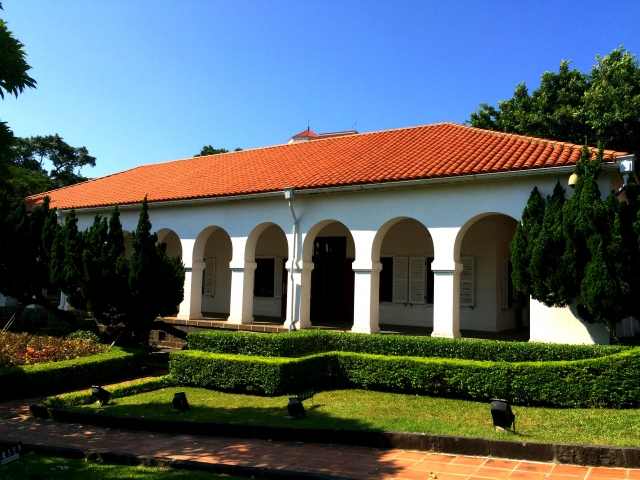
The 'Former Tamsui Customs Officer's Residence' is located in Puding, in today's Tamsui, and is also known by local people as the 'Little White House' due to its white-colored walls.
In 1862, Huwei Customs was founded in Tamsui to impose official duties. Huwei Customs was the first custom duty agency in Taiwan in charge of the management of foreign trade, while the customs offices founded later in Anping, Keelung and Kaohsiung were all based on Huwei and extended the operations of customs affairs in Taiwan.
In 1863, the Qing Dynasty government agreed to assign a foreigner as deputy commissioner of customs, with substantial control over the power of customs administration and taxation. Huwei Customs then became an international harbor with systematic management under the foreign commissioner of customs. Consequently, the Qing Dynasty government also received abundant profits.
As custom affairs became increasingly complex and the number of foreign custom officers gradually increased, the customs office purchase land from Puding to build an official residence in order to solve the problem of accommodation.
By 1875, another two dormitories were built for use of the secretaries and low-ranking customs officers, known to local people as 'Puding Sankuaicuo.'(the three mansions in Puding) However, with the outbreak of the Sino-French War in 1884, the dormitory for low-ranking custom officers was destroyed.
During the era of Japanese rule, the decline of Tamsui Harbor and diminished custom duties led to the Japanese Customs Duty Commissioner to form the 'Fifty Club' renovating the destroyed official residence for re-use as an official entertainment center and guest house.
After Taiwan’s Retrocession, when the Taipei Customs, Customs Administration, Ministry of Finance (Keelung Customs) took over, only one of the previous three official residences and dormitories remained. In 1950, it became the official residence for the American General Customs Service Commissioner, Lester Knox Little.
The Little White House faced a crisis in 1996, with proposed demolition and reconstruction as a new building. Fortunately, local people, scholars and experts all made efforts to save the Little White House, which was then assessed by the Ministry of Interior Affairs in 1997 as a municipal historic relic and has been preserved until today.
Hollow Brick Wall
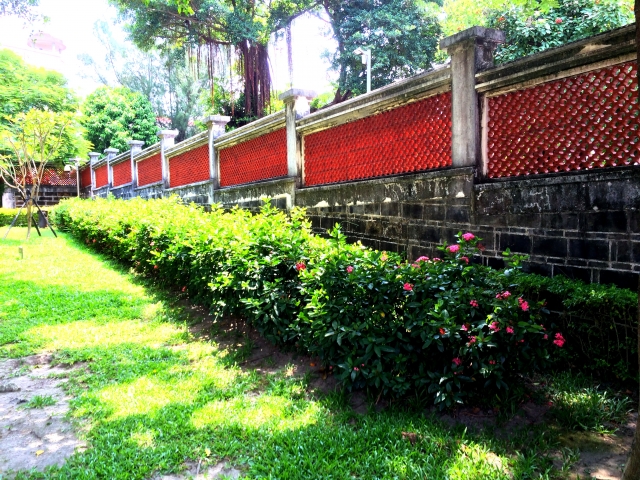
Here, some of the black bricks remaining from the time the Little White House was built can be seen, as well as the different materials used in the outer walls in later renovation and restoration periods.
Water Pipe Head
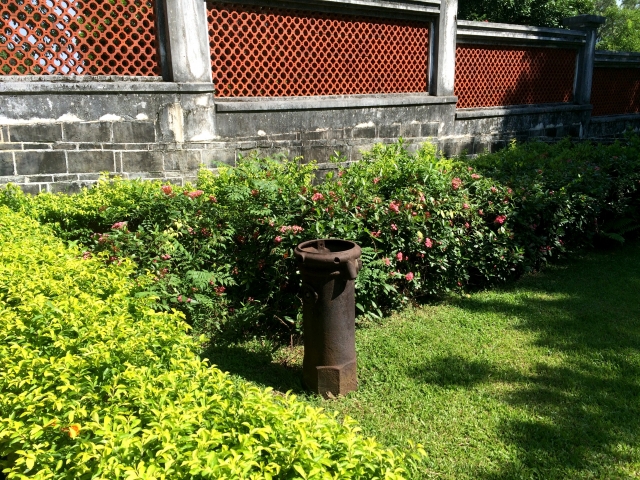
The government carried out planning and construction of water conduits with enthusiasm during the era of Japanese rule. The first modern tap water plant in Taiwan was built in Tamsui with diversion of a water source from Mount Datun supplying a stable source of clean water, thus saving the locals the burden of carrying water, and at the same time providing water for firefighting. The local people call it the 'Water Pipe Head' since the water intake equipment resembles the shape of a mailbox.
Scenic Viewing Platform
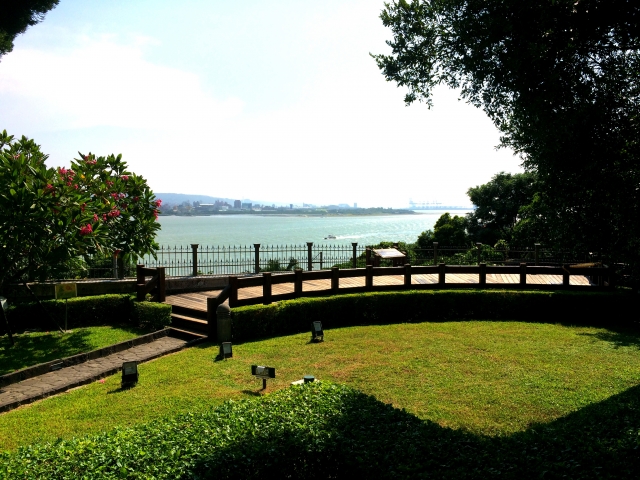
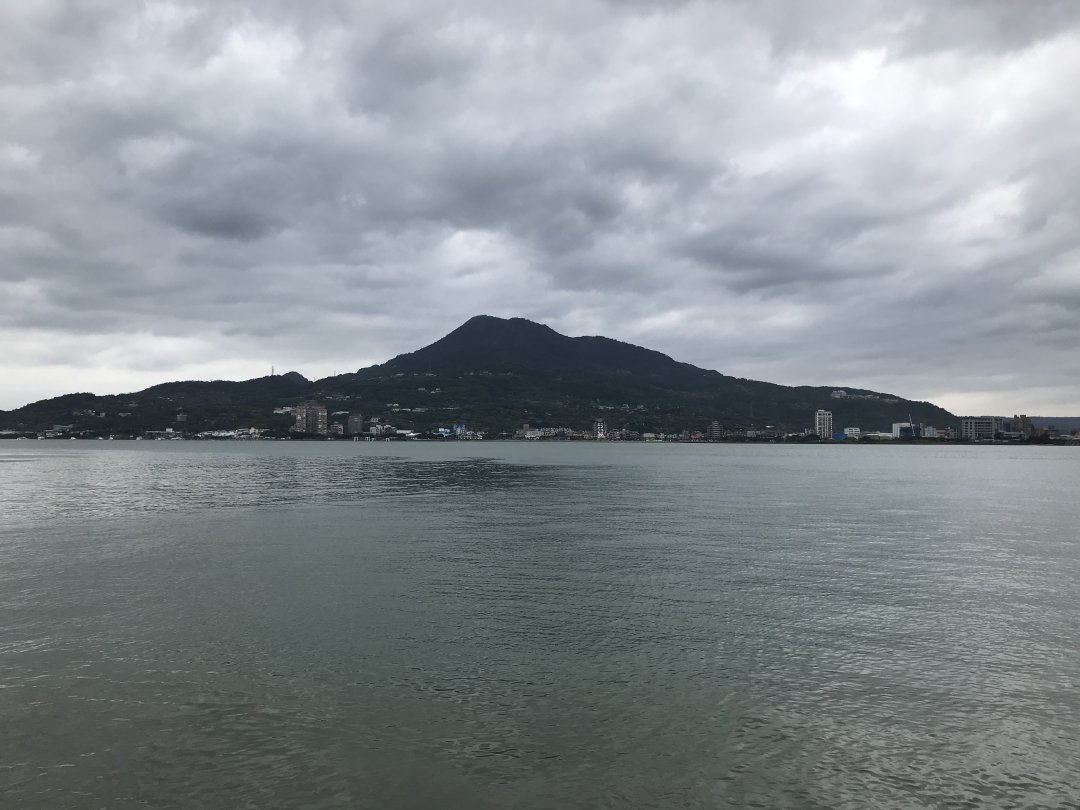
This position one can see as far as Guanyin Mountain and Tamsui River, taking in a panoramic and wonderful view of Tamsui in one glance. Guanyin Mountain across the bank was formerly known as 'Balibon Mountain' and 'Xinzhi Mountain.' There are different explanations as to the origin of the name 'Guanyin Mountain' which appeared later.
One explanation has it that the shape of the mountain looks like the Bodhisattva of Compassion (Guanyin) lying down with the highest position looking like the chin of Guanyin, the concave below as the eye socket, followed by the forehead and extension to the ocean. The overall shape looks very much like the side of Guanyin and hence it received the name. Another explanation has it that there are many temples on the mountain known for enshrining Bodhisattva of Compassion and hence the mountain received the name for this reason.
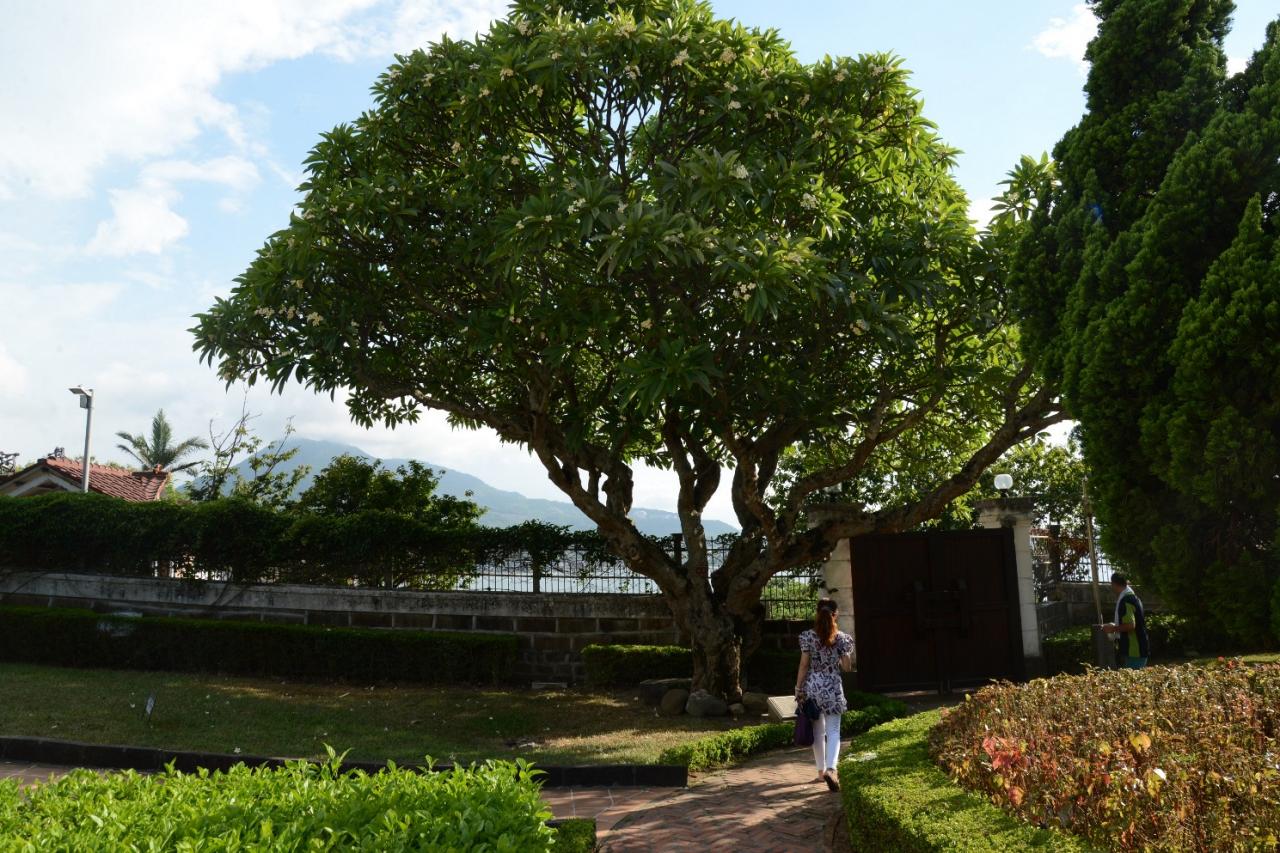
Former Gate Border Stone and Plumeria
Tamsui Customs Duty Office was re-opened in the era of Japanese rule. Stone tablets were set up at the border as indication, which was the origin of border stone reading 'Tamsui Customs Duty Office Property'.
After Taiwan’s Retrocession, the Taipei Customs, Custom Administration, American General Customs Service Commissioner Lester Knox Little re-validated the property of customs duty in addition to setting up several 'General Customs Customer Service Border Stones' on the land of the official residence and Tamsui Customs.
Today there are four 'Tamsui Customs Service Property' border stones that have survived until the present. During the initial preparations for the Customs Museum, the museum collected one of the border stones while the other three were excavated from the customs wharf during renovation in 2014. The border stones were then collected by the Museum.
Moreover, among the three surviving 'General Customs Service Border Stones' . One has been collected by the Customs Museum, one has been set up in front of No. 364, Zhongzheng Rd., Tamsui, while the other one has been collected by this Museum. The Museum erected the 'Tamsui Customs Property' and 'General Customs Service Border Stone' as commemoration within the Little White House.
There is another tall Plumeria tree in the front yard of the Little White House near the gate. It thrives with vitality, gives off a strong fragrance and a highly exotic atmosphere. It was said to have been planted by the British and has stood in the Little White House for over one hundred years. Its listing as a 'rare tree' was announced by the New Taipei City government'.
Cypress Explanatory Sign
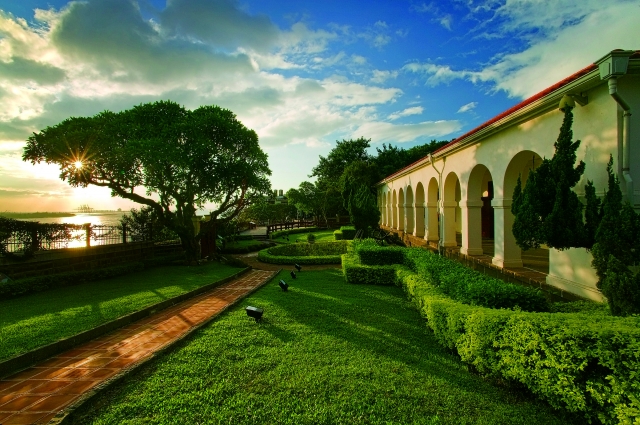
Britain mostly used colonial-style corridor buildings in colonized Asian regions such as Hong Kong and Singapore. The Little White House is a classical representative building. Such buildings feature an elevated base, and four-sloped slanted rooftops, surrounded by a terrace similar to corridor, large windows and chimneys.
Stone was used for the foundation of Little White House, elevated about one meter above the ground to express the noble majesty of the building entrance. Additionally, surrounding the periphery of the foundation, there are square inlets with metal bars in every few meters, used for air circulation and ventilation to prevent humidity.
Apart from this, there are terraces designed like corridors on the east, west and south sides of the Little White House, which occupy a large proportion of the building area. The front side of the Little White House faces Tamsui River with the 11 circular arches and four additional circular arches each on the east and west sides respectively. The regular symmetrical arches are able to visually coordinate with the mild aesthetics.
The arched corridors on the east, west and south sides are not only used as rain shelters and sun shields but also expand the area of lighting, providing sufficient daylight and field of vision at each space and the optimal space for leisure life.
At the same time, the window positions corresponds with the arches of the corridor, where wooden blinds can adjust the lighting and enhance the sun shielding effect. The four-sloped slanted roof features convenient water drainage while the elevated roof also expands the interior space, which not only can be designed for use as an attic but also provides heat insulation.
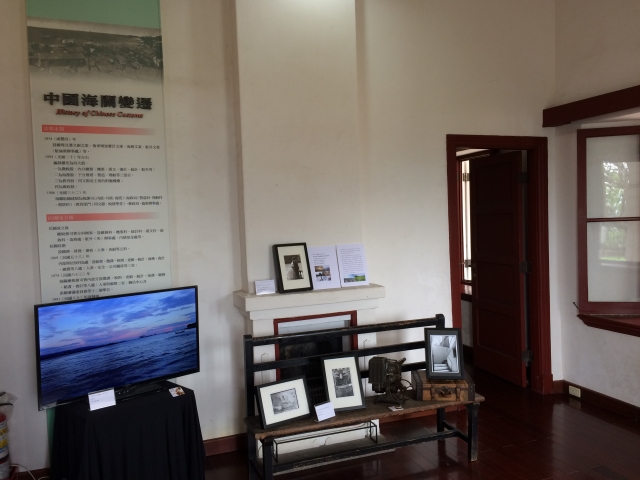
Customs Duty Display Area
Currently the room takes the furnace as its center, the inner wall of which is divided into three spaces, where it is speculated that the larger room with furnace was used as a study room and office, or a small family room.
Although the climate in Taiwan is subtropical, so a furnace is not necessary for keeping people warm, such European building styles reflect the nostalgia of colonialism.
The inner wall of a small room on the other side has been demolished, combining the previously two separate rooms into one larger space, which it is speculated was used as the bathroom and storage room.
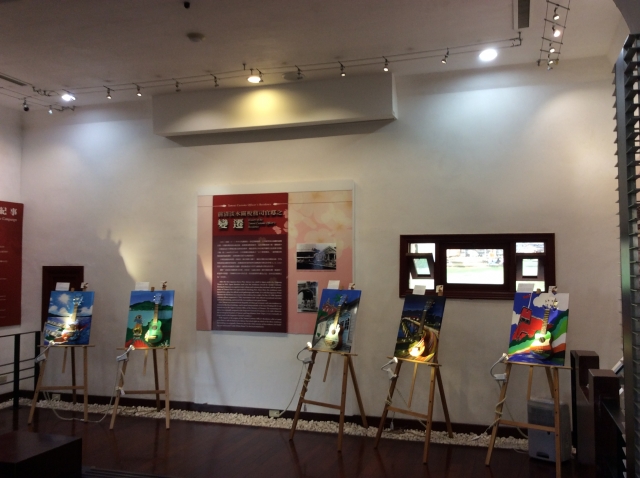
Main Hall
The current position of the Main Hall is at the center of the Little White House and it is the largest space. The two side entrances connect to the hallway leading to the main entrance. This is believed to have been a public space for receiving guests and an official ballroom or large living room.
The back wall of the Main Hall features two asymmetrical rectangular openings, which though having shape of windows did not have the actual functions of windows. The space connecting the windows and the wall was added during the era of Japanese rule for use as a kitchen, the size and shape of the opening matches precisely the size of a dish delivery window. Therefore, this space once was used for both dining and reception.
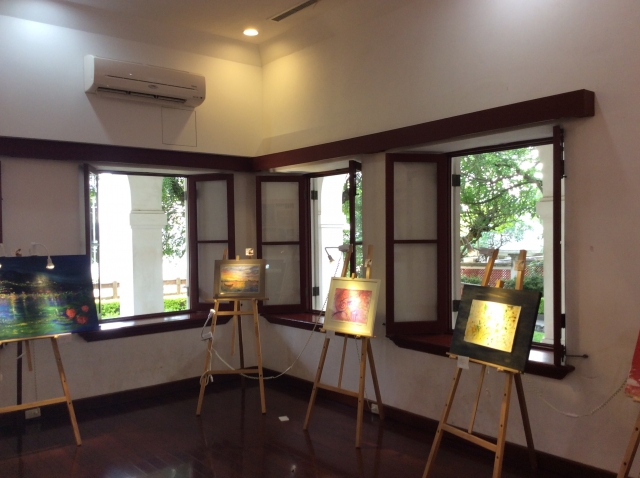
Architecture Style Display Room
The room now features two doors connecting to the hallway. Looking from its logical planar symmetric design, this space was previously used as two separate rooms which mainly functioned as bedrooms.
The inner wall was probably knocked down during renovation to turn it into a spacious master bedroom. Also, a room was added to the corridor as a bathroom.
Traces of the circular arches can still be seen and hence it can be known with certainty that the original appearance of the Little White House was that of a corridor with four symmetric circular arches on each of the two sides.
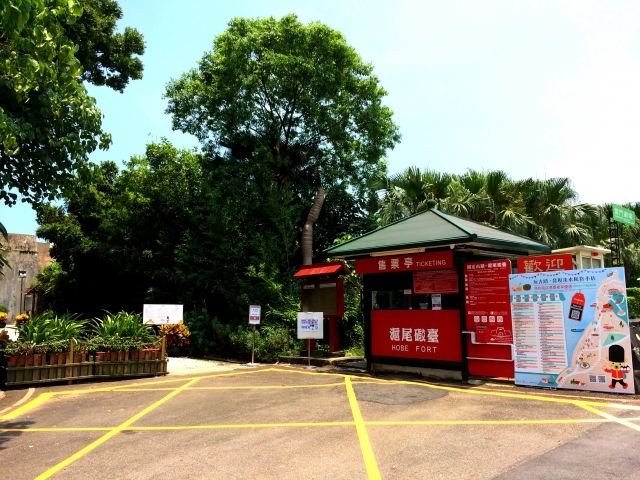
Ticket Booth
After the outbreak of the Sino-French War in 1884, the war spread from the main battlefield in Keelung to Tamsui. After the Qing Dynasty regime's victory, the establishment of Taiwan as a province was given impetus. Taiwan’s first governor Liu Mingchuan, quite aware of the vulnerability and significance of marine defense, was determined to reinforce Taiwan’s marine defenses by adding forts at all the island's seaports.
At the time, Liu invited German technician Lieut Max E. Hecht to build ten new western-style forts around Taiwan, of which the fort with the door sign 'The Key to the North Gate' was one. The fort was near the estuary of the Tamsui River and also the highest observation point near the estuary, able to fully control the movement of the river's marine transport.
The military value of Tamsui during the era of Japanese rule, although not comparable in importance with during the Qing Dynasty, this area was still preserved as the drill site for shooting by the fort's soldiers.
After Taiwan’s Retrocession, the ROC military was stationed there, and the fort was designated a national historic relic by 1985, at which time it underwent renovation carried out by Taipei County Government (now New Taipei City Government) and was opened to the public. As no wars have broken out since its completion in 1886, Hobe Fort has hence been fairly well preserved until today.
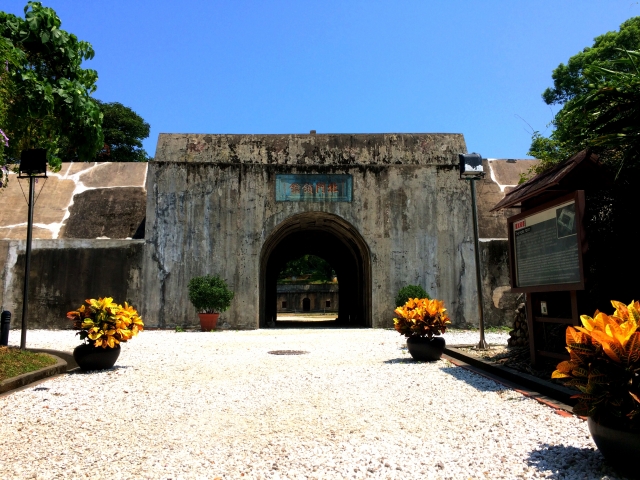
Key to the North Gate
Hobe Fort commands an excellent field of vision. In addition, the surrounding earthen walls and dense forest add a high degree of screening making it difficult to detect. It is an excellent 'hidden fort' with excellent defense, making it easy to guard but challenging to attack.
The design of the fort utilized a rectangular 'hui'(回) character shape, situating on the northwest and facing the southeast. It faces the Tamsui River, and, from its exterior to interior consists of earthen walls, trench, battalion door, sub-walls, fort, cover, corridor, and square.
Earthen walls also known as mother walls, are stacked with earth outside of the fort to the approximately same height as the fort, providing shielding and defense functions.
The trench circumscribes between the earthen walls and sub-walls, providing a defense function similar to a city moat.
The only access to the fort is the battalion door located on the southeast side, with the entrance sign inscribed as 'Key to the North Gate' by Liu Minchuan in person. The semi-circular arch door of the entrance and the entrance sign are all made of Guanyin stone.
The sub-walls are the main walls of the fort. To build a robust and unassailable fort, Liu Mingchuan made special use of western cement to build the sub-walls. The cement was very expensive at the time and hence some of the sub-walls were made of earth, covered with cement for reinforcement.
The soil covering the top of barracks is known as 'coat,' and has a soft texture and resilient absorbency effect, covered by chimney-like protruding objects as the ventilation holes for the barracks.
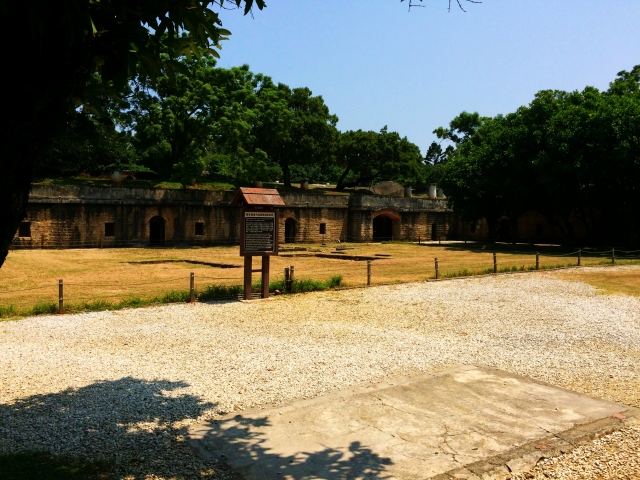
Central Square
The construction of Hobe Fort was completed in 1886, where there was previously a military administration building inside the square. The building has now been leveled to the ground with only some debris of walls remaining after having undergone different period of renovations.
When the ROC military was stationed here, a command post, basketball courts and other modern facilities were set up at the square. Currently the command post has been demolished.
The earth walls outside of the fort, sub-walls and internal opening spaces demonstrate considerably abundance of plant types. At the sub-walls on the north side the mainly species are Chinaberry trees, where purple blossoms and branches thrive in the spring and leaves fall with only robust trunks remaining in the winter, constituting a beautiful scenic skyline for the fort.
On the edge of the square hallway are wax apple trees, planted by the ROC military during their stationing in this area for replenishment of materials and resources. The wax apples falling all over the ground during summer, and the branches are thick with clusters of the fruit.
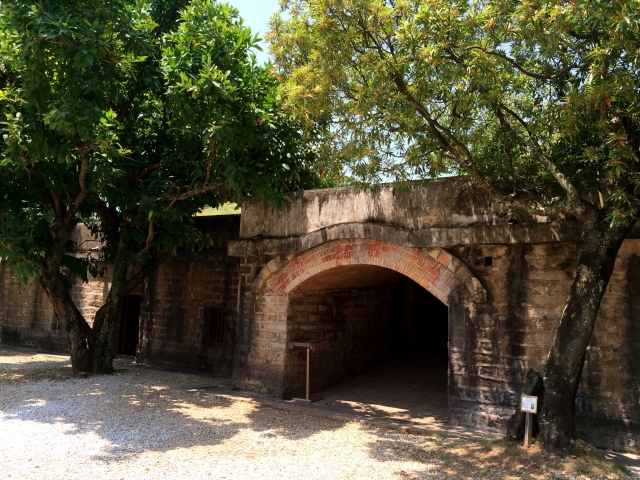
Ammunition Depot, Ammunition Transfer Hill
The ammunition depot is a semi-dome building specifically used as space for storing ammunition. There is a wall that separates the hallway and protective space. There are also two doors to the ammunition depot : one is the small door for personnel access and the other one is the gate for transporting fort ammunition.
To transport the fort ammunition to the fort with convenience, there was a special ammunition transfer hill set up in a Y-shaped route which has considerable special features. The route to the right connects with the British 'Armstrong's Rifled Breech Loader' cannon and the route to the left connects with the German 'Krupp Gun' cannon.
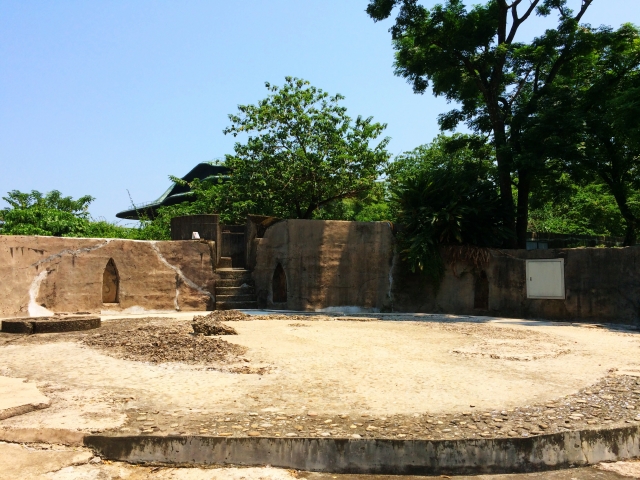
Northwest Main Fort
Back then Liu Mingchuan purchased 31 cannons overseas through the British company Jardine Matheson Holding for installation in the ten new western forts built in Taiwan. Hobe Fort came with one of 12 inches and 10 inches British Armstrong's Rifled Breech Loader cannons and two 8 inches German Krupp Gun cannons, where the base was centralized on the two sides facing the sea.
The largest 12 inches Armstrong's Rifled Breech Loader was installed on the northwest position, using a 360 degree fully-circular gun carriage so the shooting angle comprehensively covered the entire Tamsui River estuary and north coast. However only the trajectory of the gun carriage remained.
The sub-wall in front of the signaling cannon formed an arc shape down, a design made in response to the ballistic launch. The ROC military built a machine gun base in the front of the fort.
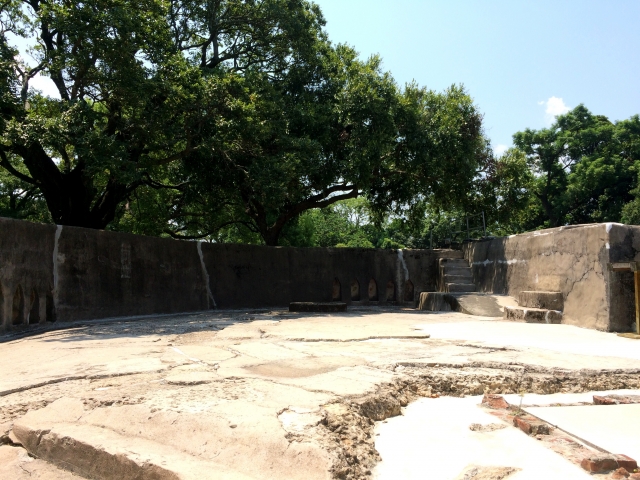
West Main Fort
TThe German Krupp Gun cannons and British Armstrong's Rifled Breech Loader cannons were both very famous contemporary artillery in the mid to latter 19th century. Compared with the 12 inches Armstrong’s Rifled Breech Loader, the 8 inches Krupp Gun cannon adopted semi-circular gun carriage with a relatively smaller trajectory and hence a narrower shooting angle.
The four forts of Hobe Fort used breech loaders while were also known as post-loaders. Different from the front loader, the post-loader loads bullets from the tail and is sealed with a latch before shooting. The men firing post-loaders stood behind the cannon where their positions were not easily exposed. The sub-wall next to the cannon comes with several bullet-shaped indentations as bullet storage.
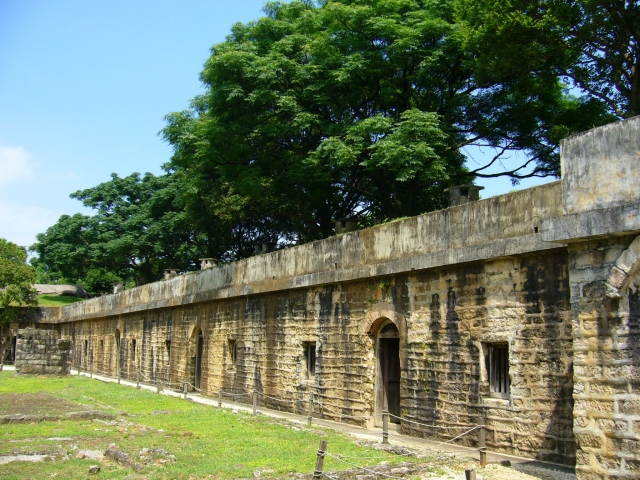
North Corridor
The corridor refers to the semi-circular tunnel inside the inner lop of the sub-wall, used as the squad room, storage room, ammunition depot, and daily living space. The corridors connect with each other and feature the mobility of relocating soldiers during battle. During the ROC military's stationing period, a kitchen and bathroom were built on the northeast side, but these have now been demolished and restored to its original appearance.
The material of corridor is based on stone wall and consisting mainly of Chi-Li coastal rocks with a minority consisting of rocks from Guanyin Mountain. The top is a semi-circular arch stacked by red bricks, where the brick arches are drilled with holes by interval for facilitate air circulation from inside the corridor to outside.
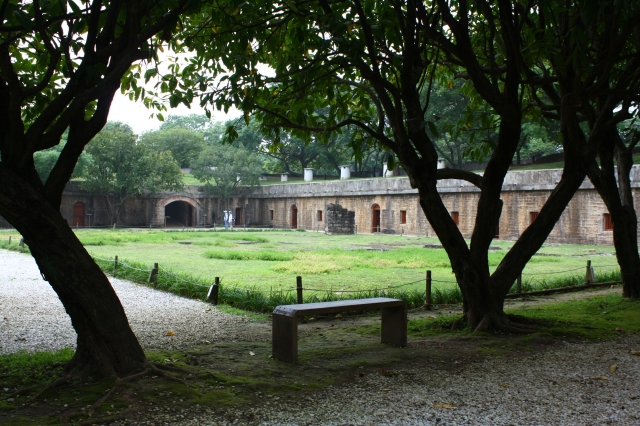
Southeast Corridor
The bricks used for the brick arches of the corridors are the common 'plain bricks' of a smaller size than western-style bricks while the side of the bricks show some smoked spots. Inside the two sides of the corridor is a row of small holes, the precise function of which can no longer be discovered. It was said that the holes were used for building the arch roof on top during the initial construction and used for installing scaffolding.
Another explanation is that the holes in the walls were used for setting up wooden plates as separation and hanging bed due to the humidity during the period the ROC military was stationed here. Today some space of the corridor has been designed as a display area to give different expressions of the fort.
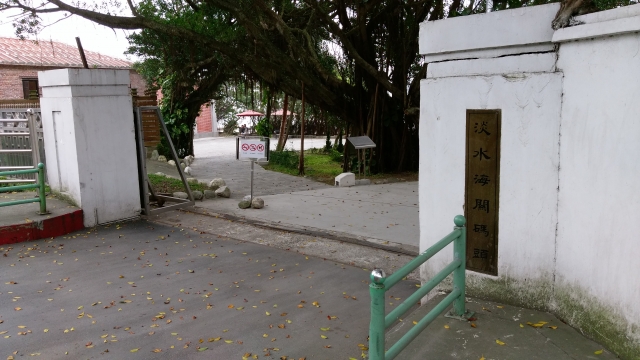
Security Guard Office
After the signing of the Treaty of Tianjin in 1858 and the Treaty of Beijing in 1860, Huwei became one of the commercial ports in Taiwan and the great powers thereafter gained the right of navigation on inland rivers. In 1862 Huwei started imposing customs duties and by 1863, Britain's John William Howell served as the first commissioner of Huwei customs, which consequently initiated the era in which westerners controlled Taiwan customs.
Huwei Customs was the first customs duty agency administering outbound trade in Taiwan during the Qing Dynasty with administration over Keelung, Anping, and Kaohsiung branch customs. During the era of Japanese rule, due to the increasingly serious stilt sediment issues in Tamsui Harbor, the General Customs relocated from Tamsui in 1916 and transferred to Keelung Harbor in 1921.
After Taiwan’s Retrocession in 1945, the Tamsui Customs Wharf was transferred to the administration of the government today. After this, it also hosted the Haiguang Performance Art Group, River Search (Ocean Search) units, a Fast Attack Boat fleet and the Third Police Battalion and 7th Police Company as well as other ROC military units. Eventually cement and steel buildings were built.
In June 2000, the New Taipei City Government announced Tamsui Customs Wharf as a municipal historic relic and the wharf was transformed into a cultural park and opened to the public in 2014. Due to the beautiful scenery of the river coastal horizon at the wharf, it has also become the most ideal place for tourists to overlook the sunset on the Tamsui River.
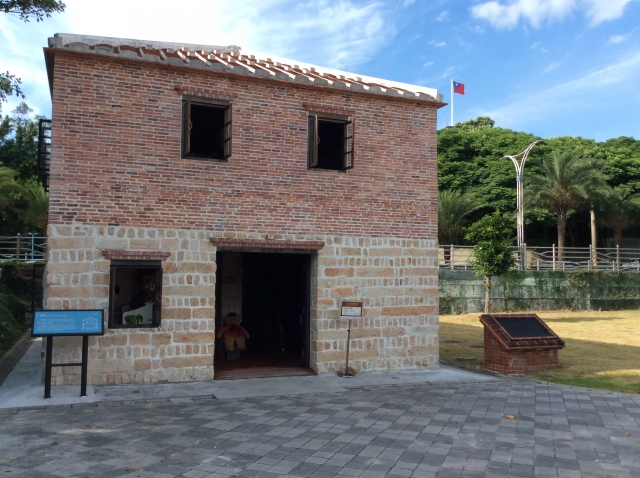
Western Building
Tamsui Customs is divided into the Customs Administration, Official Residence and Wharf Zone. The Customs Administration was built in 1869 with offices, a sailors’ dormitory and a warehouse as well as other buildings, located in the parking lot below today's Fort San Domingo, and it has now disappeared.
The Official Residence area was built between 1866 and 1875, followed by the tax official’s residence and dormitories. The 'Former Tamsui Customs Officer's Residence,' nicknamed by the local people as the 'Little White House' is one of the buildings which have survived.
The Wharf Zone was gradually built since the Qing Dynasty, and its construction was only completed by the era of Japanese rule. The wharf zone at the Tamsui Harbor then centralized on the last section of Huwei Street, namely across from the Douglas Lapraik & Co. today. The border for commercial vessel berthing extended from the west side of the MRT station today to the ferry, some distance away from the location of Tamsui Customs.
In 1893, the riverfront in front of the Customs Administration was eventually with structure for vessel berthing and water drawing, which became the main scope of custom wharf park with the relative riverfront area across from the street where the Customs Administration is located.
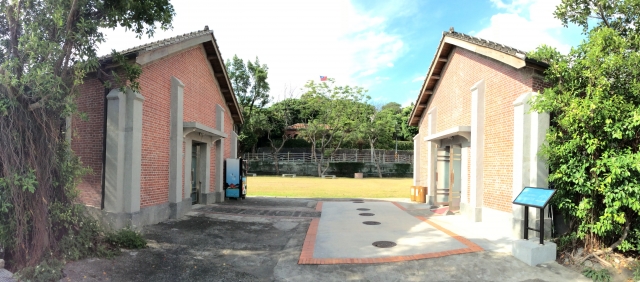
Warehouse B、C
The wharf near Tamsui River bank in the early era of Japanese rule already showed some areas with protruding trestle type of 'water drawing,' onshore and unloading areas. There was one large flood land between the customs wharf and Huwei fishing port (the first fishing port of Tamsui). It was until 1900 when a tidal landfill project was carried out and so Tamsui River bank eventually evolved into its present appearance.
After completing the landfill project for the customs wharf, several buildings were added, including a warehouse, dormitory and inspection functional buildings.
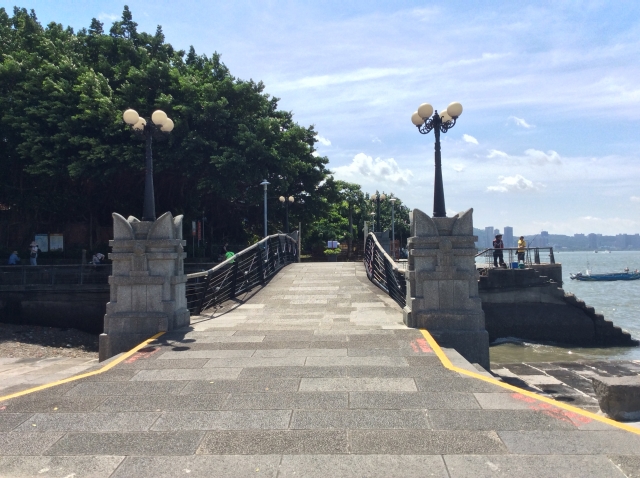
Mechanical & Electrical Room
The customs wharf today refers to the Tamsui Customs Administration and the wharf zone of the British Consular Residence, with the scope of preservation divided into the eastern, middle and western sections. The East Section Wharf was made of Guanyin Mountain rocks, pebbles, cement, and concrete. The middle section mainly consisted of Chi-Li coastal rocks while the western section used crisscrossed Guanyin Mountain rock. The wharf levee is installed with bollard with appearance in square columns and cylinders.
The customs wharf was not open to the public after the ROC military took over, hence the public had difficulty catching a glimpse of the interior appearance but that actually helped preserve more of the riverbank seclusion and scenery in the early days. There is a hinterland with 200 meters in width and is the key spot for the old street and fisherman’s wharf; this important location for overlooking sunset by Tamsui River has its own complete hinterland and special historical background context.
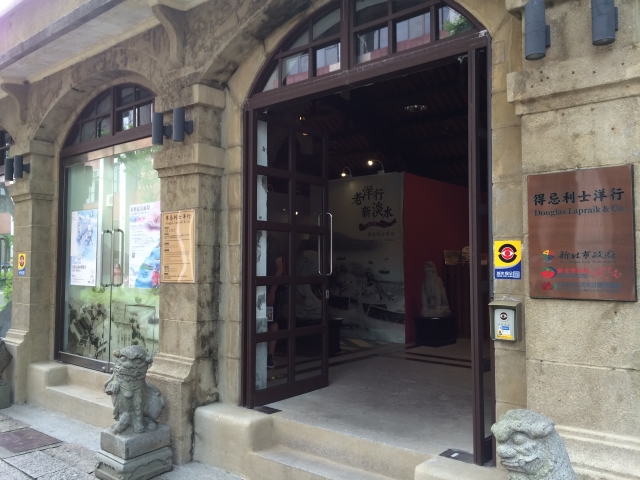
Douglas Lapraik & Co. (Front Building)
Located on the last section of the old street on Zhongzheng Road, Tamsui, Douglas Lapraik & Co. building was a witness to the historic port opening of Taiwan in the late 19th century and the development of northern Taiwan navigation. The building is divided into front and back buildings, named according to the usage functions given to the space at the time. For example, the front building was the 'First Inspection Site' and the back building was the 'Import Warehouse.'
The front building of Douglas Lapraik & Co. was a building with a stone structure and a width of approximately between 15 and 19 meters. The building's surface was applied with traditional clay tiles with the main structure divided into the front brick arcading, Stone Mountain walls on the sides, and the western wooden framework inside.
In particular, the arcading structures, including the beam structure and arches feature a heavy-loading wall system on the mountain wall, while the wooden framework is a combination of mountain framework and wooden arch. The imitation Gothic style wooden framework is the only case seen in Taiwan so far.
The back building is a rectangular wide building with its main structure constituted by roof frame, pillar, wall, and foundation. The roof frame consists of special forms of Chinese pillar wooden house frame and tension bars, serving as the primary framework for supporting roof loading. Additionally, the mountain walls on the east west and north side are brick walls while the wall on the southern side is made up of nine tiled arches.
The restoration of the Douglas Lapraik & Co. building was completed in March 2013, and the building inherits the past history of the company to convey the historic look and memory of the Tamsui street zone, which has become the new highlight of Tamsui old street's cultural assets connecting with the Puding area.
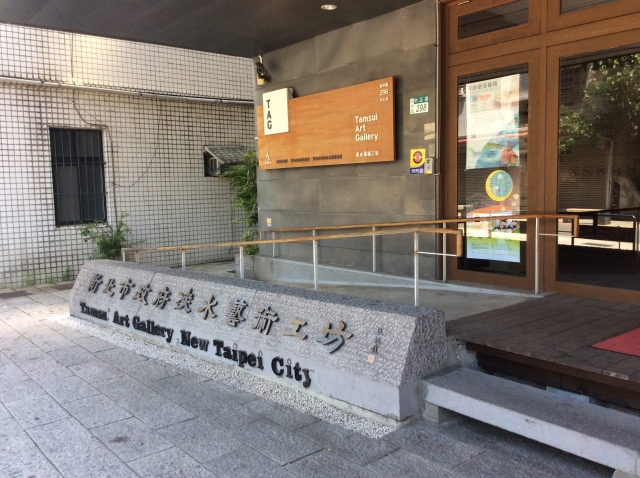
Tamsui Art Gallery, TAG
Located at No. 298 of Zhongzheng Road, Tamsui, Tamshui Art Gallery, TAG, is the first public green building in New Taipei City and has been recognized as a 'Diamond-grade' Taiwan green building. The original location was a Japanese-style dormitory for police spouses formed by four attached houses during the era of Japanese rule.
In 2011, TAG cooperated with 'Tamsui River Art Website' and opened the northern Taiwan flagship plan to become the first brand-new art and cultural creative space in Tamsui's historical street zone.
The appearance of the building is a four-floor steel-bone building with the front adopting massive viewing windows to introduce sufficient daylight while overlooking the scenery of the Tamsui River. The roof offers a chimney-like bronze cone structure and solar photovoltaic panels to produce an effect of air circulation, reducing stuffiness and heat in the summer, in addition to providing nighttime lighting, saving power and reducing power consumption.
Moreover, to preserve the historical connection with existing buildings, the tiles once dismantled from the original Japanese dormitory were reapplied to the interior design of the new building, exhibiting the time, space and exceptional qualities of the building itself.
Currently the first floor is used as cultural and creative product display and sales area; the second floor features a food court and multi-purpose stage, while the third floor is routinely designed by the Tamsui Historic Museum to hold various art and cultural exhibitions, seminars and teaching experience activity.
It is expected that the artistic landscaping, creative thinking, space re-utilization and re-purposing model will boost the living quality of local arts and culture, thereby activating the overall development of Tamsui's cultural industries and tourism recreation through interaction and fusion with peripheral residents, businesses and tourists.
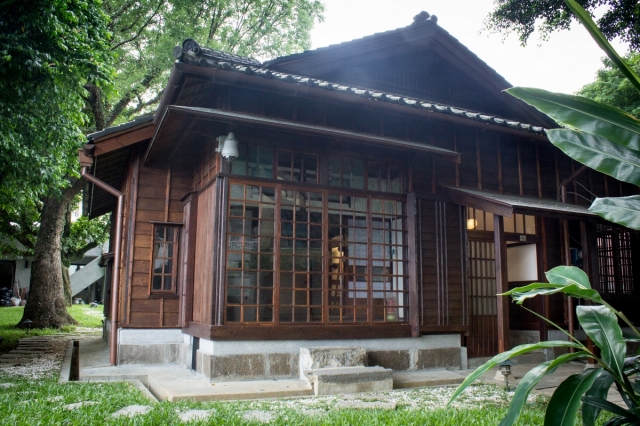
The Former Residence of Tamsui Township Head Tada Eikichi
Tada Eikichi was a Tamsui Township Head in the era of Japanese rule. Previously registered at Kobe City, Hyogo Prefecture, Japan, his family has been renowned as famous land owners for generations. Tada Eikichi was the oldest son of the family and was aspired to become an entrepreneur since little.
He first came to Taiwan in 1897 and then to Tamsui in 1905 to work as a bartender for Tamsui Customs. In 1919 he founded the 'Tamsui Enterprise Combo' to encourage Tamsui people engaging in farming and fishing to work for family part-time jobs.
Between 1930 and 1933, he was commissioned to take the fourth Tamsui Township Head, committing in the promotion of Tamsui Railway infrastructure, library renovation, schooling and other public business; Tada Eikichi made a considerable contribution to the development of Tamsui at the time.
The site of the residence was originally school-owned farm of the Xue-Hai Academy in the Qing Dynasty. Then it became property of the Japanese Educational Fund Corporation. The building was completed in 1934. Which became one of the early civil residents connecting with tap water in all Tamsui , even Taiwan. This building not only denotes humanistic meaning but also an important milestone in regional development history of the era.
After Taiwan’s Retrocession, Tada Eikichi sold the building for six thousand dollars and it has since been used privately for a long period of time. Since there were people living in this building, the renovation of the house drew much attention while having a substantial positive effect on the extension of building life.
Nonetheless the house was nationalized by the Ministry of Economic Affairs under the excuse of receiving Japanese property and hence the ownership was registered under the Ministry of Economic Affairs with proof of land registry transcript. After multiple reconciliations over the ownership between the residents and the Ministry of Economic Affairs, both parties agreed to list the residence as a historic relic for conservation while the City Government shall take over the management.
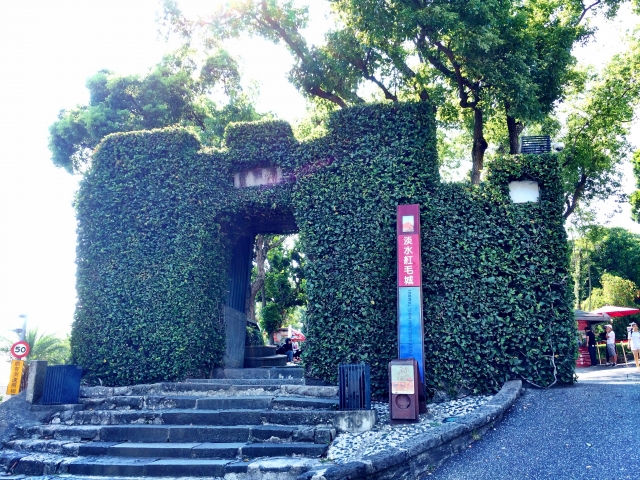
South Gate Entrance
The first thing you see when arriving at the entrance of the Fort San Domingo park area is vines crawling over the south gate. This Chinese-style stone castle gate dates back to the early Qing Dynasty. In 1724, government official Wang Quan from Tamsui added the east and west main gates and south and north doors while renovating Fort San Domingo. However ever since it was leased to Britain, the north, west and east gates were removed during the renovation of walls, with only south gate left for use as the main access.
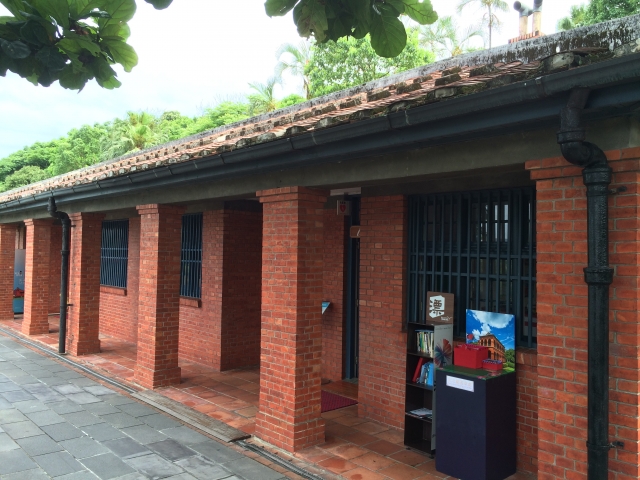
Briefing Room Building
This building was used as servant dormitory for the British Consulate while renovation of the four attached dormitories designed by architect J. C. Wynnes in 1933 was completed with renovation on April 25, 1934. The building was used for four households, each of which had a living room, bedroom, a kitchen as well as other identical elements. However, it was discovered from later use that various partitioned rooms had been taken down while the kitchen was also used as storage room. Moreover, the public toilets were built additionally next to the wall but no longer exist today.
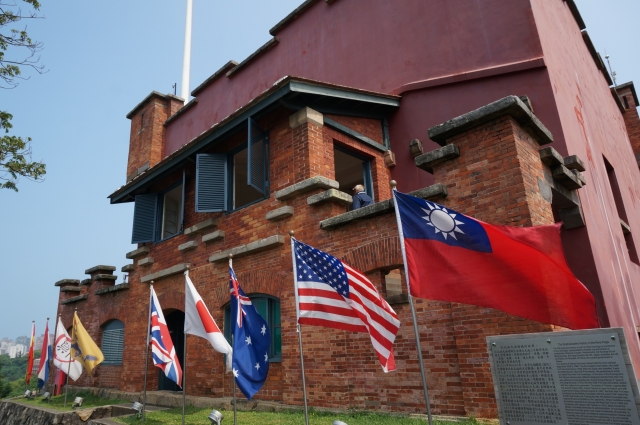
Nine Flag Area
The Nine Flags of Fort San Domingo represent more than three hundred years of the fort's historical evolution, during which it underwent the management or administration of Spain, the Netherlands, Koxinga's government, Qing Dynasty China, Britain, Japan, Australia, the U.S., and Republic of China.
Between 1628 and 1980, there were nine flags of countries or regimes waving in the sky of Fort San Domingo. The earliest was that of the Spanish, who came to Taiwan in 1628, and established Fort San Domingo. In 1642, the Dutch expelled the Spanish from Taiwan, and the Spanish destroyed the original castle when leaving Taiwan.
The Dutch then built Fort Antonio near the original site, and this is also known as Fort San Domingo today. During the Koxinga period, the government deployed soldiers by the Tamsui River estuary and used Fort San Domingo as a granary. In 1724, the imperial Qing Dynasty government renovated Fort San Domingo and added four fortress gates.
However, after the signing of the Treaty of Tianjin, Huwei opened the port for commerce and the Qing Dynasty government lost its consular jurisdiction and customs duty autonomy. In 1867, Britain and Qing Dynasty China signed a permanent lease to use Fort San Domingo as a British Consulate.
After the outbreak of the Pacific War, Tamsui's British Consulate was blockaded by Japan was temporarily administered by Japanese employees until the end of World War II.
In 1948, the British returned to Fort San Domingo and in 1972 the British Consulate moved out of Fort San Domingo, commissioning British Commonwealth member state, Australia, to manage it. In the same year that that the Republic of China and Australia broke off diplomatic relations, Fort San Domingo was commissioned to the U.S. for management.
In 1979, when the Republic of China and U.S. broke off diplomatic relations, and after government negotiations, Fort San Domingo was nationalized in 1980.
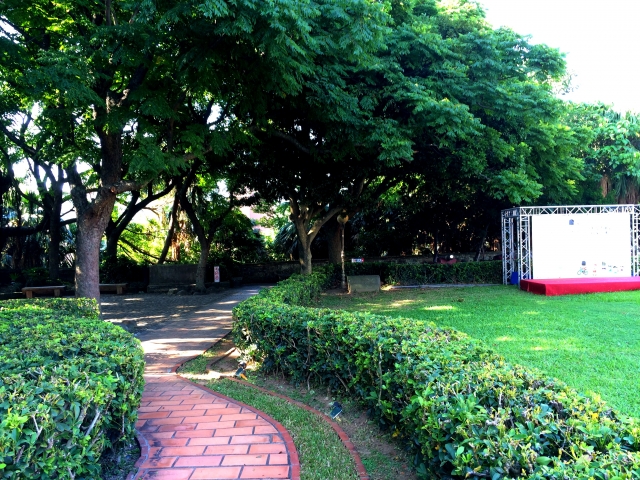
Fort San Domingo Main Fortress Plaza
The Spanish came to Tamsui in 1628 and built Fort San Domingo at the estuary of Tamsui River for military purposes. The fortress was used as a base for the military, government, trade, and missionaries. In 1642, the Dutch launched an attack on Keelung in northern Taiwan and defeated the Spanish. The Dutch then built a new fortress nearby the former site of demolished fortress, known as Fort Antonio. This square fort is the origin of Tamsui's Fort San Domingo. The locals called the Dutch "the red-haired people", which led to the name 'Red Hair Fortress' in Chinese.
Fort San Domingo is a solid square fortress built of 'stone on the outside and bricks on the inside.' The fortress is divided into two floors, designed in a semi-cylindrical arched ceiling structure. The directions of the arched ceilings for the first and second floor are perpendicular to each other in order to stabilize the main fort.
After the British were stationed here, they changed the pointed rooftop to a flat-style one and added watchtowers on the northeast and southwest sides. The terrace built on the south side of the second floor was intended to handle official business with the public, while the terrace facing Tamsui River and Guanyin Mountain were installed with battlements and embrasure for the purpose of overlooking and defense from the top. The solid structure designed with defensive guard function made Fort San Domingo a military fort easy to defend and difficult to attack at the estuary of Tamsui River.
In fact, the original Fort San Domingo built by the Dutch back then is slightly different from what we see today. The fortress used to have gray-white walls before renovation, while the viewing platform on the second floor and the attic were subsequently built after leasing to the British. The color of the outer walls was also changed to red and it became the red fortress we see today.
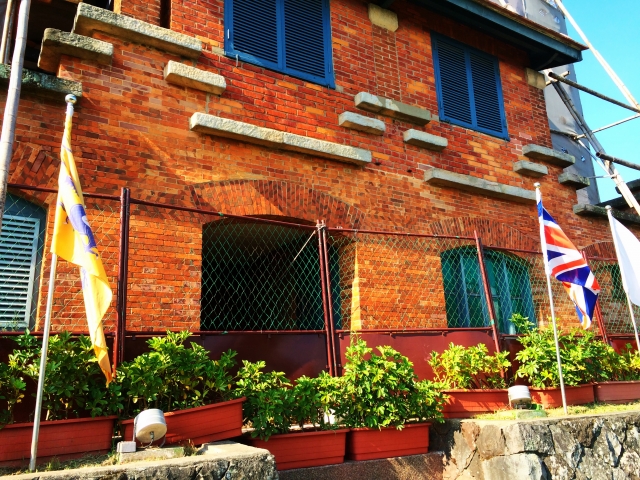
Opening Space outside of the first floor of Fort San Domingo
The surface of the main fortress has a square appearance and is about 15.25 meters on each side. It faces the Taiwan Strait to the west, guarding the Tamsui River estuary, overlooking Tamsui River and looking across to Guangyin Mountain on the other side.
Its walls are very thick at about 1.9 meter. The inside utilizes a 'stone exterior, brick interior' approach in which the walls towards the inside are built with red bricks into round arches and the external walls are mostly built with stone.
The outer layer of the wall was painted a gray-white color during the Dutch period to add privacy. During the British leasing period, to match the style of the Victorian period the entire fort was painted Chinese red. Evidence suggests that the place of origin of the coating was Batavia, Indonesia while the stones were taken locally.
The height of the main fortress is about 13 meters with the inside divided into upper and lower levels. The bottom level is aligned with two rows with dome of horizontal opening while the upper level also features two aligned rows of the domes. However, the direction of the dome differs from the lower layer, in vertical direction. The circular arch of upper and lower levels forms a ninety-degree angle, using principles of mechanics to enhance the binding force of the wall. There are deep moats on the east side and north side of the main fortress.
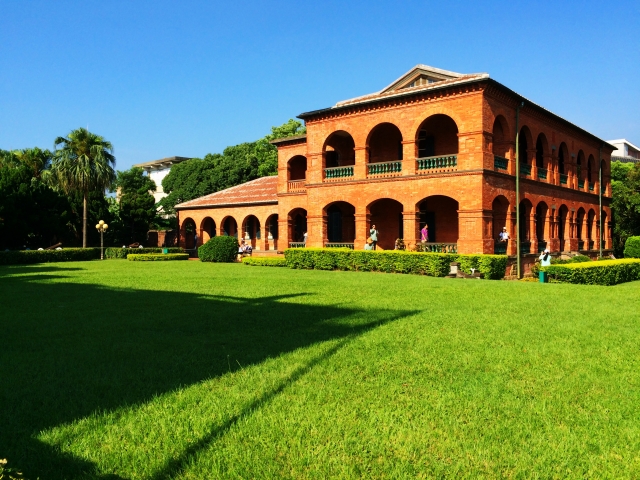
Grassland Tennis Court
Tennis was a sport which originated in France in the 14th century. However, the earliest lawn tennis originated in Victorian Britain. The British not only played lawn tennis in Britain but also played lawn tennis as a leisure activity when leasing Fort San Domingo in Taiwan.
Britain leased Fort San Domingo as the British Consulate in 1860 and built an additional consulate residence on the east side of the fort, which was the official residence of the British Consul. The large lawn in between Fort San Domingo and the British Consulate was the tennis court for the British at the time. Sitting on the veranda of the Consulate’s Official Residence, drinking afternoon tea and appreciating lawn tennis was a very British style pastime.
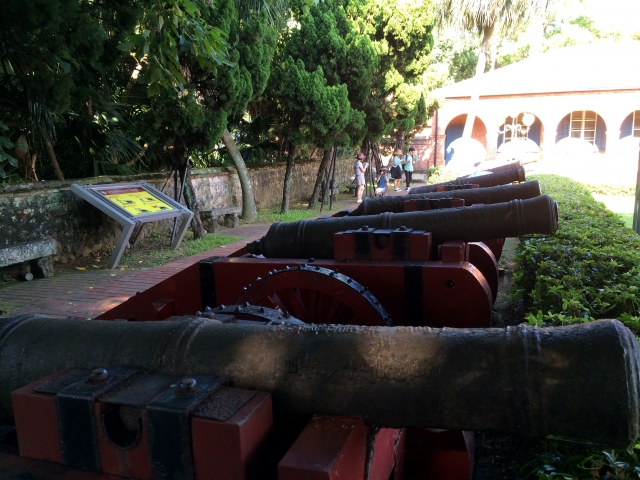
Fort San Domingo Ancient Fort
The cannons inside the park were mostly discovered by the British in Tamsui and other regions, who collected them as display items. There are Chinese and British cannons pieces which date back to the Qing Dynasty.
The Qing Dynasty cannons used jin as artillery measurement unit, which include 500 jin, 800 jin and 1,200 jin, cast with Qing Jia-Qing. There are also cannons left from Fleet Guard Battalion during their stationing in Huwei in Qing Dynasty-Jia-Qing period. The cannons were engraved with 'Jia-Qing 18th Year, Summer, Tamsui Battalion Cannon engraved with Northern Taiwan, Weight 800 jin.'
As for the British short cannon, it displays the royal insignia with a fixing ring on the tail which could be used with a rope, suggesting its use on ships and it was the short cannon for short-distance defense. Such cannons required two people pulling the rope for station due to the powerful recoil after shooting.
The cannon requires blocking with a cap after installing the gunpowder, then combusted, generally known as front artillery. Any reckless handling could lead to explosion, which is to say the rear of the canon would explode. For this reason, the exploded canon was at the front door. If this were the destructive actions of the Dutch before leaving, it would be considered highly valuable.
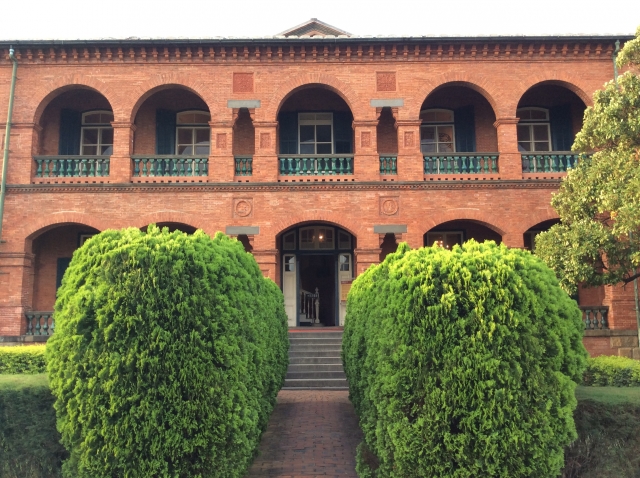
Outside of British Consulate
During the reign of emperor guangxu (1875~1908), the British believed that it was necessary to build an additional consul's official residence and then built a one-story wooden British consular residence on the land east of the main fortress of Fort San Domingo in 1877, in order to separate the office from the official residence.
However due to humidity and termite invasion, the building was renovated into a two-floor red-brick building in 1891. The entire consular residence is divided into two floors. The arch loop corridor western-style building is a classic British colonial building, in which a large area of green land is retained in front of the consular residence and the main building is withdrawn to the back. It possesses an exceptional and elegant character, which was quite a contrast to the rigid military style of Fort San Domingo.
There are 12 brick sculptures on the pillars of the sides of the front gate at the consular residence. The sculpture shows 'VR1891,' where VR is the abbreviation of Victoria Regina, Britain's Queen Victoria, and 1891 denoted the year of the consular residence's completion.
What’s most special is the brick sculpture is carved with the thistle' representing Scotland and the 'rose' representing England. The brick sculpture is highly elegant and attractive. The eaves of the outer walls feature a decorative belt made of bricks with a bellow line outside the corridor on second floor. Both are magnificent and beautiful.
The elevated base of consular residence is inlaid with Chinese-style ventilation holes, the design of which not only provides ventilation function but also denotes the auspicious implications of 'fortune and wealth' at the same time, a common approach in Chinese architecture. The roof design of consular residence, known as a 'four-slope slanted roof', features southern Fujianese red bricks on the house framework. The design allows convenient water drainage while elevating the indoor space and producing a thermal insulation function, which is an ingenious idea architecturally.
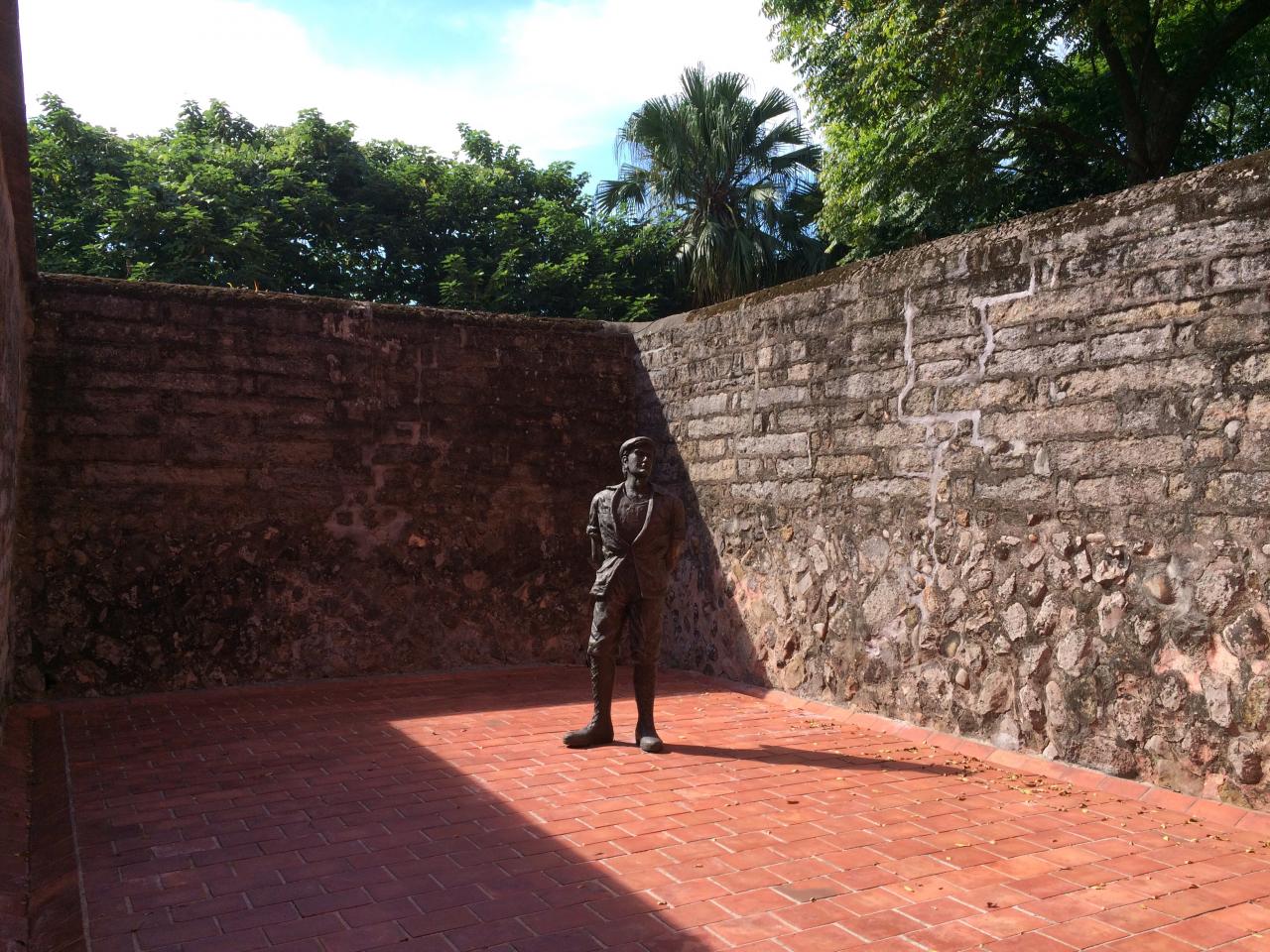
Dungeon and Relief Room on first floor of Fort San Domingo
Before entering the first floor of the main fortress, one can see the bathroom, toilet, kitchen, and the place where the guard lived. These were built by the British after they were stationed at Fort San Domingo. To execute consular jurisdiction, Britain changed the previous two big rooms on the first floor into four small prisons in order to temporarily collect and detain foreigner committing crime in Taiwan, and will send them back to their home country for judgment in the future.
The door on the dungeon features a food delivery hole and peepholes. Britain is known for protection and respect for human rights by building an area for criminals to move around outside, namely the relief yard, where criminals can have some exposure to sunlight and stretch a little.
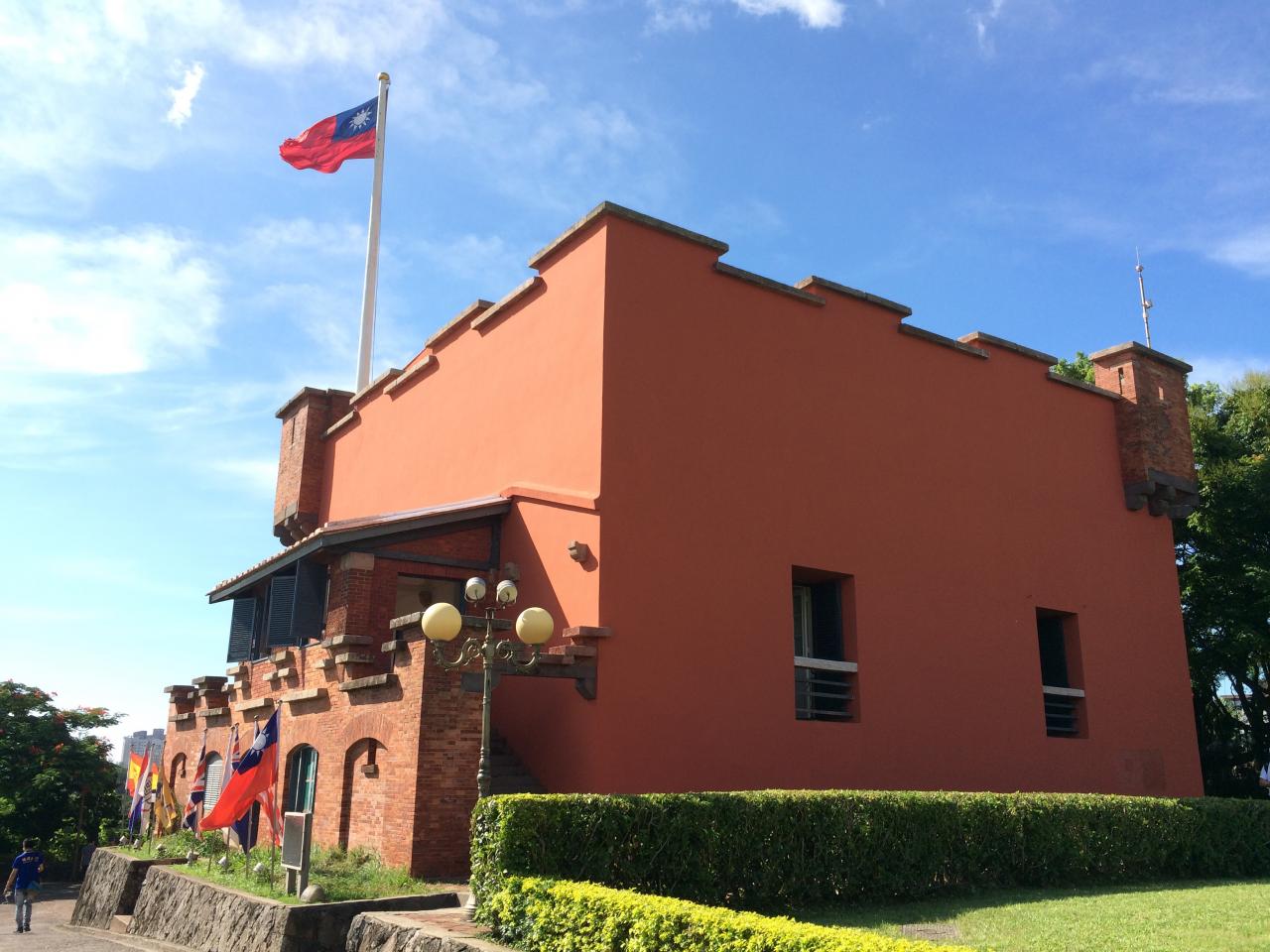
Main Fortress Second Floor of Fort San Domingo
The Dutch built the second floor at the main fortress of Fort San Domingo with only one pillar inside the spacious room. After the British were stationed there, the second floor was separated into four rooms used for consular, secretary office, bedroom, family room, kitchen, and living room.
During renovation of Fort San Domingo, it was discovered by accident that there was an alcove under the red bricks below each window. It is inferred that this was for use as a cannon carriage or space for turning a cannon carriage, which was probably placed there during the Dutch period. Additionally, there were earth bricks made of pure mud with mud and rick husks still remaining inside the wall, as well as a sealed door.
It was likely made for convenient access for British people between the kitchen and living room during the early stage, and was sealed after building the terrace. Other items include a document security box, key box, large safety box, document incinerator, fire extinguisher, and baby cart, which were all left behind by the British.
There are steep wooden stairs on the left of the entrance to the second floor, where one can access the roof terrace. The center of the terrace is elevated to facilitate roof drainage. There are battlements around the roof that were built by the British, featuring a stone strip on the brick wall.
Overall, Fort San Domingo combines the architectural style of ancient Dutch and British castles, which feature solid structure and magnificent appearance, erecting on the Tamsui River estuary and becoming the true witness to the history of Taiwan.
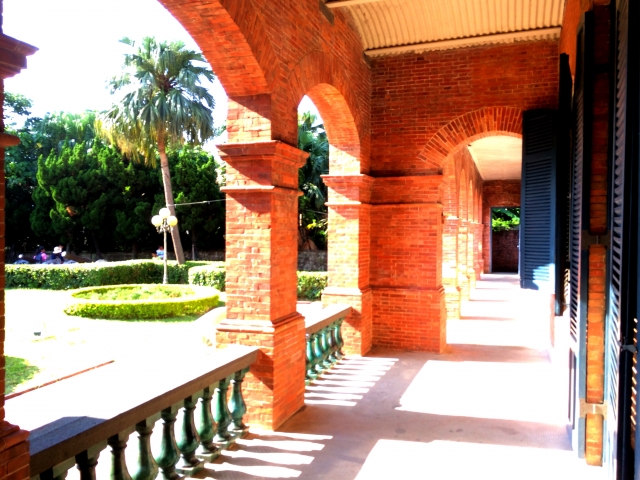
British Consulate First Floor Corridor
The corridor on the first floor of the Consular Residence adopted an arch shape while the second floor corridor adopted a semi-circular arch. The corridors served both as sunlight shields and rain shelters. This place provides a perception of the leisure time at the official residence at the time. The handrails of the corridor adopted green glaze vase handrails that combined the feature of Chinese ceramic arts and Western vase handrail.
Looking up to observe the first floor of the Consular Residence, the corridor ceiling on the east and west sides adopted special flooring techniques, using waving metal arch structure to build on 'H-shaped metal beam.' This highly special structure was the architectural technique that appeared at the end of the 19th century, which contained both fireproof function, known as the most progressive architectural technique at the time before the wide popularity of steel cement.
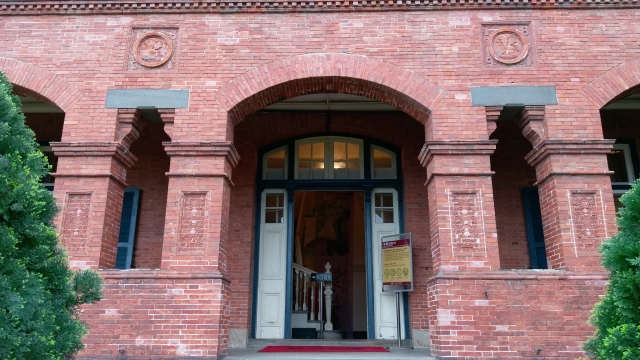
British Consulate First Floor Entrance
There were many rooms to the Consular Residence for the consul and spouses to live. The building was situated on the north and facing the south, overlooking in reverse T-shape. The first floor was built on the base in one meter above, where the handrails with sophisticated sculpting spiral stairways appeared from the entrance into the building.
The west side of the first floor consists of living room and study room while the east side consists of dining room and the kitchen. The back is the toiletry for the guests and the servant’s room. On the second floor there is a large bedroom and several toilets, living room, dining room, and master bedrooms, while each room comes with a wall furnace device
In particular, the geometric pattern tiles on the floor of living room, hall, and dining room were imported collage tiles that merit much appreciation.
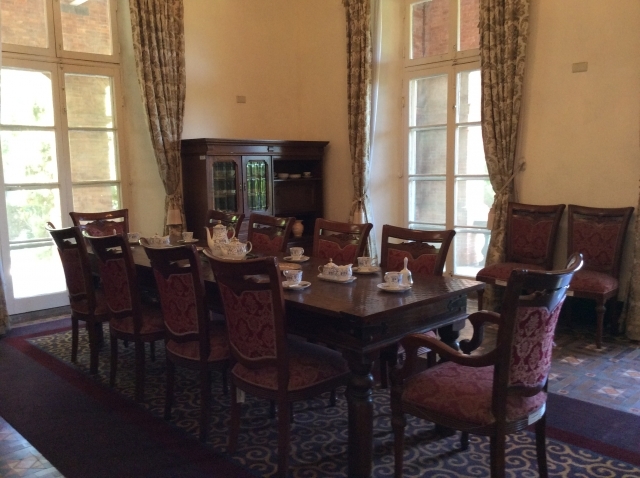
British Consulate First Floor Dining Room
The dining room of Consular Residence was designed for comfort and grace. There is a meal preparation room connecting with the back of the kitchen, because in times of rigorous ranking of management at the residence, servants could not enter the space of the consular without permission.
Hence the chefs had to prepare the food and allow the servants to send the food to the meal preparation room, then deliver to the meal delivery opening upon serving, while the servants working at the dining room would serve the food to the table.
There were service bells next to the furnace and dining room. The consul only needed to press the button and the ring at the operator would go off, while the number card indicating the location will drop so the butler would know where the consul was located in order to provide immediate services.
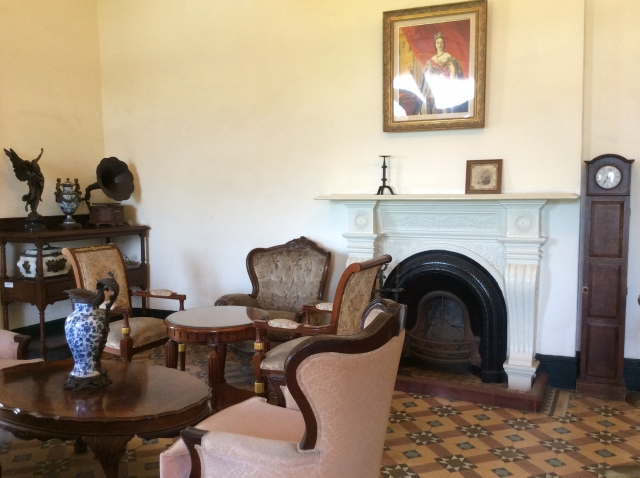
British Consulate First Floor Living Room
The British removed most of furniture when they left. The furniture and decoration we see today are simulations based on the literature and photos at the time.
The only thing that never changed since 1891 was the floor tiles under our feet, which are known as Victorian tiles, while some people call them the collage pattern tiles or inlaid tiles. Their special characteristic is that they are a mixture of earth and colors heated to reach a highly consistent color that will not wear off or fade. These tiles were already phased out of production in Britain and therefore became more valuable.
The rolling large flower window curtain was the most popular color at the time. The furnace in the room was not used for defending the coldness when traveling from high-altitude country to low altitude country, but served more like the projection of nostalgia for home. Meanwhile it can have dehumidifying effects and moisture removal.
The electric hanging fans in the living room and dining room were produced by G.E.C. Kingsway in Britain in 1941 and have been preserved until today.
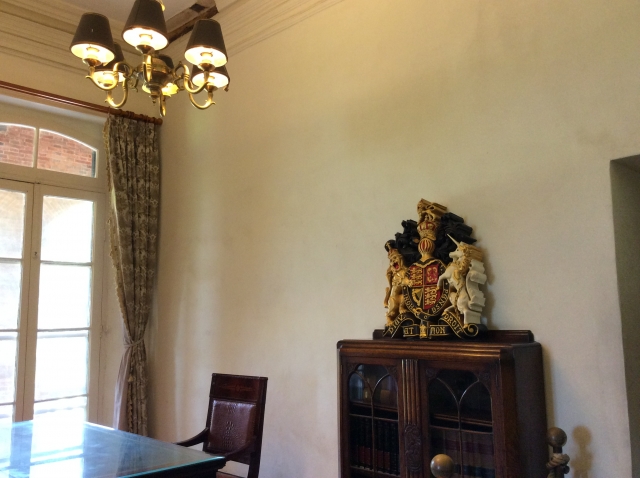
British Consulate First Floor Study Room
The tiles used for the study room separated by one wall from the living room were significantly different, which fully demonstrated the clear distinction between personal and public spaces for the British. In general, living room, hall, dining room and public spaces were intended to highlight the identify and ranking of the owner, which tended to be more glamorous in decoration when compared with the study room and bedroom as well as personal space. Hence it can be discovered that the pattern of the furnace in the study room is more simplistic than that of the living room.
Additionally, the armorial bearings symbolizing the British regime were hung up high on the south entrance and the main fortress of Fort San Domingo during the leasing period of Fort San Domingo by Britain. The original armorial bearings were taken away when Britain left and the one currently exhibited in the study room is a replica.
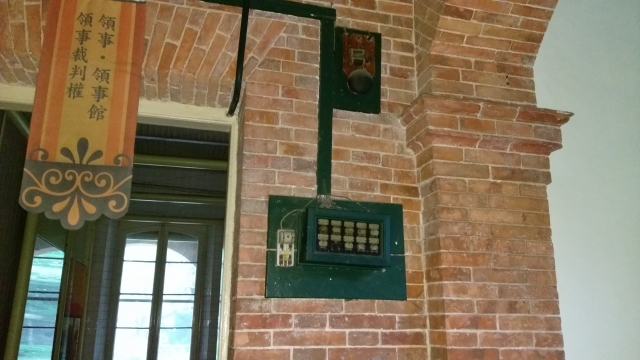
British Consulate First Floor Servant Bell and Servant Room
Britain put a lot of stress on hierarchy, and also applied a rigorous distinction for the space between the owner and the servants. In the British Consular Residence, inside the reverse T-shaped building, the two-floor building in the front was the space which belonged to the owner while the back of the of the building was the only space where the servants could move. Unless requested by the owner, the servants could not have entered the owner’s room.
At the same time, the stairways at the entrance were only used by the owner. Another narrower stairway was discovered when approaching the passage connecting the space between the owner and servants, which was used by the servants at the Consular Residence for providing services to the owner downstairs or upstairs.
There were service bells inside the servant’s space on the first floor, a calling operator for the owners to call for servants with convenience. The buttons of call bells were installed in the hall, the living room, the dining room and bedroom, so that the owner could press the button, and when the operator bell rang, number cards inside each room would drop to let the servants know which place requested their immediate services.
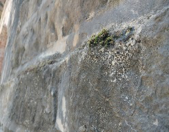
Construction materials of the corridor
The corridor is made of Chi-Li coastal rock, a type of sandrock. Since the corridor has a high level of moisture, the presence of moss can be seen on the stone material which has been exposed to a humid environment over the years. Normally, the stone contains quartz (silicon dioxide) that shines brightly under the sun. It used to be an important material in Taiwanese architecture but is now prohibited to extract.
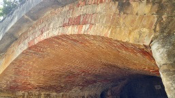
Construction of the corridor
The upper structure of the corridor was built using bricks, showing an arch structure. The handmade bricks
came from Xiamen. Concrete (glutinous rice, brown sugar, lime) was used as a cohesive material in between the bricks. The unique structure of the Xiamen brick’s upper and lower groove increases the frictional force on the brick’s surface, like tenon or arch structure, which can support the top covered by a two-meter thick soil and trees. This is a kind of seismic retrofitting technique.
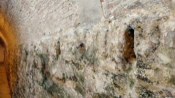
Corridor hole relics
The Chi-Li coastal rock walls on both sides of the corridor have bilaterally symmetrical rectangular holes. The holes were not driven outside of the corridor. It is quite possible that these holes were from the scaffolding used by construction workers when they were building the vaulted roof of the fort during the Qing dynasty. During the periods of the Qing dynasty, Japanese occupation, and the Nationalist government, the corridor was used in the military camp/garrison of the national army. The national army made use of the holes on both sides to erect wooden strips. The upper side served as the soldiers’ dormitory while the lower side was the corridor and armament room.
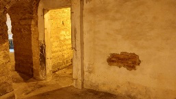
Corridor partition
When the sub-wall was constructed during the Qing dynasty, it was ensured that the corridor is accessible from all sides without partitions. The soldiers could walk through the corridor, and a person who walks back and forthcould not be seen as well. The design considered the safety aspects. The current partition, which is constructed with cement, should’ve been the one used by the national army during the war. The bricks used for the wall are also different from Xiamen bricks. The construction of these partitionswas kept confidential in order to identify the ranks of officers and soldiers.
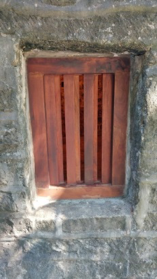
Sliding window with wooden grilles
In refurbishing the sliding windows with wooden grilles, new wood strips were used but the previous construction technique was applied. Commonly seen in local residences, this type of sliding window with wooden grilles can control sunshine and air flow. The design of the fort and its windows is a combination of western and Chinese styles, respectively. The windows have an odd number of grilles which is considered lucky in Feng Shui (In geomancy, odd number means "Yang/positive element of Yin and Yang" and even number means "Yin/negative element of Yin and Yang").
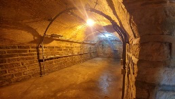
Utilizing corridor space
The western style Hobe Fort was built during the Qing dynasty. It was classified as second grade national historic relic in 1985 and has now been declared a national monument for its historical value. Since it is open to the public, many visitors have been interested to explore the place. Aside from regular exhibitions held inside the sub-wall, there are also special ones organized. In order to protect this historic relic, iron stands were originally set up to display items rather than support the roof.
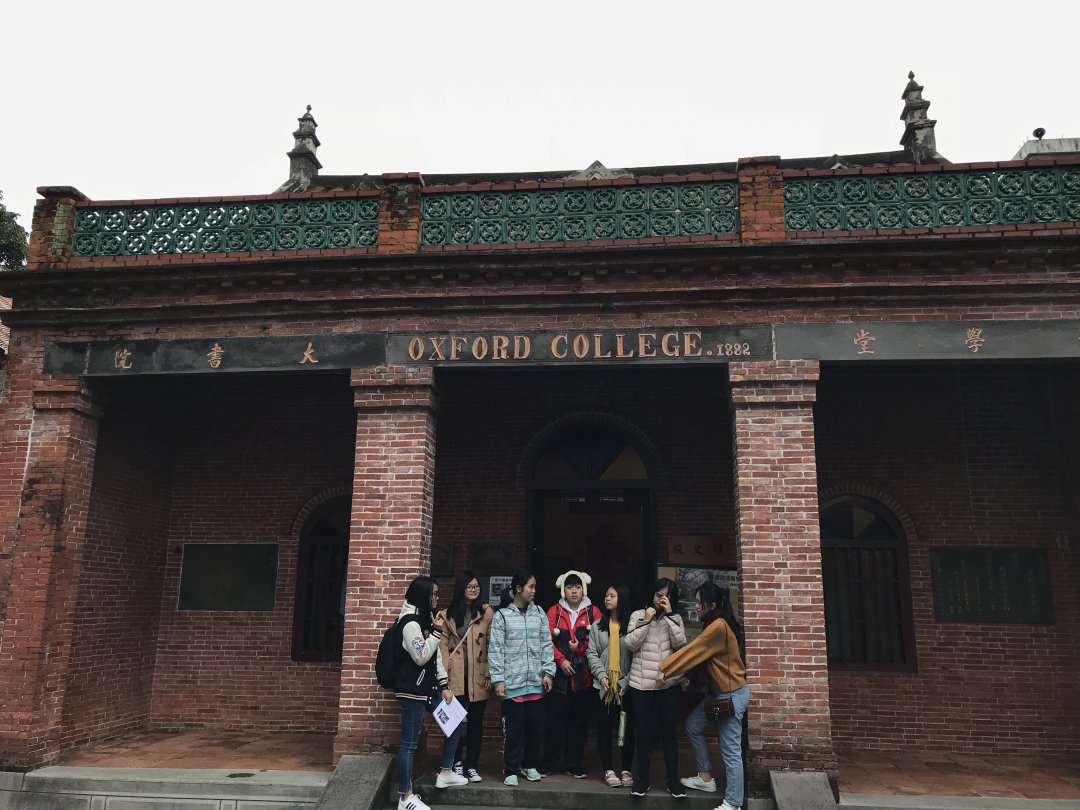
Oxford College
George Leslie Mackay had a deep connection with Tamsui where he built Oxford College. In 1880, he went back to his hometown in Canada for the first time to report his missionary work in Taiwan for the past 8 years. Despite the success of his mission, Mackey revealed the difficulties he encountered while holding classes outdoors, "sitting on the grass under a banyan tree". For this reason, he was able to obtain funding from local people in Oxfordshire and eventually built a school in Taiwan. He used the donation to buy land and supervised the construction of a modern school, which he personally designed. In July of 1882, construction was completed and the new school was established in Taiwan. The school was named "Oxford College" in appreciation of the local people from Oxfordshire. Oxford College was designed using both Chinese and Western architectural styles, utilizing a mixture of glutinous rice, dark brown sugar, lime and sand instead of cement, as well as tiles and bricks from Xiamen. The building faces south and is patterned after the traditional courtyards in Taiwan. Oxford College is located in the campus of Aletheia University, which is near Fort San Domingo, the former Tamsui Customs Officer's Residence, Tamsui Girls' School, Mackay's Cemetery, Foreign Cemetery, Octagonal Display Hall, etc., all of which have historical significance and aesthetic value.
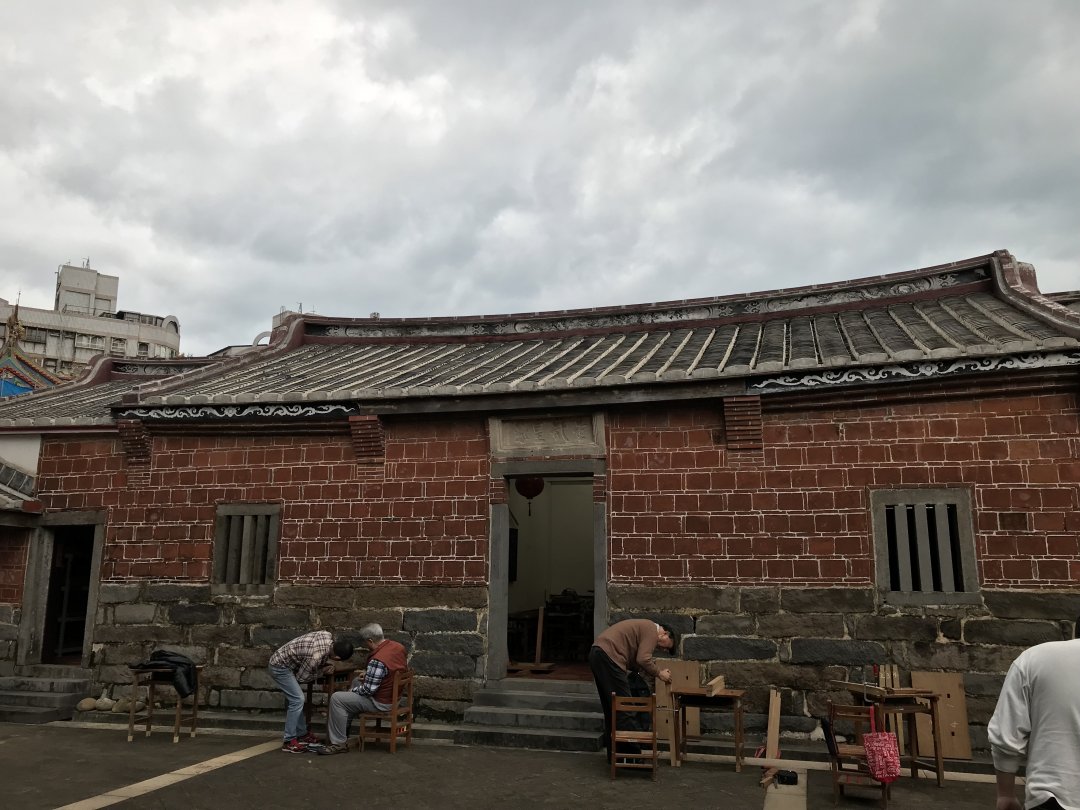
Gongsitian River Chance Garden
"Gongsitian River Chance Garden" is a traditional private house with a rich history, located in Tamsui district of New Taipei City. The construction date of the house is unknown, but according to scholars, it was before 1884 during the Sino-French War. During the Hobe battle in the Sino-French War, the Qing troops that were stationed in the area surrounded and suppressed the French troops. This ancient house features a hundred-year old Hoklo-style of architecture and characteristics depicting local culture, and is located in Tamhai New Town, Tamsui District. The areas being developed around the Gongsitian River can be traced back to the Dutch era, while the Chance Garden is the only farm house preserved in the area. The house represents the Sanheyuan architecture in past agricultural society, and surrounding it are bamboo reeds and flowing water. Preserving this structure gives value to the development history of Tamsui district.
The establishment of The Association of Tamsui Leisure Agriculture in New Taipei City brought art, local education, and tours to the simple and ancient Sanheyuan, making the Chance Garden a center of art showcasing aesthetics and creative culture in New Taipei city.
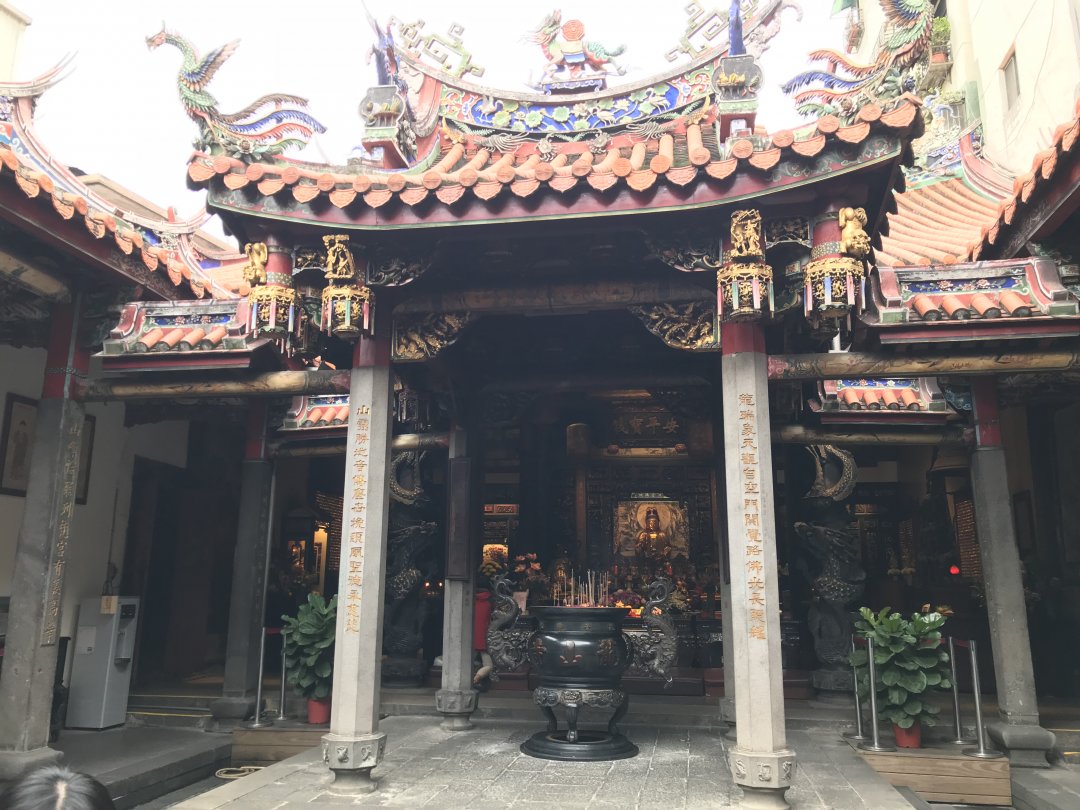
Tamsui Longshan Temple
The five best known Longshan Temples in Taiwan are Tamsui Longshan Temple, Bangka Longshan Temple in Taipei, Tainan Longshan Temple, Fengshan Longshan Temple, and Lugang Longshan Temple. Tamsui Longshan Temple was built in 1858 with Guanyin Bodhisattva as the main focus of worship. In the past, there was a square in front of the temple and a garden behind it. There was also a typical Tamsui market nearby. It was said that during the Sino-French War in 1884, there was a theophany in which Guanyin Bodhisattva appeared before the residents of Tamsui. The temple was therefore blessed with a miracle.
Tamsui Longshan Temple is a typical Fujian southern style building with simple construction. It faces east and presents a strip layout. In the temple, the stone sculptures, wood engraving, and statue of gods are considered the most delicate structures. The temple is located in an old market where the area is for mixed residential and commercial use. It is barely visible given the lack of illumination in the area and not easily noticeable to outsiders. The east entrance of the temple is adjacent to the south of Qingshui street, which has long been occupied by many street vendors, making the originally wide Qingshui street into a narrow road, where individual vendors set up stalls that make the street dark and offer little illumination. Even though this has an impact on health and sanitation, a dark street scene has become uncommon in Taiwan and is therefore considered a rarity.
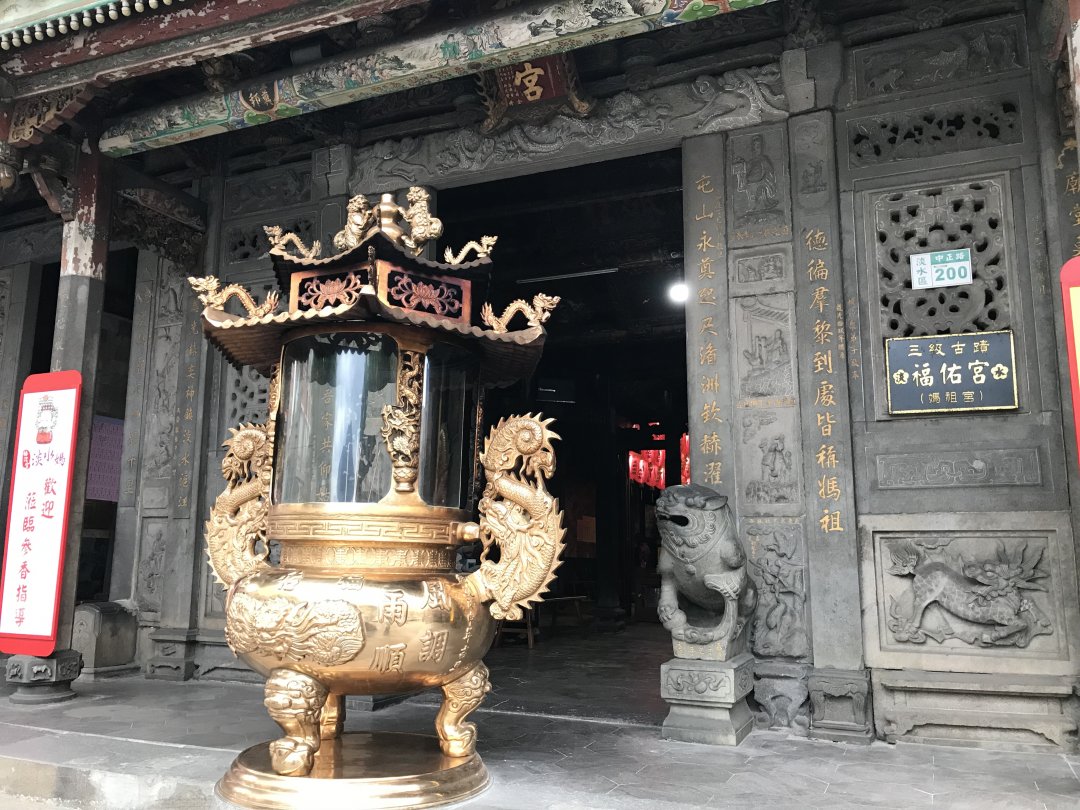
Tamsui Fuyou Temple
Given the unpredictable marine weather along the Taiwan Strait, early immigrants to Taiwan had to cross the dangerous "black ocean (current)" with waves that could overpower them if they were unlucky. At that time, it was common to hear statements like, "6 dead in the sea, 3 were able to cross the strait safely, and 1 returned back", which describe the difficulty of crossing the strait. Hence, immigrants normally went to Mazu temples to pray for safe travels to Taiwan, and they built a temple as a religious offering in gratitude for success in their endeavors. As such, Mazu has become the most common focus of belief in Taiwan. Tamsui Fuyou Temple was built in 1782 and the construction was completed in 1796. The establishment fund, which was donated by people from different areas who arrived in Taiwan via the Hobe port (the only port of destination in the Taipei Basin), also demonstrates their common belief in Mazu regardless of their place of origin. Fuyou Temple is located in Tamsui Old Street. It is the starting point of Qizaiding (Chongjian Street) in Tamsui Old Street, and the center of Hobe street. This shows that there is a close relationship between the temple and Hobe street.
Tamsui Fuyou Temple is facing north with Tamsui river in front and Qizaiding at the back. This is considered an ideal geographical location given the "mountain background and mirrored water in the foreground". The most complicated and amazing part of the whole temple is its stone sculptures, most of which are made of Guanyin stone and of different subjects ranging from symbolic animals like the qilin, dragon, white tiger, magpie, bat, etc. to scenes depicting everyday life of "fishermen, woodcutters, farmers and scholars" from past agricultural societies. These sculptures are simple yet vivid and moving. The highly distinctive brick carving technique was used to create patterns depicting a happy life, wealth, and longevity, which reflect the people’s expectations in life.
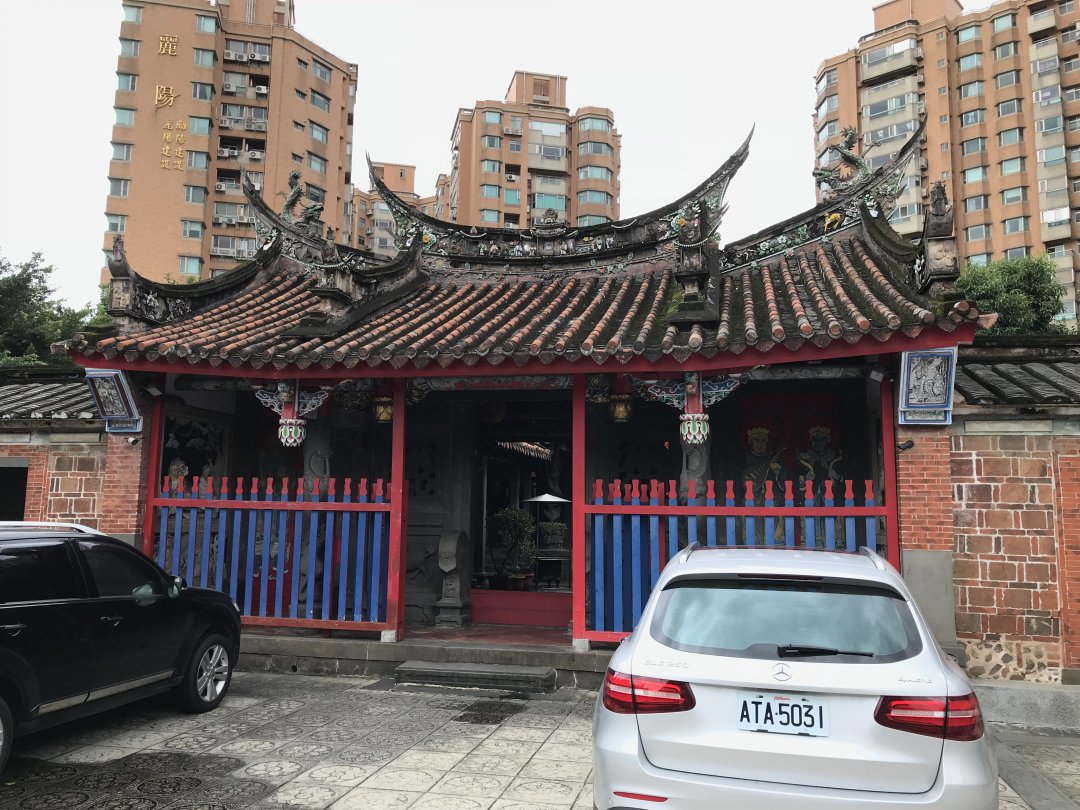
Yinshan Temple
In the history of the Qing Dynasty, there are only two temples of Ding-GuangFo; one is Changhua Ding-GuangFo Temple in central Taiwan and the other is Yinshan Temple in Tamsui. Tamsui Yinshan Temple was built in 1822 and preserved close to its original form, including the clay sculpture of the ridge, which is normally the hardest part to preserve in temples. As such, Yinshan Temple has research value in terms of Taiwanese architectural history. Yinshan Temple was not only a place of worship for Hakka immigrants from Tingchow, Fujian, it also served as a "hostel" for immigrants. There are several guest rooms on the left and right wings of the temple, serving as temporary residence for fellow countrymen. Aside from the layout of Yinshan Temple which reflects the features of Yongding architecture, the location resembles the "Toad Cave", which is considered the most superior cave in Feng Shui Geography. It is facing west, which is just at the mouth of Tamsui river with the Tatun mountain in the background like an ancient folding armchair on a high pedestal, presenting a majestic scenery. Two wells were dug in front and behind the temple possibly to complement the landscape. The two wells seemed like the eyes of the toad and the half-moon shaped pond in front of the temple served as the mouth of the toad, which together made the place an ideal Geomantic location for its "mountain background and mirrored water in the foreground". The colorful lion, tiger, and qilin (Chinese unicorn) at the Sanchuan Hall of the temple were likewise ingeniously crafted. The lion is playing with a "flag" ("Qi" in Chinese) and a "ball" ("Qiu" in Chinese) while the qilin is playing with a "halberd" ("Ji" in Chinese) and a "chime stone" ("Qing" in Chinese). These four words combined means, "praying for good fortune". All facets of Yinshan Temple symbolize ancestral gratitude towards God and the earth.
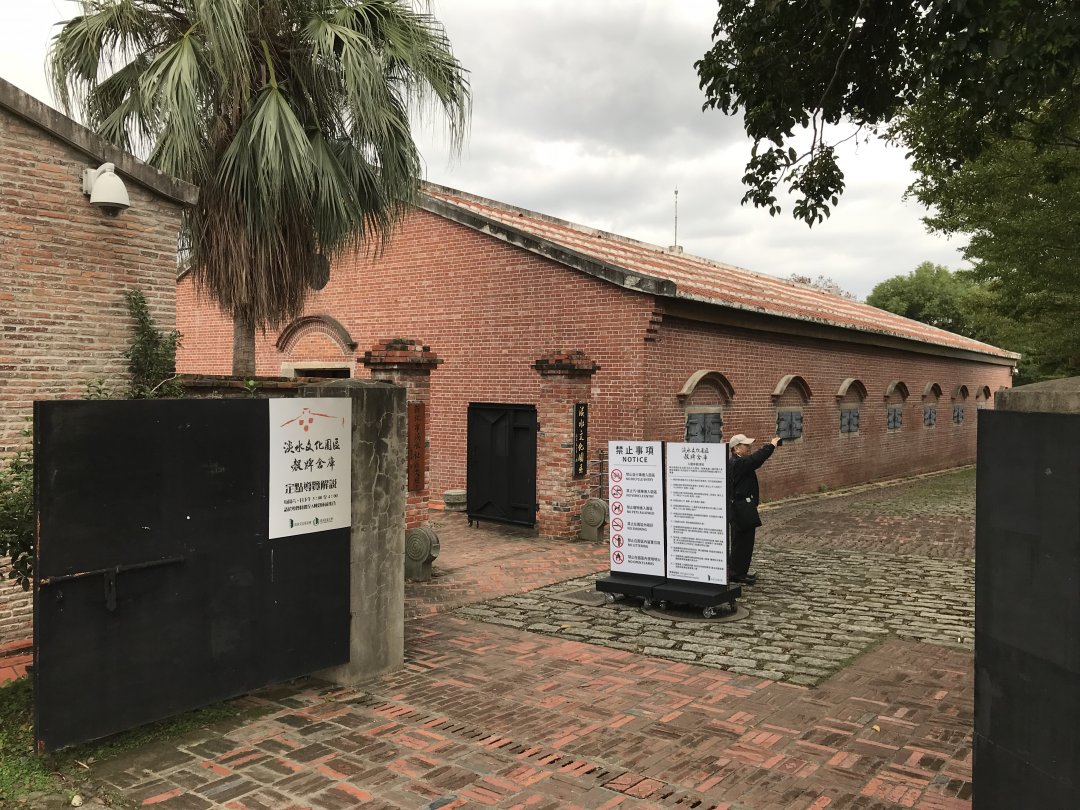
The Former British Merchant Warehouse
In 1862, Hobe Customs was established and started the imposition of taxes and duties. Tamsui port soon became the largest port in northern Taiwan whose trade volume accounted for more than 60% of the country’s total trade volume. Tea, coal, and camphor were Taiwan’s main exports. In 1897, British company Shell bought Case & Company and made it as one of its centers for trade in the Far East. The warehouse and oil tanks were set up for oil storage, railroad tracks connecting to Tamsui railway were laid to facilitate the loading of oil into containers. This place was also called "Shell Warehouse". In early years, people in Tamsui called it the "Stinky Oil Loading Rack" because of the unpleasant pungent smell coming from the oil. In October of 1944, the oil tanks were bombed by the U.S. air force during an air strike in northern Taiwan. The fire lasted for three days and this incident remained in the memory of the Tamsui people. Eventually, the warehouse gradually lost its value and was used only for stoarage.
With around 4,000 pings (ping, unit of area equal to 3.3 square meters), there are 4 large warehouses, 3 small buildings, and remnants of oil tanks that were part of significant historical events such as the opening of the Tamsui port, the Japanese occupation of Taiwan, and the U.S. army air strikes in Taiwan during World War II. These are also one of the few industrial archaeological ruins. In June 2000, the government declared them as historic relics. In addition, Shell company has donated a relic with a hundred-year history to local cultural group, Tamsui Culture Foundation. The "Shell Story House" was built inside the park to showcase the history and development of the Shell Warehouse. The Tamsui Shell Story House also serves as a workshop for Tamsui Community College and an a venue for various cultural activities.
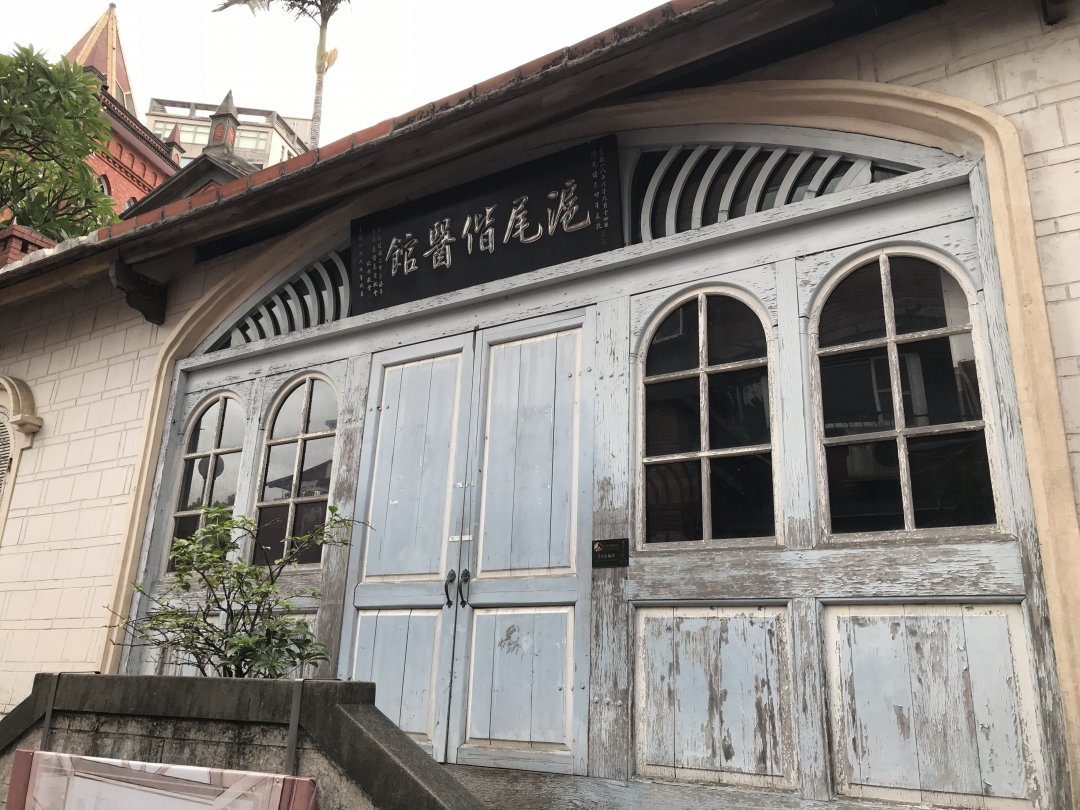
Hobe Mackay Hospital
In 1879, Mackay received a donation from the widow of an American captain whose last name was also Mackay. With that donation, Mackay was able to establish a hospital and named this Chinese and Western-inspired building "Hobe Mackay Hospital" (The Mackay Hospital) in honor of the Mackay couple. Hobe Mackay Hospital was the first western hospital in Taiwan. The Sino-French War in 1884 reached Tamsui and this hospital was responsible for rescuing people wounded during the war. Liu Mingchuan presented an award to the hospital for this achievement. The hospital was closed when Mackay passed away in 1901, but was re-opened in 1906 when Canadian doctor J. Y. Ferguson came to Taiwan. Soon after, with the gradual decline of the Tamsui port and in coping with the times as well as commemorating Mackay as a medical pioneer in Taiwan, the Taipei Mackay Hospital was built and completed in1912, symbolizing the achievement of Hobe Mackay Hospital's mission.
Mackay personally designed the hospital, which features a Hoklo style with Hoklo roof tiles and western style arch doors and windows. A famous mason from Tamsui was in charge of the construction. Although the hospital had a simple exterior and interior design, it was a considered a modern hospital at that time, providing organized case files and medical reports. Patient appointments and re-examinations were distinguished using black and white wooden tags, and hygiene education programs were offered to patients awaiting treatment. After the hospital closed in 1912, it was converted into a divinity school, library, kindergarten, and student dormitory. The building also underwent renovation and was maintained until 1992.
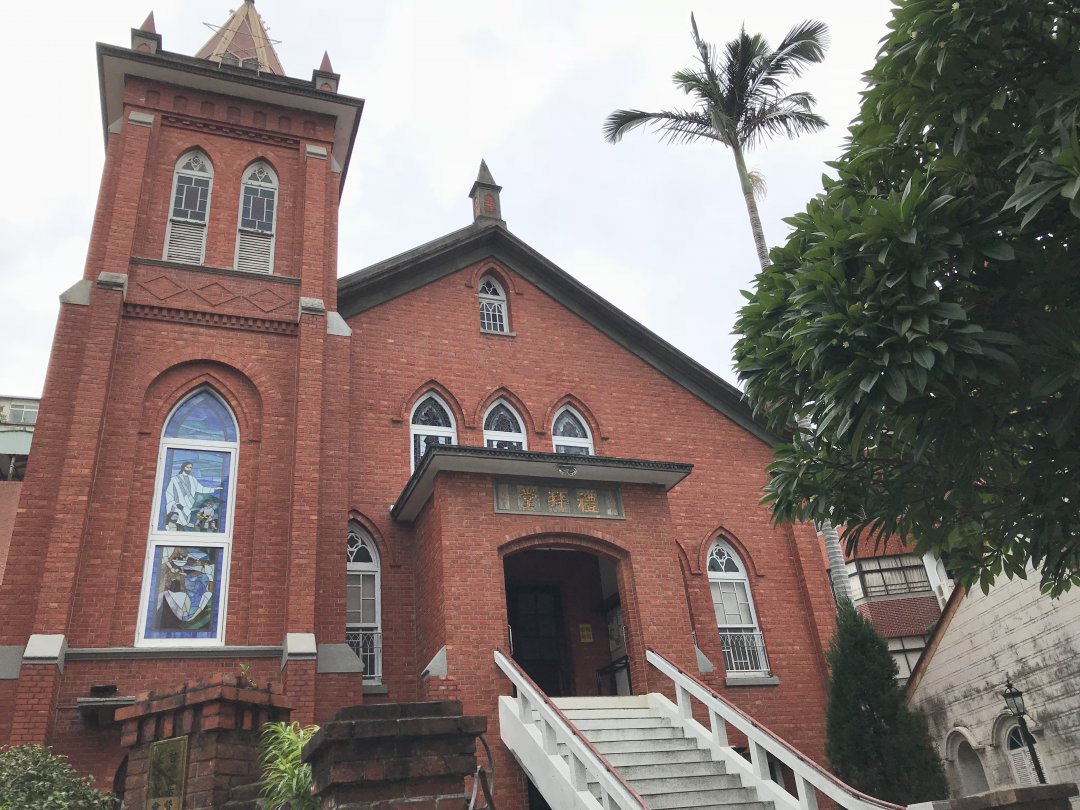
Tamsui Church
Thanks to Dr. Mackay, Tamsui served as the foundation for the development of the Presbyterian Church in northern Taiwan. Upon his arrival in Tamsui on March 3, 1872, Mackay aggressively began his missionary work and diligently learned Taiwanese and the local culture. The original house that he rented served as a hospital and evangelical place. This was the first generation church. With the passing of Mackay in 1901, Tamsui Church entered a new era. The church was remodeled into a North American style structure with whitewashed brick walls that satisfied expansion requirements. It was commonly referred to as the White Church, with a bell tower right above the main entrance. In 1928, the church underwent another renovation due to lack of space. The funds that were used for the renovation came from church members, students, and other churches. But it was Mackay's son George William Mackay who provided most of the funds through the mother church in Canada. He also designed and supervised the construction himself. The remodeling started in 1932 and was completed on September 30, 1933. Today, the beautiful church in Tamsui old street has become a well-known tourist attraction.
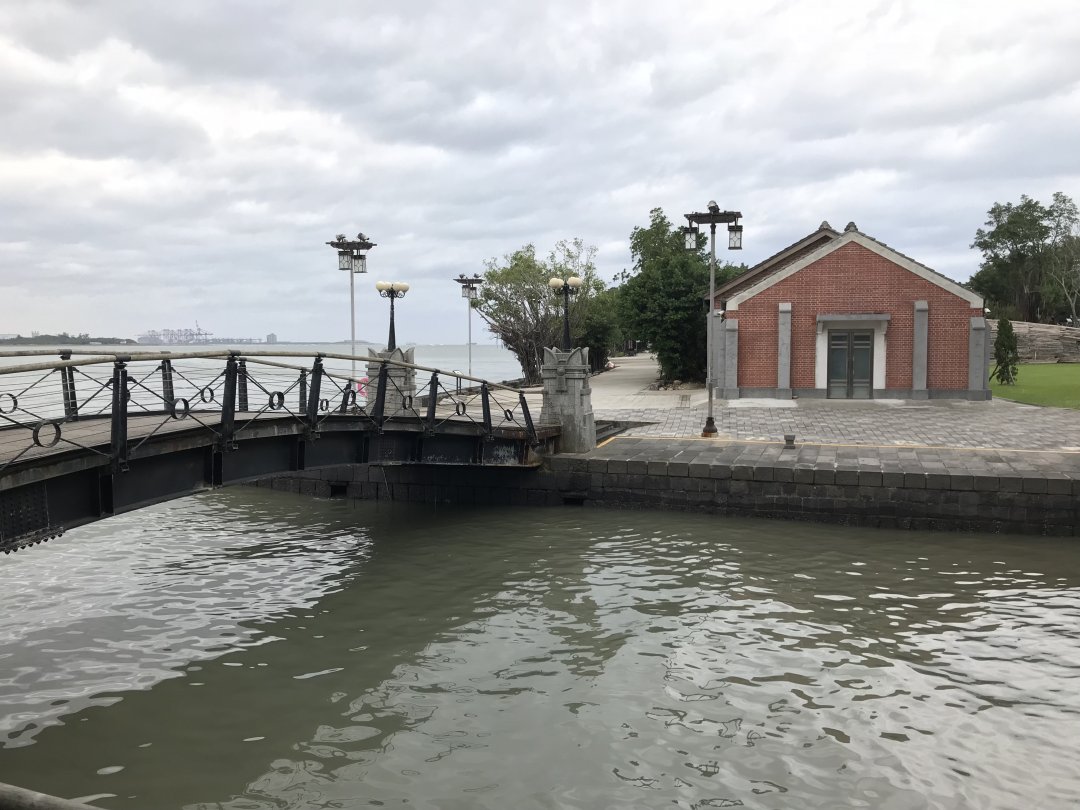
Wharf drainage for embankment
The customs wharf has played an important role in Taiwan's modern history. At present, structures constructed during the Qing Dynasty, Japanese occupation, and post-war are found here. At the time Tamsui port was booming, there were more than 10 countries that had their ships docked here. The western style house during the Qing dynasty and the two port warehouses during the Japanese occupation were part of the trading history at Tamsui port.
At the opposite side of the bridge from this position, one can see the wharf drainage for embankment. The drainage gets flooded during high tides.
Since the drainage is perpendicular to the embankment, the land is only visible here. Part of the wharf drainage is fitted with an iron fence, presumably to prevent animals or debris from blocking the river.
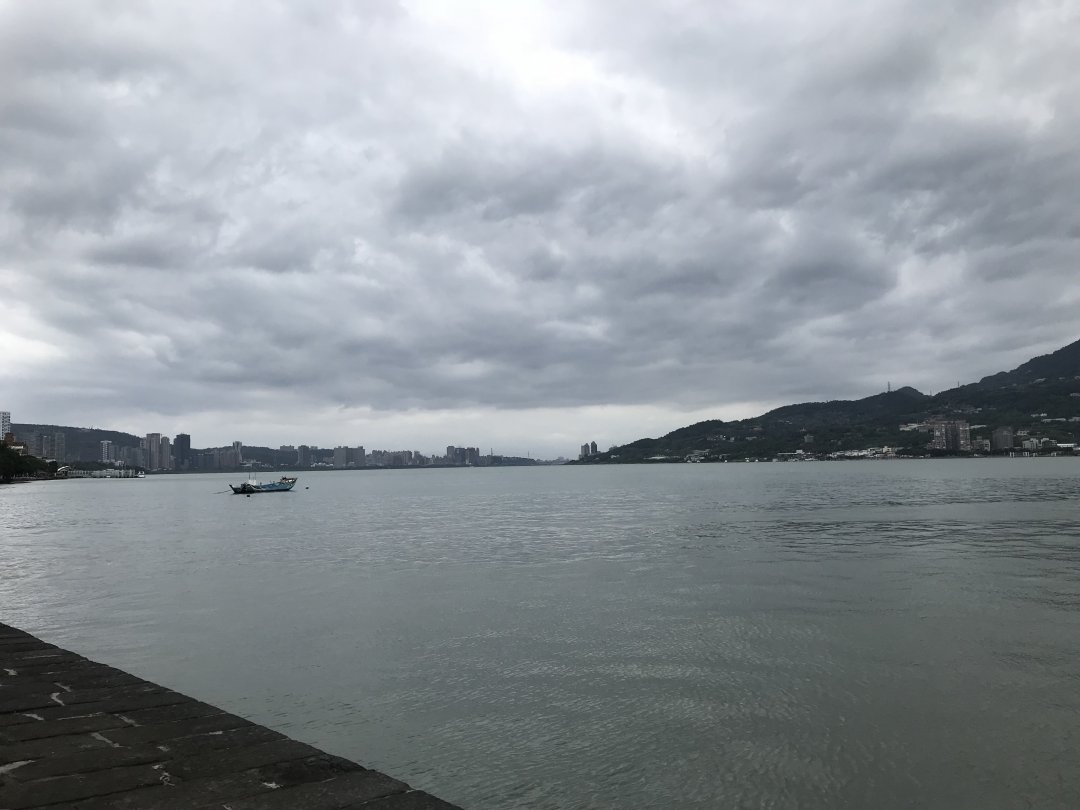
The sampan ship in customs wharf
In the 19th century, the Tamsui Customs Wharf was once the largest trading port in Taiwan. However, due to sediment deposition at the river’s mouth and the completion of the Taiwan State Railway, the Keelung port replaced the Tamsui port. Moreover, sampans replaced large merchant ships and sailing vessels that once navigated the Tamsui port.
The main feature of the sampans in Tamsui river is the fish eyes drawn on the bow, which are generally considered traditional patterns signifying safe sailing, inherited from ships traveling between Mainland China and Taiwan during the Qing dynasty. With the fish eye drawing, one can distinguish merchant ships from fishing boats. The "fish eyes" on merchant ships that are "looking forward" represent the ability of a ship to figure out directions and arrive at its destination safely, while the "fish eyes" on fishing boats that are "looking down", represent the importance of observing shoal movements for better catch.
Given the impact of modern shipbuilding techniques and the issue of seakeeping, newly built ships have applied the principle of fluid mechanics in their design, making the ship’s appearance more and more streamlined. Traditional sampans have gradually ceased to exist.
Prosperous Hobe Customs
Hobe Customs is part of the new organization that imposes customs duties on international goods. There is also the regular customs (or old customs) that imposes commodity tax on local trades. Before the port opening, the primary trade partner of Taiwan was Mainland China, followed by Japan and Southeast Asia. After the opening, the port became an international commercial port with trade partners from all over the world. In 1888, the trade volume of Hobe harbor had reached its peak, accounting for 74.9% of Taiwan’s total trade volume.
As a result of strong exports, there was an increase in importation and employment. Not only did local people enjoy greater job opportunities, but there was also an influx of immigrants from China with the emergence of large families such as the Lin family from Banqiao. Given the prosperous trades in Tamsui port, the north had greater income than the south from duties on tea and camphor exports, and this led to the transfer of Taiwan’s economic center. It was also a critical factor that made Liu Mingchuan decide on moving the political center to northern Taiwan. The flourishing trade resulted in higher annual income for Taiwan. It also facilitated the country’s modernization through the construction of railways, as well as installation of electrical cables and telecommunication.
Zhong-yi Pond
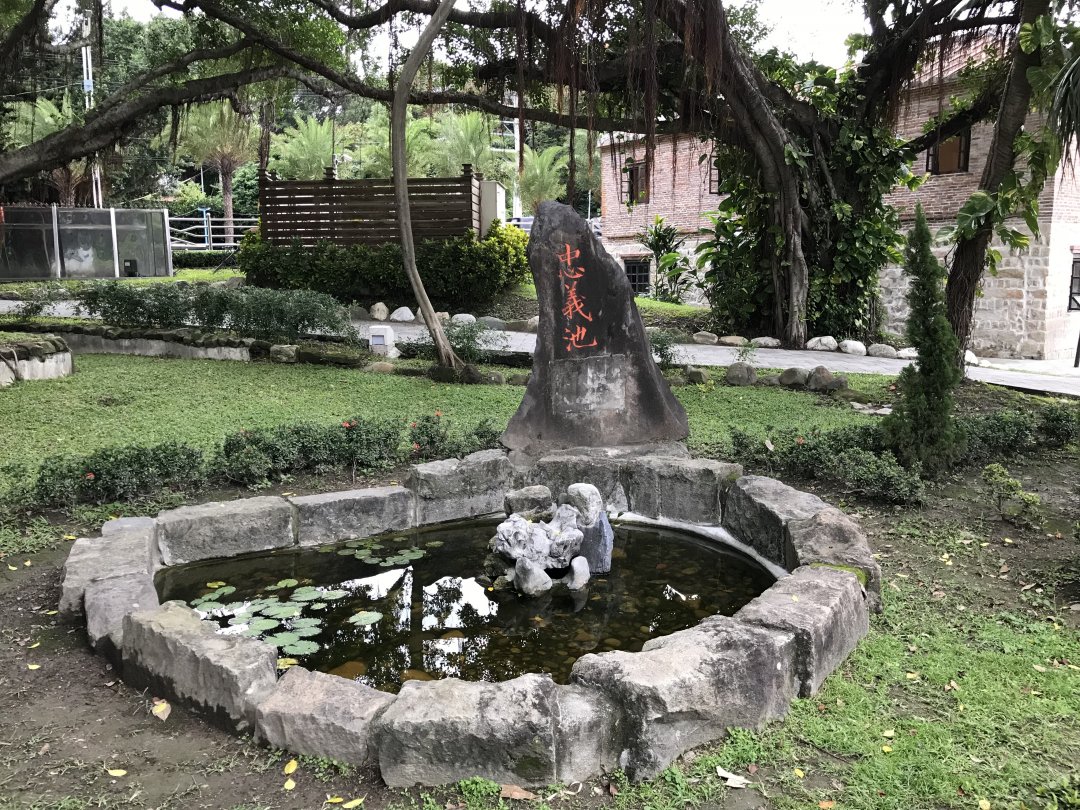
Since the military took over the Customs Wharf, several constructions were undertaken. The small pond at the entrance of the park area called "Zhong-yi Pond" represents the navy’s "Zhong-yi (loyal)" culture. There's a stone beside the Zhong-yi Pond with the words "The legendary dragon travels around." written on it, signifying naval presence as well as the history of a military take over.
A valuable and graceful banyan tree that has lived for half a century
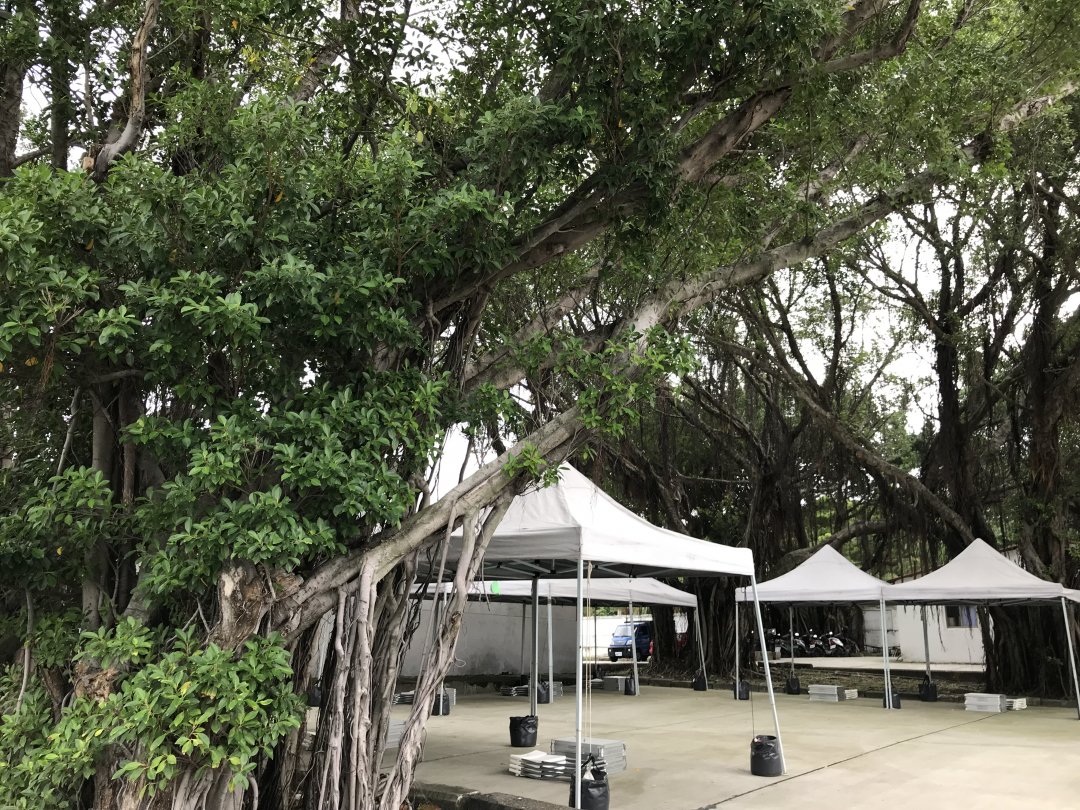
While walking along the Tamsui Customs Wharf, the first scenery that can be seen is the vast and beautiful Guanyin Mountain and Tamsui river. One of the best ways to enjoy the Customs Wharf is to sit and relax quietly under the shadow of banyan trees found along the embankment.
The banyantrees in Tamsui Customs Wharf are normally big and cannot be surrounded by only a few people. The flourishing trees are like attractive canopies and the branches extend out toward the embankment. During sunsets, the image of branches on the water is simply stunning.
A banyan tree has a shallow root that is good for the soil and groundwater conservation. It can also prevent wind-blown sand. Hence, it is ideal for planting along the seaside or river side and can serve as a windbreak. Since it is near the mouth of a river, the ground of Tamsui Customs Wharf is suitable for planting banyan trees. Apparently, many banyan trees were planted around the Tamsui Customs Wharf during the Japanese occupation.
The western embankment and hidden scenery of the Customs Wharf
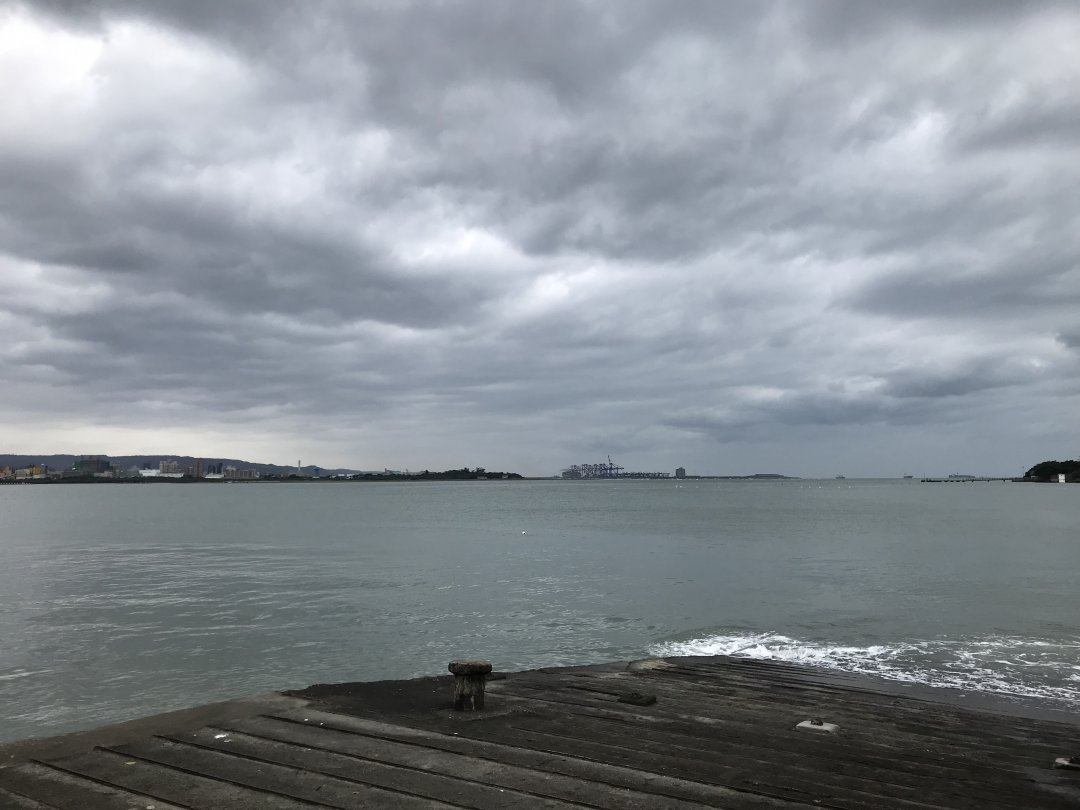
The current location is the western embankment of the Customs Wharf. The construction of this area started around 1901. It has a similar structure and materials as the eastern part, except for the mooring post, which is a concrete column. The construction was most likely built in a later period. The Tamsui Customs Wharf has a splendid view, overlooking the Guandu Bridge, Guanyin Mountain, Tamsui river mouth, and Taipei harbor. Furthermore, it is hidden in the trees and often ignored by visitors. Hence, this site is regarded as the hidden scenery of the Customs Wharf, which is known only to locals for its spectacular ocean view.
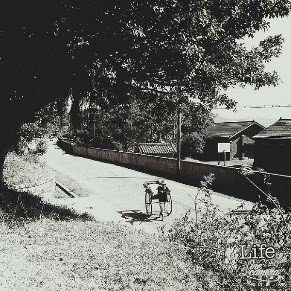
Years of military take over of the wharf
This photograph was probably taken in the 50's to 60's when the rickshaw was still around. The roads at that time had two lanes for traffic, and had yet to be widened to four lanes. The photographer who took the picture should have been standing beside the Fort San Domingo and on the road in front of the main entrance of the Animal Research Institute.
In the photo, western building A and warehouse B are clearly visible, and there's also a basketball stand commonly seen in military camps. The military once built a dormitory beside warehouse B, C but it has since been demolished and converted into a lawn for public use (i.e. picnic or leisure). Art exhibitions are also held for the public, so people can enjoy and take pictures.
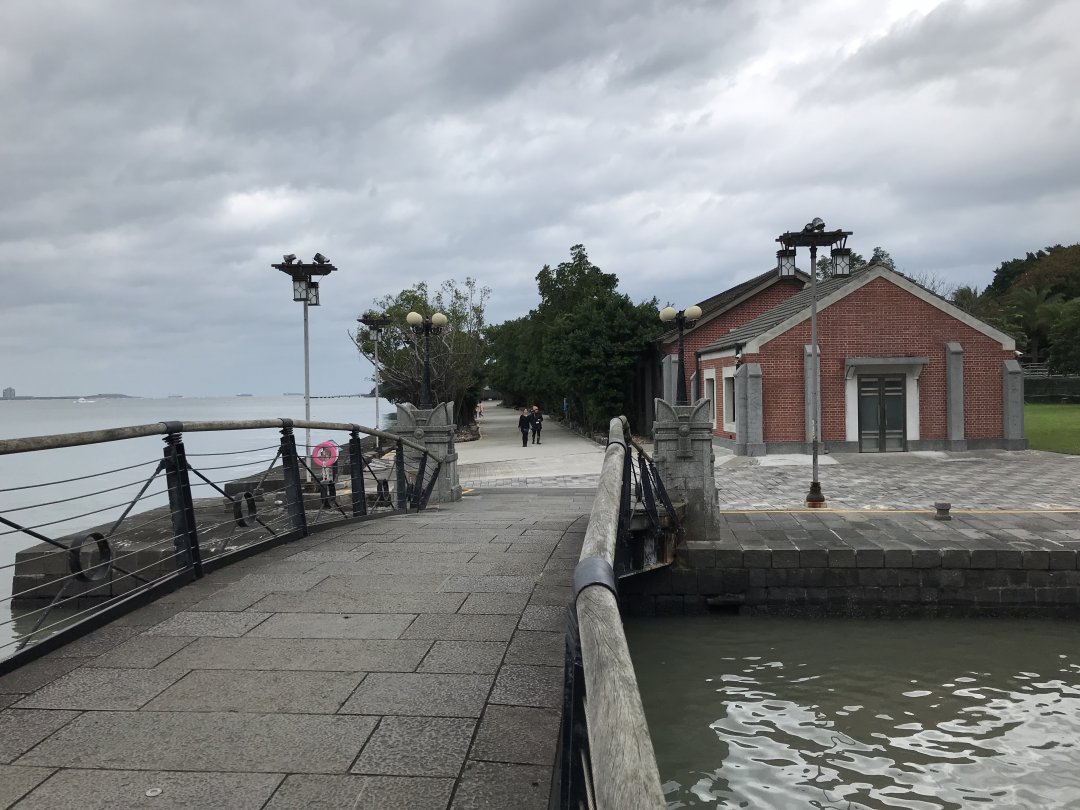
Warehouses during the Japanese occupation
The construction of the wharf started during the Qing dynasty and was completed during the Japanese occupation in the late 1920s, which established the wharf’s current appearance. In the area are two warehouses made of red brick walls, originally for storing goods. Inside the warehouses are wooden partitions, window frames and door frames with white paint outlines that create strong color contrasts. Both the walls and roof trusses are western style with simple structure and practical architecture.
The customs wharf is located at the mouth of the river, where the weather is normally humid and severe storm and heavy rain are strongly monitored. In case of high tides, there is a possibility of seawater intrusion. Before, goods stored in the warehouses were kept dry to prevent them from becoming stale and rotten. Vent holes inside warehouses B and C were made higher, making it difficult for heavier humid air to rise along the aisle where air flows internally from the outside. Despite sea waves hitting the outer vents, the water couldn’t easily flow into the warehouse. With the absence of air conditioner in the past, this was apparently a clever design made by architects.
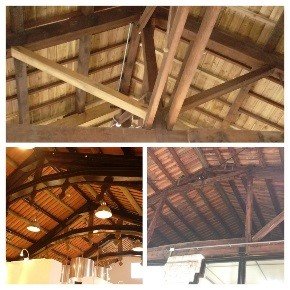
Features of warehouse roof trusses
A truss is a huge triangular structure that supports the roof and is commonly seen in the roof structure of western warehouses. Considering the building's storage function, a truss can enlarge a roof, and therefore expand the entire space of a warehouse.
There are three nearly hundred-year old warehouses with three different trusses in Tamsui. These are the warehouses of the Tamsui Customs Wharf (municipal historic relic), the former British Merchant (municipal historic relic), and Douglas Lapraik& Co. (commemorative building).
Warehouse B, C of the Customs Wharf (shown above) have King post trusses, i.e., pillars in a triangular structure. This kind of trusses is common in Taiwan, particularly in warehouses, assembly halls, and railway platform canopies built after 1920.
The Former British Merchant Warehouse (bottom right) has a Queen post truss, i.e., truss with double column in a triangular structure, found in its warehouse B and C.
The front building of the Douglas Lapraik& Co. Warehouse (bottom left), i.e., "The First Examination Site", has a wooden structure that resembles a Gothic style with unique and beautiful shape and additional features.