The Marine Museum of Art / Indifference From Marine Debris to the Marine Museum of Art
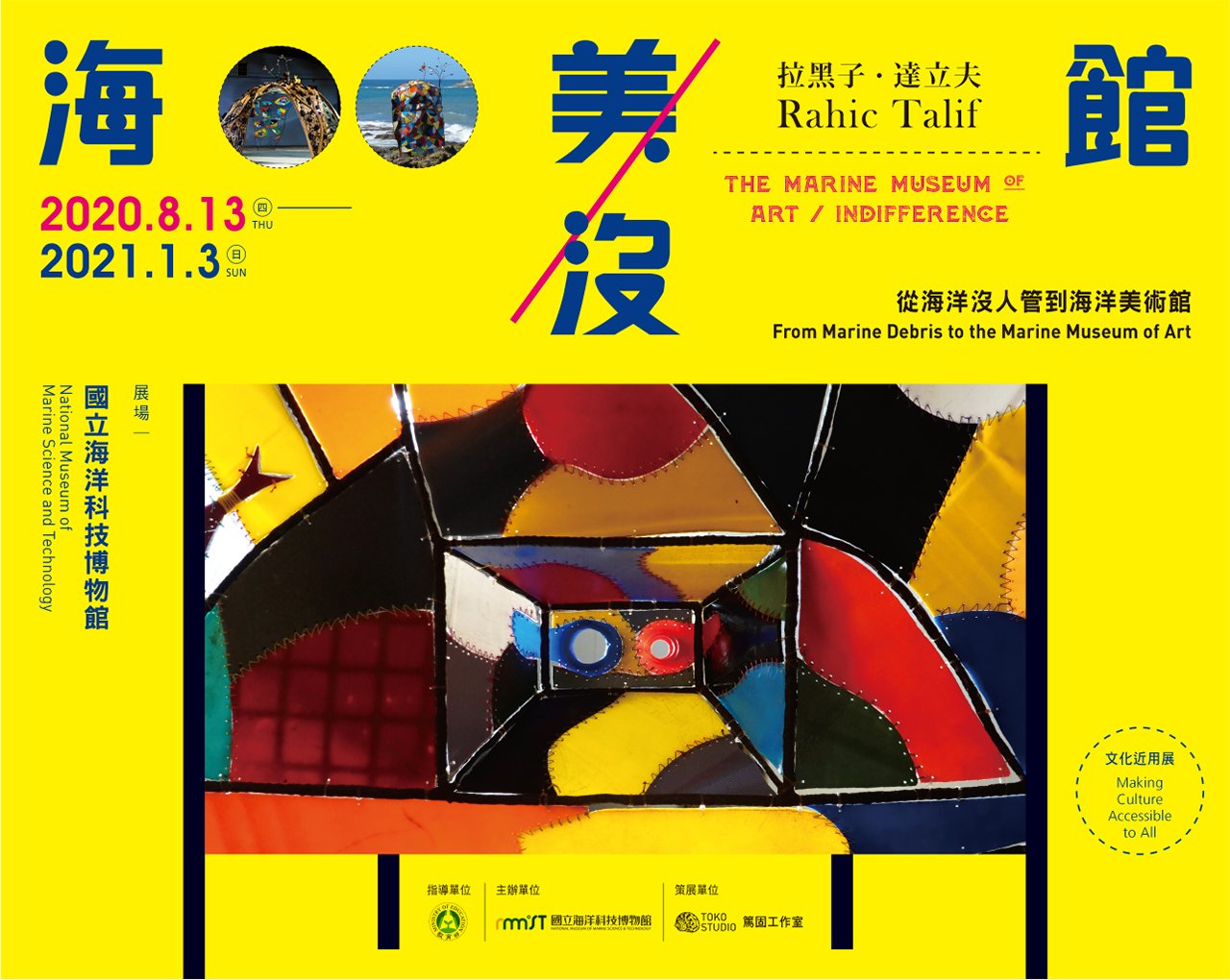
On this exhibition
Artist Rahic Talif was born in the Makota’ay Pangcah Community. His hometown is a narrow hinterland hugging the Pacific Ocean and bisected by the Siuguluan River. The inconvenience of transportation meant that Rahic’s home was among the last Pangcah communities to be modernized, maintaining relatively abundant traditional maritime knowledges. Thus Makota’ay Pangcah understand how to live in harmony with the ocean. The ocean remains an important subsistence resource for their community. Rahic has personally observed how both the natural environment and social structure has been transformed in a few short decades, as if in the aftermath of a typhoon.
To Rahic, making a living and learning lessons from the ocean is as natural as breathing. For millennia his people have drifted, following the Kuroshiro Current and other currents, moving along with the pulse of entire South Pacific. Their perception and logic have maintained this connection without interruption. Over the past 30 years, Rahic has kept the ocean as the core of his artistic practice as he engages in deep dialogues with the environment, culture, economy, values, and ethnic identification. The series of works Marine Museum of Art / Indifference—From Indifference to the Ocean to the Marine Museum of Art represents the crystallization of several years of thinking about the ocean in relationship to culture.
Although the transformation and degradation of the marine environment has influenced every facet of Indigenous life, Rahic attempts to narrate his maritime stories from another perspective. From amidst the grand narrative of marine history, he has gently taken the origin story of his people, describing for us how the first Pangcah ancestors saw the moon disappear into a cavern (the Moon Cave near today’s Shihtiping), as if guiding them to the coast of this small island where they would give birth to many descendants. And then, how the ancestors also erected a cluster of torches, and forming a shape like that of a pregnant woman’s belly, made the first clay pot, through which they declared that they had settled and brought forth all of the knowledge and wisdom of this land.
When the first ancestors arrived on land, they possibly exclaimed “Wata!” as they marveled to see the cave. The cave responded in its sacred, resounding echo. This pure sound embraced the ancestors fully. The cave thus became the font of all voices: all acts would be transmitted by that voice, which became infectious. Rahic takes these stories into his works, responding to the lifeways, forms, and phenomena that this land gradually nurtures. Perhaps they are not as dazzling as “civilization.” But they have a kind of purity.
This series of works created by Rahic over a period of several years includes works in driftwood, marine debris, found objects, and other media. All of these are items that the artist personally gathered from the beach, transforming them into a fusion of sculpture, installation, and mixed media works. Entering into these works, one can see where Rahic has written the names of fish, shellfish, aquatic plants, and places, inscribing many kinds of Pacific Ocean consciousness. To Rahic, we should no longer overlook the ocean. The ocean is both in his genes and a place that he reveres. Yet, there are still too many conflicts that arise here. In The Marine Museum of Art / Indifference Rahic hopes to explore the beliefs we hold. What is it that you truly believe? What does your spirit ultimately depend upon? It is true or not? If the truest thing to you is your everyday life, why do you feel no need to give back to the environment which sustains you?
The Artist
Rahic Talif was born in 1962 in the Makota’ay Pangcah Community, in Hualien County on Taiwan’s East Coast. Beginning with fieldwork on folklore, oral history, and historical sites in his community, he renewed his understanding of his community’s traditional knowledge. He has often led members of his community to participate in art events and exhibitions in Taiwan and abroad. For the past twenty years he has constantly engaged in self-reflection and has walked along the ocean countless times, gathering and employing natural materials full of life and memories, as well as objects that one can see along the beach, products of modern overproduction, as his materials. His works contain many characteristics of maritime culture and the traditional spirit of his people. Rahic is noted for the refinement of his clear sculptural lines and installations with an exacting language, through which he engages in dialectical thinking concerning globalization and the environment, explores the collapse of traditional social organization, and comments on conditions of social transformation. His works employ his own action and artistic practice to encourage his audience in self-reflection. Along the way, he has moved from exploring the possibilities of cultural interpretation for purposes of social criticism, thought, and representation toward a pure exploration of the essence of art.
In 2000, Rahic was Asian Cultural Council Fellow in contemporary art. In 2014, he was selected by the National Museum of Marine Science and Technology as a Marine Culture Artist. His representative works include the sculptural installations Modern Assembly (1993) and Ending Origin (1999), which sense origins through continued existence; works that concern the possibility of reconstituting Indigenous consciousness, such as Resetting (2000); works made in conversation with traditional ritual, such as Standing Dance (2005); and Remnant (2007), which explores both the weakness and strength of life force. Over the past ten years, Rahic’s works have made intimate connections with the ocean and island life, expanding his focus beyond Indigenous culture to ecological questions. These recent works include Typhoon Project (2008-2013), The Space of 50 Steps (2013-2018), and The Museum of Marine Art / Indifference (2018-2020). Meanwhile, he has documented the environmental and cultural transformations he has witnessed in the publications Makota’ay (2006) and Travels in the Space of 50 Steps (2019).
Works from the Collection of the Marine Museum of Art / Indifference: Jellyfish, Fish, and Stingrays
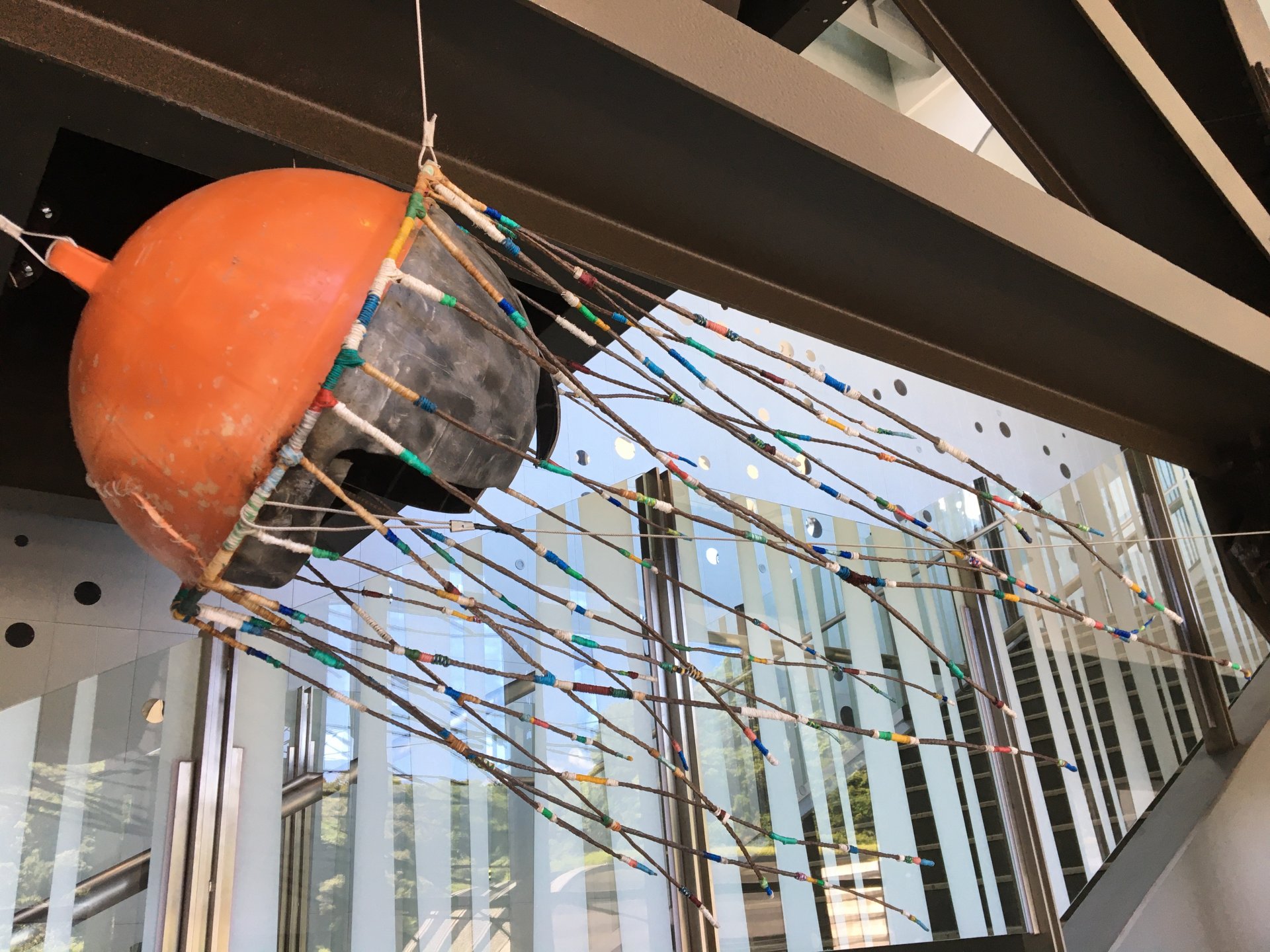
Traditionally, there was never a Pangcah word for garbage. Today, when referring to garbage, Pangcah use rakaw, a word that originally meant fallen leaves, weeds, and discarded items that couldn’t be burned, such as shells. In response, Rahic forms sea creatures from discarded nets, rebar, and plastic items that he collects from the ocean, in order to reflect on the habits of modern people who both take too much from the earth and discard things too readily.
Huge quantities of trash float in the oceans, coming in and out of visibility, as if they were a school of ocean creatures on patrol. Eventually, it is difficult for us to distinguish what is marine debris, as it has already melded together with fish and seagrasses. In the past, Pangcah knew the ocean as the back of their hand; the ocean was their most important food source, and they knew precisely which coral caves held lobsters or other edible creatures. Today, the ocean has become unpredictable and full of crisis. Yet the danger is not the fault of the ocean but of humanity. We can no longer predict the movement of fish schools because we do not know when the fish will be obstructed by marine debris, nor can we tell which reefs will be entangled in discarded nets.
The skeleton of these works have been constructed from discarded construction rebar scavenged from the coastline, and the bodies of these sea creatures from discarded fishing lines, nets, and fishing bobs. These discarded objects have lost their original purpose, yet the ocean has remained the same. Should fish mistakenly eat plastic or be entangled in discarded nets, what will be left for us to eat? These large scale models of fish become a kind of reverse creation or narrative. They capture the viewer’s attention through their colorful appearance and, when the viewer turns to look at the seafood on their plate, Rahic hopes that they will perceive their a deeper sense of the ocean.
Misacepo’
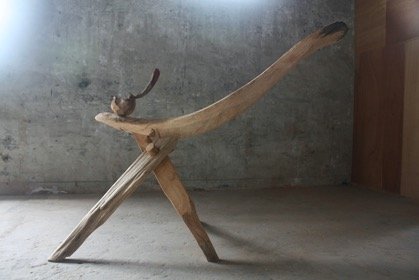
Misacepo’ is one of the most important rituals of Pangcah nations. In Makota’ay, this ritual is held in the beginning of May as the rice begins to send forth stalks. On the day before the ritual, the men’s age set organization goes down to the ocean to fish. Dividing up their labor according to their responsibilities in the age set organization, the men all gather at the ritual site and together express their gratitude to the Ocean God and to the gods of Heaven and Earth. They thank the abundant resources that the gods give to the people and ask for continued prosperity and peace for the coming year. During the misacepo’ elders guide the youth, giving them ocean teachings and diving skills, passing down knowledge of undersea landforms and the ocean’s wisdom. The youths learn reverence for the ocean, taboo and ceremony, thus continuing a way of life in close relatedness with the ocean.
This work abstracts from the structure and ritual implements of the misacepo’. Apart from its flowing sculptural lines which are characteristic of Rahic’s work, this sculpture was constructed from driftwood that Rahic personally carried from the ocean. This use of embodied labor of gathering material is an important component of Rahic’s artistic language. Work along the ocean provides opportunity for careful field observation; and the act of bending to touch the earth lets Rahic experience a closer connection with the larger world. In this everyday act of labor, he refines a unique sense of a Pacific Ocean aesthetic.
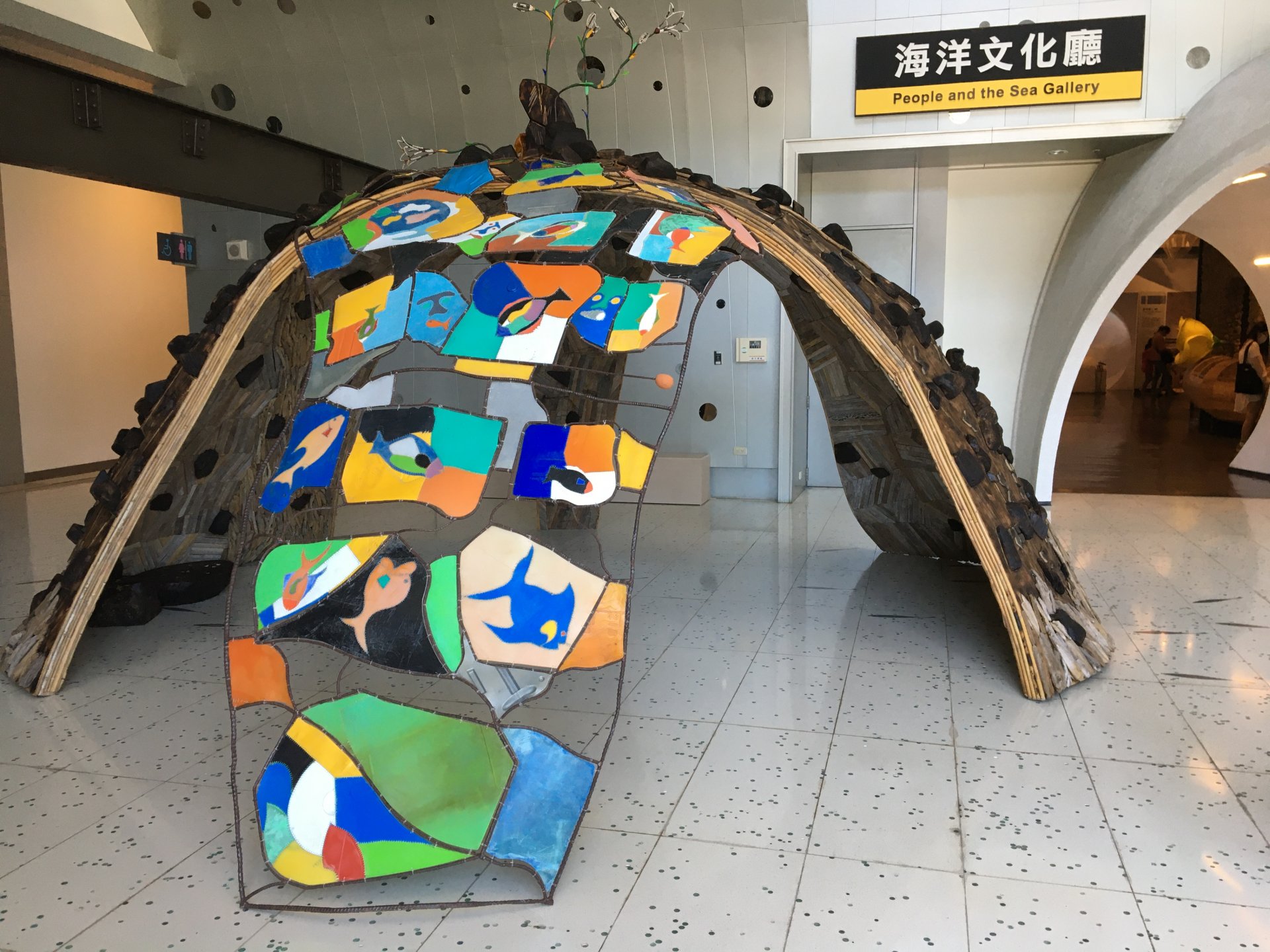
The Museum of Marine Art / Indifference: Gallery One
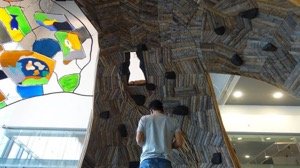
The Museum of Marine Art / Indifference: Gallery One relates how the original homes of humanity were seaside caves, from which people gradually developed their culture, ceremony, and social organization to become nations, eventually moving to live on the plains and in mountain forests. Everything began from seaside caves; thus, many languages, ceremonies, and cultural forms from the past are inscribed in these caves, where artifacts such as clay pots, stones, and shells may be found. These artifacts remain in the caves but did not exert much influence on the environment. However, in the past several decades, at most a century, the everyday objects we have produced—Rahic calls these “beautiful objects”—have caused serious pollution along the entire ocean and its tidal zones. This contrast reflects how people in the past, including the ancestors of those who live on Taiwan today, revered the Pacific Ocean and respected many taboos concerning it. However, this way of living with the ocean has been forgotten. As he works along coastline, Rahic has gathered so much marine debris; and yet, no one notices. People feel indifference. Thinking of this coincidence, Rahic puns “Fine Arts” and “Indifference” to name his Museum.
Museum: Gallery One responds to the many wave-cut caves along Taiwan’s Pacific Coast. The structure is made from driftwood and bamboo, combined with sea plastics and other commonly seen marine debris. Archaeological finds such as clay pots and stone axes are installed together with discarded plastic toys in Rahic’s finely crafted cave, producing an ironic juxtaposition. Piecing together sea plastics as if they are components of a cathedral’s sacred stained-glass window, and placing these mosaics throughout the installation, Rahic’s Museum touches on the environmental problems facing coastal communities.
In the distant past, the ancestors of Rahic’s nation carried jadestones from Hualien and sailed outward, transporting their tremendous craft and knowledge across the ocean. But today, the Pacific Ocean still carries on its currents products from all over the world: Chinese manufactured flip flops, plastic Japanese dolls, Korean buoys, and goods from Southeast Asia. These objects make us realize that we have not been separated even a single day; the ocean connects us. They also incite us to thought. What are the messages that we are transmitting to each other?
When one walks into the sculpture’s interior, one sees that Rahic has inscribed intricate letters which resemble a code. These signs document the names of coastal fishes, shellfish, plants, toponyms, and the names of people. Each of these names holds rich connotations, the vast knowledge of the Pacific Ocean. They await the audience to enter, listen attentively, and interpret.
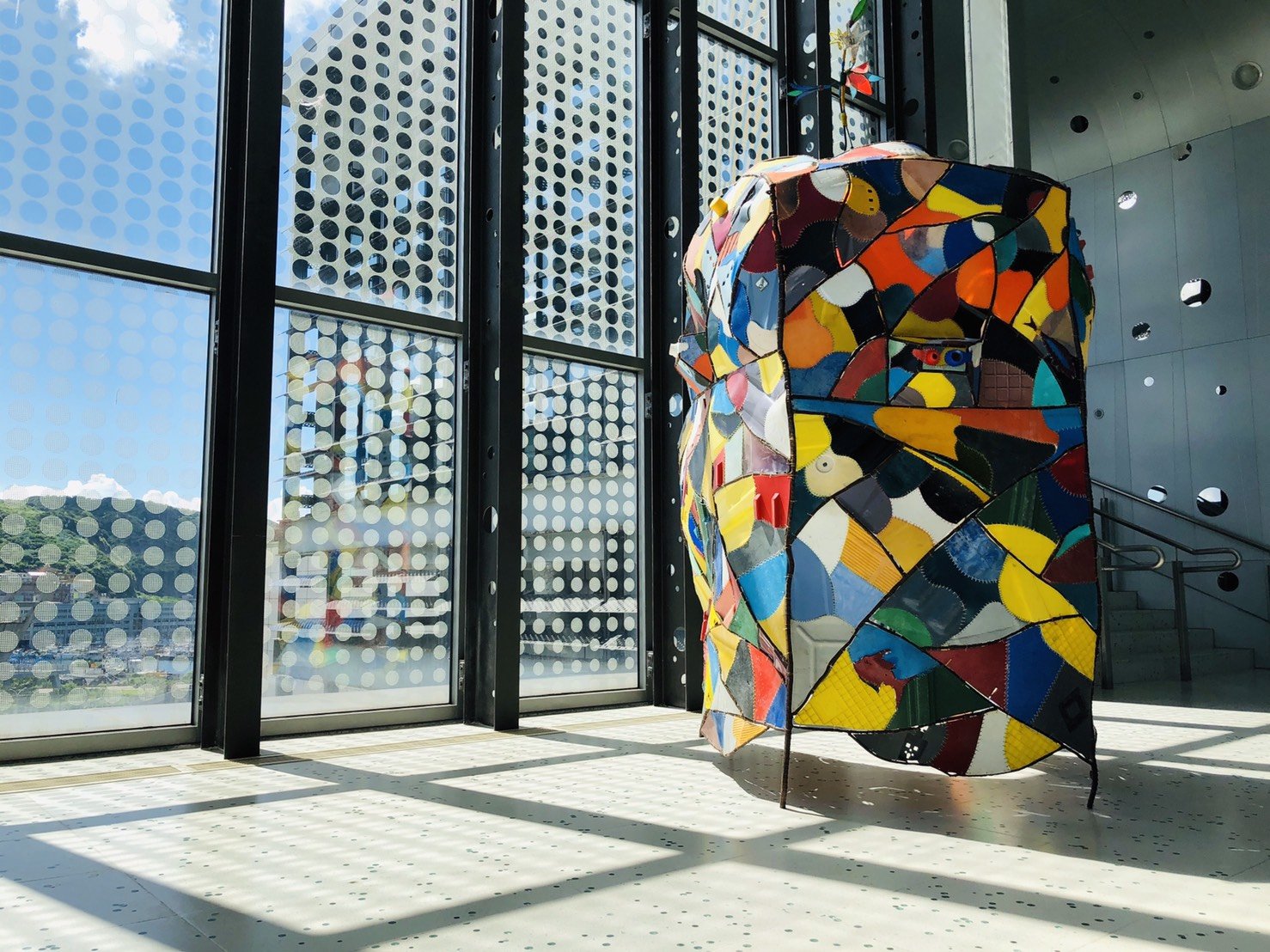
Museum of Marine Art / Indifference, Gallery Two
The works in Gallery Two extend the creative vocabulary of those in the “Museum of Marine Art / Indifference Gallery One” to show the cultural transformations of the Makota’ay Pangcah Nation. While the caves in Gallery One concerned cultural beginnings, the bunker like structure in Gallery Two is a product of Pangcah encounters with so-called “civilization.”
Before the arrival of colonial governments, Indigenous people never built structures like this bunker. Pangcah had no distance from the ocean. But “civilization” reiterated that there needed to be defensive structures along the coast, to repel an enemy invasion. Still, Pangcah never had thought of protecting themselves this way. The bunkers had an almost sacred quality. One was forbidden to draw near to them. When civilization maintained these structures, it fenced itself about with restrictions and limited people’s access to the ocean; however, once civilization loosened its hold on the ocean, the bunkers became ruins and accumulated garbage. Standing at attention all along the shoreline, some bunkers filled with the lapsed obsessions of those who governed, but most with a sense of being at a loss about the future.
In this set of works, Rahic expresses the alienation and barrenness behind civilization. Turning the decaying bunker into a museum of marine art Rahic hopes that the structure, bearing the weight of local customs and conditions and transcending the oppositions of language and culture, might let all of us who depend upon the ocean no longer live divided, lacking a common language to face our common history. Once we have transcended language, we will all stand here, using the ocean’s vocabulary as our common tongue. Then, together, we will be able to confront the enormous pain that the ocean bears.
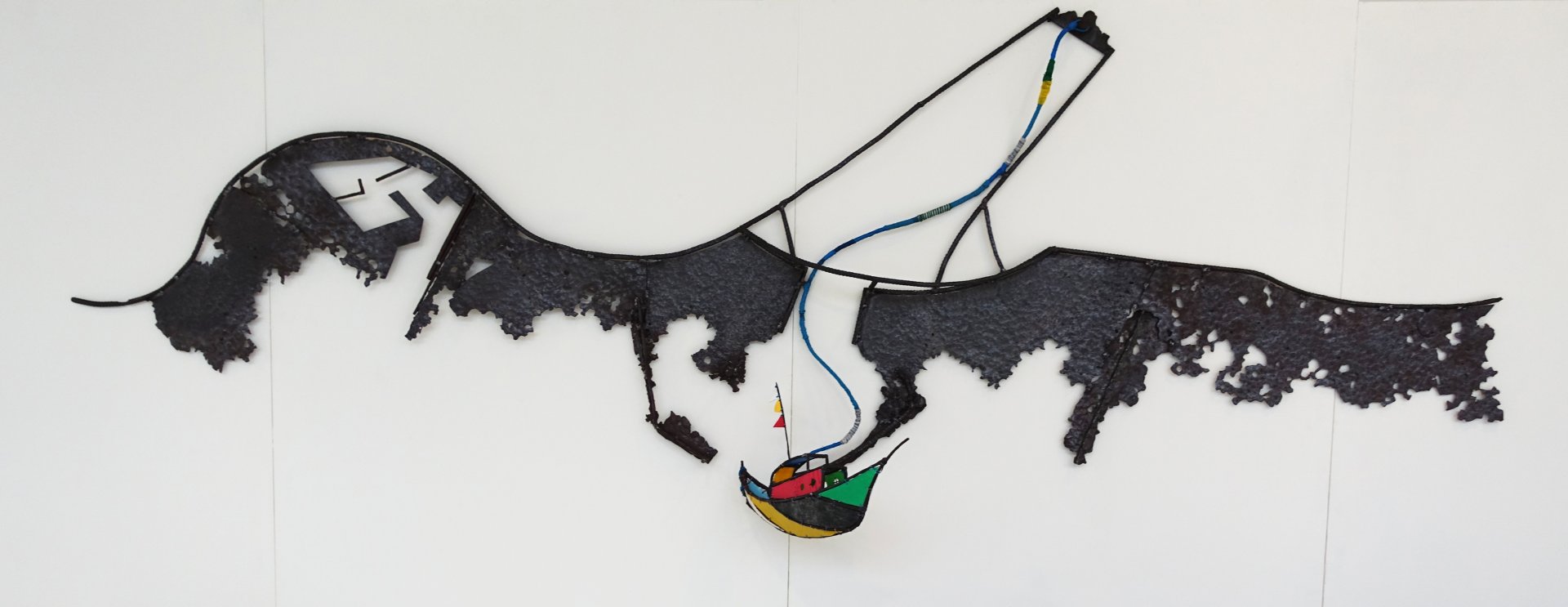
Northeast Cape
Special version (those with visual impairment may experience this piece through touch)
Every village or community has its own distinctive set of lines. As we travel up and down along them, we begin have a unique tactile sense of this land. In his creative process Rahic has spent much time along Taiwan’s various coastlines and even the coasts of Southeast Asia, the Philippines, Indonesia, Japan, Korea, and China. Continuously walking and gathering along these coastlines, touching them in his stooping over to labor, he develops a connection with each place, which guides him as he sculpts pieces that display his sense for the land. This is Rahic’s fieldwork; it is also a ceremony of recognizing locality.
This piece is the outcome of fieldwork on Taiwan’s Northeast Cape, in the environs of the Marine Science and Technology Museum. Extending Rahic’s creative vocabulary to the Northeast, it documents old place names, transforming them into the art work. This work lets us touch different materials, including mud encrusted rebar, plastic, fish nets, everyday objects, natural sand, and rocks—among other materials. Rahic has employed these materials to create a relief map of the Northeast Cape. Rahic entwines discarded steel rebar with fibers salvaged from discarded nets that he has collected along the Pacific Coast to convey the symbiotic relationship between Indigenous bodies, handicrafts, and the ocean. In order to highlight this physical connection, Rahic invites visitors to close their eyes and, with him, to use their hands to develop a tactile knowledge of the land.