Museum of World Religions

The vision behind the Museum and its mission
Through exhibitions on world religions, Master Hsin Tao of Ling Jiou Mountain Buddhist Society founded the Museum of World Religions to advocate the concepts of “respect, inclusion, and universal love”. After a preparation phase spanning a decade, the Museum of World Religions was inaugurated on November 9, 2001. The museum display was designed by the famous U.S. museum design firm Ralph Appelbaum Associates. Moreover, Dr. Laurence Sullivan and his team at the Harvard University Center for the Study of World Religions were also invited to finalize the content and research regarding the religions. The international teams collaborated to establish the world’s first museum for the ten major religions in Taiwan. The exhibition area in this museum is distributed across two floors, covering over 695 square meters. In addition to hosting permanent religious exhibitions, the museum introduced the Children’s Hall in 2005 to focus on the theme of life education. Also, special themed religious exhibitions are curated each year.
【Indra’s net】
The image on the dark blue ceiling depicting a net of stars surrounding the Milky Way is one of the theme concepts of the museum. It is called "Indra’s Net". This image is derived from the "Avatamsaka Sutra", a Buddhist text, in which the whole universe is depicted as an endless net that contains a shining crystal at each knob. Each crystal reflects the entirety of all the other crystals, which means that each and everything is deeply interconnected and interdependent. The human heart is also like this crystal, and when it radiates love and kindness, the world becomes peaceful and beautiful. This theme of interconnectedness is highlighted throughout the Museum.

The keys of the heart
When you exit the elevator on the 7th floor and lift up your head, you see the proverb " The doors to goodness, wisdom and compassion are opened by the keys of the heart” written over the entrance to the hall. This saying stems from the fourth patriarch of Chinese Chan, Master "Dao Xin ". It means that even though there are different practices and different religions in the world, their common origin lies in the human heart.

Water Curtain Wall
Natural elements, such as water and fire, are often used as a medium for cleansing and transformation. In many religions, "water" is used for ceremonial practices symbolizing the purification of body and mind. The purification of your body and return to your original pure mind is an important preparation before a pilgrimage. Therefore, before entering the exhibition area of the Pilgrim’s Way, close your eyes, touch the water gently with your hands, and then press your hands down on the water wall to experience the feeling of your heart becoming purified.

Pilgrim’s Way
Pilgrimage is an important ritual in many religions, as for example the pilgrimage to Mecca in Islam, or the kneeling of Tibetan Buddhists along the way to the Potala Palace. You may wonder what kind of power it is that brings forth so much devotion and persistence in people of faith? You may also want to pay attention to the floor design, which symbolizes the entire journey of the experience: the rough surface at the start becomes gradually transformed into smooth ground, describing the pilgrim's state of mind, from hardship to peace and joy. Oh! If you find this out yourself, you're on pilgrimage! But you're not alone, because on this pilgrimage to the Holy Land, along the left wall, you'll see many pilgrims of different religions walking together with you. The echoing sounds of the walkway, as well as the intermittent projection of Chinese and English sentences on the colonnades, remind you to reflect on the meaning of life and the value of life while you are on the pilgrim’s path.

Handprint wall
Do you see the black thermal sensor wall in front of you? We call it the hand-print wall. Press your hand on the wall for about ten seconds, and the heat sensor will leave your palm print on the wall. The seal usually represents a promise or hope. People of faith left their hand prints in the most sacred places of their religion as a tangible memory of their presence there. The color and depth of the handprint fades with time, which reminds us that our life is also changing, sometimes even very suddenly. Therefore, should we not cherish our life as much as possible now?

Golden Lobby
After the pilgrimage, you arrive at the resplendent and heaven-like Golden Lobby. For thousands of years, human beings have imagined all kinds of things about the stars. Different religions and cultures have produced different interpretations of the stars and told different stories about them. The starry sky above the Golden Lobby overlooks the realm of many different cultures and religions. The cosmograph on the floor is patterned after the labyrinth on the floor of the Chartres Cathedral in France. In the Western tradition, walking through a labyrinth symbolizes the pursuit of truth. You can carefully observe the symbols and colors of the figures in the labyrinth. They have their own symbolic meaning and also reflect the concept of time and space. Take time as an example. As the Book of Genesis in the Bible tells it, God spent six days to create Heaven and Earth and then rested on the Shabbat, the seventh day. This story is at the origin of our "seven day week". The small circular patterns on the floor represent the different week-day deities worshipped by different religions. With regards to space, ancient China determined the four directions of East, West, South and North based on the observation of the sun, moon and stars. The Green Dragon (on the left), White Tiger (on the right), Red Sparrow (in front) and Black Tortoise of Taoism can be found in the innermost circle of the floor. From the innermost circle to the outside, we can also see the symbols of Christianity and Buddhism, among others. In addition, the oval space design of the Golden Hall, shaped like the human eye, invites you not only to enjoy the rich collection by looking at it, but also to open the eyes of your heart to these rich experiences of being in the world. As a result of it, you may want to know about the similarities between the different religions? You’ll find the answer on the two pillars of the Golden Hall. There you can find "Love" and "Peace". “Love is our common truth” and “Peace is our eternal desire ". Spreading Love and Peace is also the purpose behind the creation of the Museum of World Religions by Dharma Master Hsin Tao.

Creations
The Creations is a 101 seat theater space, which regularly plays films about the universe, the world and the origin of human civilization. Please come and take a look at the different religious myths and stories about the beginnings of Heaven and Earth. Before the development of science, human beings resorted to myth and stories as their way of explaining the functioning of the universe and the life cycle. They attempted to answer questions about the creation of the world, the origin of life and the world after death through myths, which for them, reflected the truth. You will find that creation myths from different cultures have a quite high degree of similarity, such as for example the myth that the world has been destroyed several times, or the disaster of the flood, etc. At the end of the film, you will hear the sound of a baby's heartbeat, which symbolizes the beginning of life.

Hall of Life’s Journey
Step down to the sixth floor of the Hall of Life’s Journey, which is subdivided into five areas: Birth, Coming of Age, Mid-Life, Old Age, Death and Afterlife. Each of these areas introduces you to the different life ceremonies employed by the various religions to mark and celebrate these Step down to the sixth floor of the Hall of Life’s Journey, which is subdivided into five areas: "Birth", "Coming of Age", "Mid-Life", "Old Age", "Death and Afterlife". Each of these areas introduces you to the different life ceremonies employed by the various religions to mark and celebrate these Stages of Life. Pay attention to the many circular designs in this hall. The circle on the ground represents a cell. Life has evolved in a long process from the most primitive cells to today’s civilization. The size and height of the round display cabinets varies within the Journey of Life. The whole exhibit lets you explore religious ceremonies and traditions, as well as cultural relics, costumes and sculptures pertaining to each important stage of life. In addition, you can explore each stage even more deeply by paying attention the wooden benches. The different types of wood have different symbolic meanings, which are explained in the labels on the benches.

Birth Area 01
【Birch Wood Bench】
A birth is the emergence of a new life, representing hope and boundless possibilities. The bench in the Newborn Area is made of Birch Wood. The birch tree is the first tree to grow in the wilderness, indicating the “cultivation” of a forest. The birch tree also signifies abundance and fertility, and is frequently used to make cradles to symbolize a new beginning and journey.
【Zhuazhou Cremony (Korean)】
In the Birth Area, the film mainly introduces the blessing rituals offered to newborns and young children in various cultures around the world, such as naming ceremonies, the Zhuazhou ceremony – a ritual held at a child's first birthday -, baptism, circumcision, etc. These rituals of life conducted in accordance with religious or local culture express the joy of birth, blessings, and wishes for health and longevity. The Korean version of the Zhuazhou ceremony shown in the video is also a tradition shared by Chinese communities. Usually held around the first birthday, the object randomly grabbed by the child is used to make predictions of their future.
【Jewish Circumcision Knife】
Usually performed by a mohel wearing a prayer shawl, the Jewish rite of circumcision is performed on an eight-day old baby boy. The baby is held by a sandek on his lap, while the baby’s father recites prayer. After the procedures, the mohel announces the name of the baby in Hebrew, which will be used during the Bar Mitzvah (coming of age ceremony), wedding, and on the tombstone. Dating back to the time of Abraham, the ritual of circumcision signifies the baby becoming a child of God. On the lower part of the screen, a Jewish circumcision knife is placed inside the artifact cabinet. All of the tools and costumes used in the ceremony represent various types of good fortune, which are detailed in the following descriptions of artifacts. The decorative patterns convey the boundless expectations and blessings for the newborn from the family, the community, and the entire culture.
【Baptismal Shell】
In the final part of the video, you will also be able to observe a Catholic baptism ceremony. The priest holds a baptismal shell to pour holy water on the head of a newborn, giving them blessings and fortune. This also signifies the baby becoming a child of God. Also shown in the lower artifact cabinet is the beautifully designed silver baptismal shell, which also holds important religious connotations. According to legend, Jesus was baptized in the Jordan River with a shell by his older cousin John the Baptist, so the shape of a shell represents the divine blessings of Jesus. The baptismal shell is usually given to children by their guardian as a gift to celebrate the rite of Christian initiation. The back of this baptismal shell is engraved with the initials of the original baptized person, M.R.S. In accordance with Catholic tradition after baptism, a baby is given a middle name after one of the saints in the Bible as a religious blessing and guidance for life.
【Chinese Children’s Shoes (Tiger-Head Shoes), Tiger-Shaped Bib】
Also in the artifact cabinet are traditional Han tribal tiger-head shoes and tiger-shaped bibs. Tiger patterns on baby clothing symbolize power and good fortune, capable of warding off evil spirits. Tiger shoes are meant to help children walk upright without falling. The adorable designs and delicate sewing are usually done by the mothers to demonstrate their love for their children in hopes that they will grow up happily.

Birth Area 02
【Catholic Baptismal Robe】
Two white-colored baby clothes in the cabinet are Catholic baptismal robes. The one with a long dress and a white hat is a baptismal robe from Ireland. The other baby baptismal robe from Taiwan is embroidered with a red cross and a dove. Even though the robes are styled differently depending on the culture, the white color is used to express God’s blessing through baptism to bring good fortune for newborns.
【Torah Binder】
Another artifact in the cabinet is a Torah Binder, a piece of cloth used for wrapping the Torah, the Jewish book of laws. The tradition originates from German Jews around the 17th century. Originally, it was cloth used for swaddling the baby for the circumcision ceremony, which is then made into long strips by the mother or grandmother after the ceremony. They would draw or sew the baby’s name, date of birth, and patterns of the Torah scroll or the zodiac signs, as well as their expectation of the child in the future on the strips . This is an important object commemorating the birth, often preserved until the bar mitzvah held when the boy reaches the age of thirteen, when the cloth is used for wrapping the Torah.
【Miao Baby Carrier】
Across various traditions and cultures, there are ceremonies conveying blessings to a newborn from the family and the community. For example, another item in the display cabinet is a baby carrier from the Miao Tribe for use by mothers. In the Miao culture, the making of the baby carrier starts when the women are young teenagers. Their carrier becomes an important tool when they begin to take care of young children. The Miao tribal women demonstrate all of their ingenuity and creativity in the making of the carrier, using special techniques for cloth spinning, weaving, dyeing, drawing, knitting, picking, and embroidery to design their own unique carrier. The main composition is a diamond pattern paired with complex floral designs, and embroidered with many traditional motifs, including geometric patterns, the religious swastika pattern, fret patterns, flowers, animals, and figures. In the orderly aesthetic of geometric patterns, the application of floral designs add to the layered look that is full of creativity and attention. A baby carrier represents a mother’s love and expectation for her children, hoping that they can enjoy a happy and blissful life. Sometimes, a Miao tribal woman makes a carrier based on their own waist wrap. This artifact is a carrier made with a waist wrap, with symbols and diagrams representing infinite tribal blessings.

Coming of Age Area01
【Ash Wood Bench】
Growing up is a phase of learning, during which a person leaves their family and enters society, learning to establish relationships with other people while cultivating their independent characteristics. In the Coming of Age Area, the bench is made with ash wood. In ancient Norwegian mythology, connecting Heaven, Earth, and Hell was a giant ash tree named “Yggdrasil”, which was used to make the first human. Ash trees symbolize blessing and expectations for the young people that bear responsibilities for the world. Presented in the Growth film are various rite-of-passage ceremonies of different cultures, performed during various stages of growth for children and symbolize what they need to learn during the growth stage, including responsibility, commitment, and caring for others.
【Bar Mitzvah】
For example, Jews believe that boys need to obey the commandments once they reach the age of 13, and the Jewish rite of passage ceremony “bar mitzvah” literally means “son of commandments”. In the middle part of the video, you will see a bar mitzvah held at the Western Wall of Jerusalem for young men, who are wearing tefillin - a small leather box containing scrolls of parchment inscribed with verses from the Torah - on their head and arm along with a white-striped prayer shawl on their body while they recite the scriptures. The items worn during the ceremony symbolize personal commitments to follow religious commandments. After the ceremony, the young teens become responsible for their own behaviors.
【The First Dance (Inuit)】
In traditional tribal culture, the coming-of-age ceremony is an important occasion to pass on the history and cultural values of the tribe. For example, near the end of the film, the feather-fan dance performed by the Inuit girl is a ceremony of “the first dance”, signifying that the Inuit girl officially became part of the society. The ceremony is usually held just before puberty, though there is no age limit. The new dancer must learn designated movements and wear clothing and deer-skin shoes made by their grandparents or parents. Holding fans made with the feather of birds, they perform the dance in the presence of friends and families, and officially become a member of the Inuit society.
【Taiwanese Heavenly Contract】
In the round artifact cabinet, you will see a heavenly contract, which is based on a folk belief in Taiwan called “Qiniuma”, the seventh fairy in the mythical story of Niulang and Zhinu and the patron saint of children. In ancient times, children were brought in front of the deity after their first birthday. A contract is set up naming the Qiniuma deity as a godparent and protector of the children. The godparent contract is an expression of the parents’ love and expectation of their children. When children reach the age of 16, they return to the temple with many offerings to give thanks. They also crawl under the Qiniuma sedan chair to symbolize their independence after reaching adulthood, and to show gratitude for the protection they received from the deity. Another item in the display, the five-color necklace, is worn by young women of the Maasai Tribe, a semi-nomadic people living in eastern Africa near the border of Kenya and Tanzania. They are fierce warriors and outstanding shepherds.
【Young Masai Woman’s Necklace】
Young Masai girls begin learning various life skills starting at the age of ten, including cooking, farming, and sewing. They would sit with friends and sew glass beads on leather using metal or animal tendons, to make beautiful earrings or necklaces to adorn themselves. Adult Maasai women are thus known for making beaded decorations, and the pattern and colors of beads are unique to each tribe and individual. As a craft that represents the tribal heritage and culture, it is a skill each Maasai girl must learn while growing up.

Coming of Age Area02
【Christian First Communion Attire】
This white-colored ritual costume is worn by Catholic children around the age of seven, during a ceremony when they receive the Eucharist for the first time. The Eucharist consists of unleavened bread and grape wine that symbolize the flesh and blood of Jesus. During the Last Supper before Crucifixion, Jesus shared bread and wine at dinner with his disciples, inviting them to take, eat and drink, telling them to do this in his memory, and assuring them of his abiding presence whenever they would do this. More than two thousand years after the crucifixion of Jesus, Catholics continue to receive the Eucharist from the hand of the priest during Mass. For the faithful it means that Jesus is present with them, which is also an important part of the Catholic faith.
Before the ceremony, to receive the first Eucharist, Catholic children must first learn about the religious meaning of the Eucharist before the church schedules the ceremony. On this day, the parents joyfully prepare white clothing for the children, including a white suit for boys. White is the color of purity and cleanliness, and the color worn for important ceremonies including baptism, the first reception of the Eucharist, the confirmation, and wedding. The clothing and items worn during the first Eucharist reception are kept and treasured by the family until the child grows up or until their old age, becoming an important part of their religious life.
【Shinto 753 Festival Attire】
Another garment, a kimono, is a traditional costume prepared by Japanese parents for their children during the Shichi-Go-San Festival, which is a ceremonial blessing for children when they reach the age of three, five, or seven. It is usually held when girls are three years old and seven years old, and when boys are five years old. Boys also begin to wear a formal kimono during the festival, symbolizing that the child has grown enough to pass on the heritage and learn family and cultural traditions. During the Shichi-Go-San Festival on November 15, parents will dress up their children in traditional Japanese clothing. They bring the children to a Shinto shrine nearby to pay respect to the family patron saint or local deity, praying for special protection and a lifetime of happiness and health. In addition, parents will give their children a gift of “Chitose” or thousand-year rice candy, as a wish that they will live for as long as a thousand years.

Mid-Life Area 01
【Cedar Wood Bench】
At Mid-Life, a person enters society and family. We may be hard at work, but we also need to take care of our parents. Many people also get married and establish their own families, working hard at raising the next generation. Individual responsibilities also tend to increase in Mid-Life, as well as an increasing awareness of the meaning of life. Commitments and introspection are important life lessons in mid-life, which is presented on the cedar bench. Cedar trees symbolize a faithful lover in China, divinity in Nepal, and consecration in Christianity. Cedar is also used to make dowry for newlyweds, symbolizing recovery, purification, and protection. The film and artifacts of the Mid-Life Area present wedding rituals of different cultures, conveying individual promises to the family. There are also images of pilgrims that display individual introspection, self-awareness, and spiritual awakening and growth.
【Praying to the Ganges River in India】
For example, prayers on the banks of Ganges River in India convey the deep connection between the life and religion of Indians. As the holy river of Hinduism, the Ganges River is worshipped as the goddess of Ganga. Pilgrims would bathe in the river to cleanse themselves or meditate by the river, or fetch some river water in the morning and present it along with offerings to riverside shrines.
【Traditional Kekat Dance in Bali】
In addition, in front of the temples in Bali, topless men line up in a circle, wearing only unique Bali sarongs. They sit in a lotus pose, while performing the traditional Kekat dance that narrates the story of the Hindu epic Ramayana, displaying the courage and wisdom of Prince Rama, who fought against the evil King Ravana to protect his country and lover.
【Eastern Orthodox Church Headdress】
An Orthodox wedding crown is displayed in the round cabinet. The Eastern Orthodox Church is a Christian faith that spread to Eastern Europe and Russia. A wedding takes place in a church, where the priest performs the sacred wedding vows. The color white, signifying religious purity, becomes an important symbol in weddings. Traditional crowns made with fresh flowers were difficult to preserve, so most modern crowns are made with white beaded flowers. A satin sash is used to connect two crowns, which are placed at the altar at the wedding. After a prayer segment, the priest places the crowns on the heads of the groom and the bride, then exchanges the crowns before removing them to place on the altar again, all the while reciting blessings, prayers and chanting during the process. The connected crowns symbolize the commitment of the couple becoming one.
【Hindu Holy Rope and Sindoor Box】
In Hinduism, a red cotton string called the “Holy Rope” is used to link the newlyweds together, symbolizing an eternal connection between the two. The groom sprinkles a dash of Sindoor on the bride’s hairline to represent the love between the couple, as a prayer for an auspicious long marriage.
【Garment of Consecration (Ihram)】
The cabinet also contains a white Islamic pilgrimage Ihram garment. During a pilgrimage, the Ihram clothing is made easily with two seamless large white cloth, symbolizing letting go of worldly desires and ornaments. Entering the Kaaba, pilgrims wear Ihram as a symbol of equality before Allah. Healthy Muslims will make a pilgrimage to Mecca, called Hajj ,at least once in life. In the video, you will see the black color Kaaba in the center, surrounded by the image of pilgrims wearing white Ihram. In the twelfth month of Islamic calendar, about two million pilgrims arrive at Mecca for the Hajj every year. It is an important religious commitment for every adult Muslim to complete once in life.
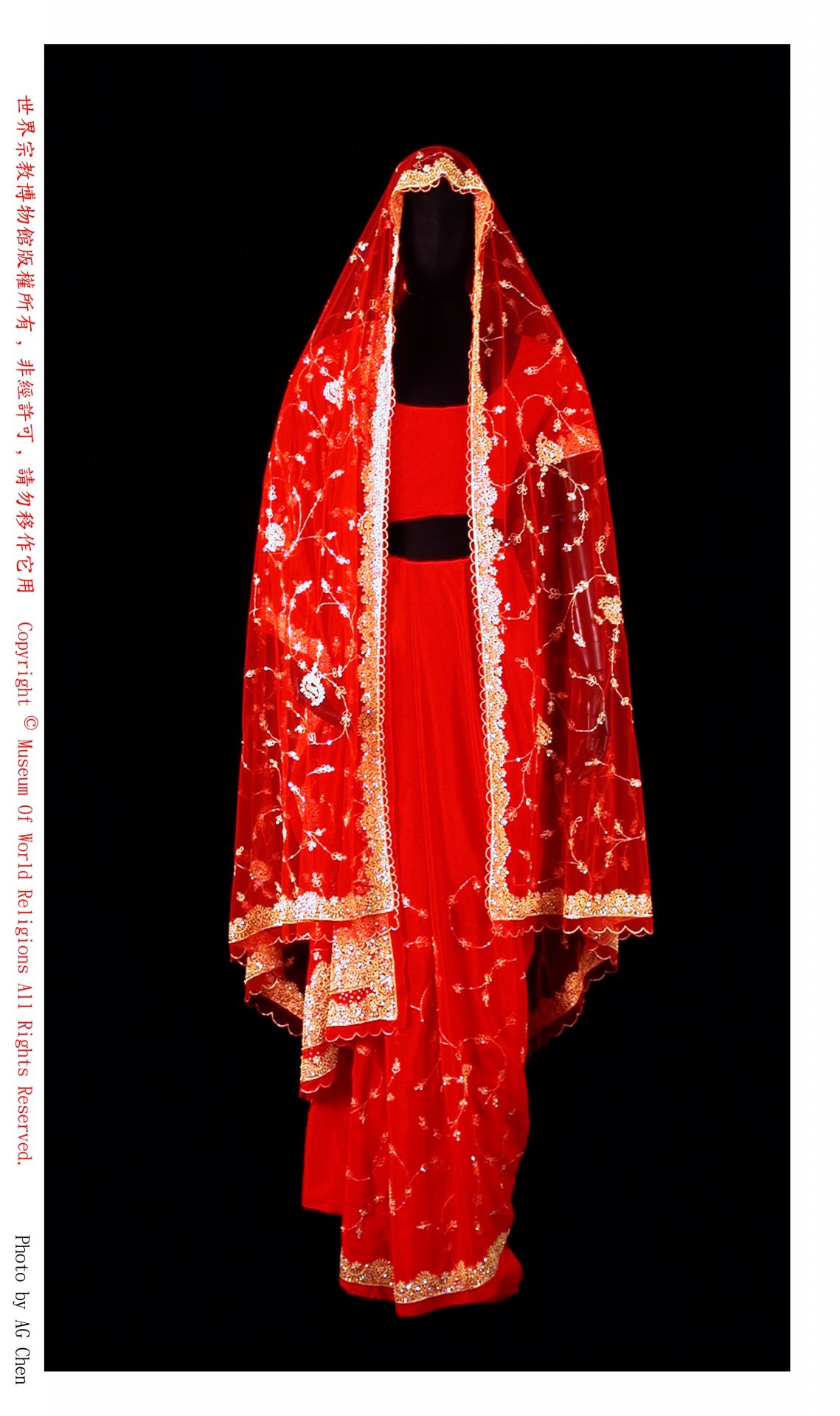
Mid-Life Area 02
【Indian Wedding Attire】
This red Indian sari is a wedding gown worn by brides in traditional Hindu weddings. Hindu weddings may last for days, and include many rituals understood only by the priest. Modern Hindu weddings have become simplified, though some rituals have been preserved, including the following: hand-painted auspicious patterns, the bride placing a wreath on the groom, the exchange of rings, and both tying the sacred threads symbolizing union. A marriage is an important stage of traditional Indian life rituals, as the groom and the bride become mutually supportive partners through marriage, and work together to shoulder the responsibility of families and having children.
Weddings are performed by a priest familiar with ritual significance, and the sacredness of traditional Hindu religion became an element of the wedding through the exchange of rings and vows, and a series of ritual ceremonies. The appearance of the bride follows the tradition, with complex details from clothing, makeup, decorative accessories, to colorful patterns painted on the hands and feet. The bride wears a six-meter long sari and a two-meter veil, made of red chiffon fabric with golden color embroidery thread. They also wear gold all around the body to symbolize a future of abundance and fortune, including gold headbands, nose rings, necklaces, earrings, bracelets, rings on fingers, anklets, and more.
【Ketubah】
Another artifact is ketubah, a Jewish marriage contract. In the Jewish tradition, an engagement banquet is held before marriage to announce the engagement and to write a “ketubah”, which is a special marriage contract stipulating the time and place of the wedding, the financial responsibilities of both parties, and the bride’s dowry, etc. The ketubah is a traditional contract between a Jewish couple, listing the husband’s obligation and rights over his wife in accordance with the Torah. Often drawn with elaborate and exquisite designs, it is treasured by the couple, with details that vary depending on the Jewish customs at each region.
Religious Jews really value family life. According to the Torah, a couple can only live together after the ketubah has been completed. All the patterns on the ketubah you see now have meanings related to Judaism. For example, what is shown on top is a Huppah, a canopy under which the bride and groom stand during a Jewish wedding ceremony. The square canopy held up by four posts symbolizes a sacred place where the groom welcomes the bride into their new home and family. On the upper-right corner, the crown on display is the Torah crown that serves as the sacred witness of marriage.

Meditation Gallery
Spiritual cultivation is a form of spiritual practice and one of the ways to explore body, mind and soul. The film in this gallery introduces you to six different forms of spiritual practice: Buddhist meditation, Christian contemplative prayer, Indian Yoga, Islamic worship, Taoist Tai Chi, and Jewish prayer. Different religions have their own ways of praying, and their own respective rites to observe. The recitation of scriptures is only one part of prayer. Worship is a way of praying that harmonizes body and mind. It is not only a time to recite and memorize religious scriptures, but also a way for people to communicate with God and to purify their soul. You can use the platform in the middle of the hall to watch the film or to meditate. Feel free to take off your shoes and try to sit up straight. The carefully designed sound and light will help you develop a sense of the spiritual dimension of life.

Awakening
Rich life experiences always lead us to reflect on and engage more deeply with life. For this exhibit, we have invited religious leaders, celebrities and everyday people to talk to us about transformative events in their own lives that led to spiritual awakenings. The film contains interviews that were filmed during the "United Nations World Peace Conference" in August 2000 as well as a dozen individual interviews filmed in Taiwan. While watching, please try to also reflect about transformative experiences in your own life that may have led to a different understanding or positive change.
Old Age Area 01
【Beech Wood Bench】
In old age, our faith and religious perspectives help us to transcend the issues of life and death. We may feel satisfied with our achievements and also seek inner peace in daily life. The Beech wood used to make the bench for this stage symbolizes ancient wisdom or guidance from the past. The rituals of religious life help us to feel connected, and we can go forth with the wisdom of those who came before us.
【Wailing and Praying at the Western Wall】
The film in the Old Age Area presents the religious life of different faiths, such as for example Jews praying at the Western Wall in Israel. Jews from all over the world return to Jerusalem to pray at the Western Wall. They would write their wishes on paper to stuff into the crevices on the wall, pleading for God’s kindness.
【Prayer Wheel】
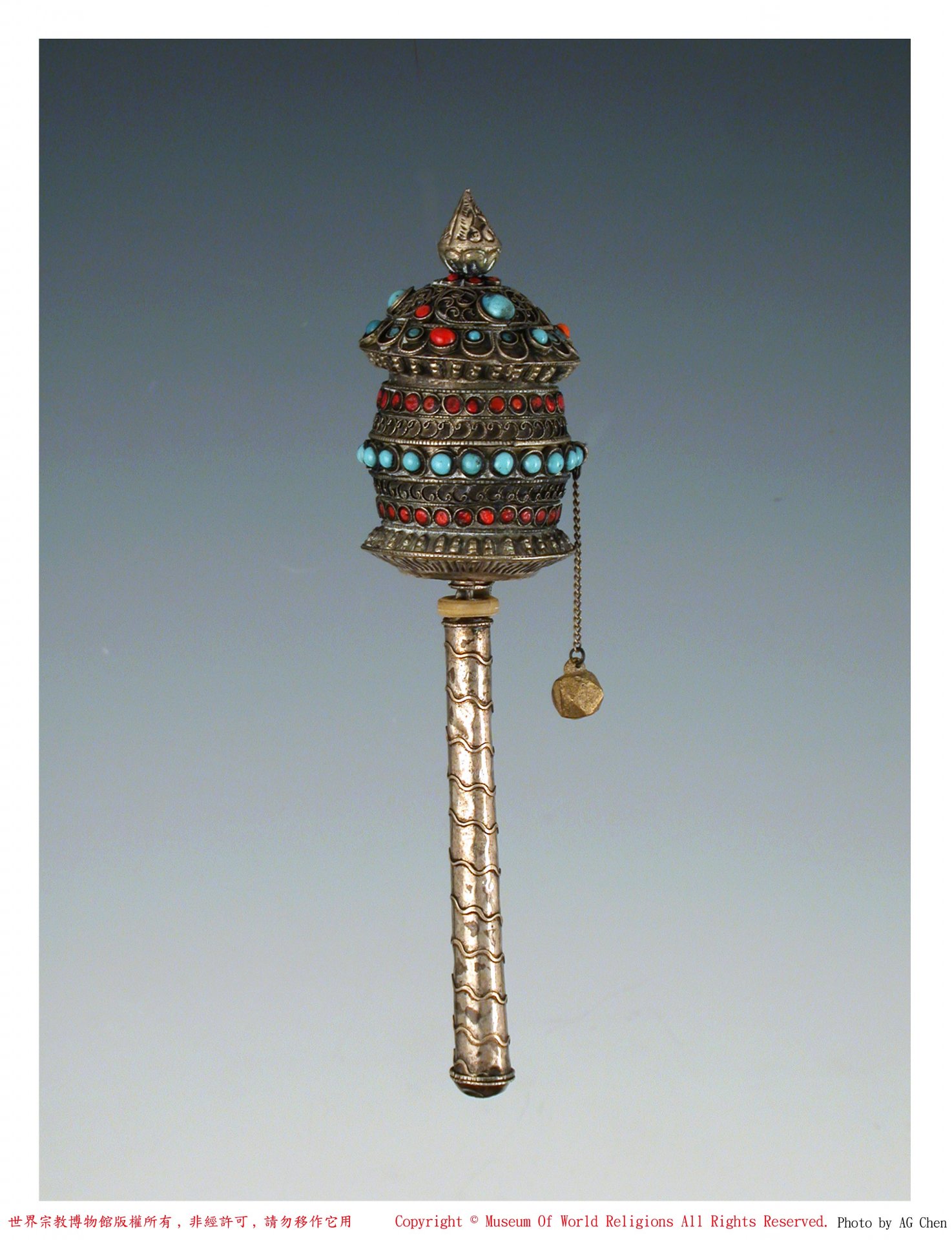
Also, there are elderly Tibetans holding in hand the Buddhist prayer wheel, engraved with the six-character mantra. Most Tibetans are devout Buddhists. The elderly, who may be illiterate, may turn the prayer wheel or chant the mantras symbolizing that they have read the scripture once. You can also see a prayer wheel in the round display cabinet.
【Islamic Prayer Beads】
The artifact display cabinet also contains Islamic prayer beads, which are religious objects used by various religions to help the faithful with chanting or praying while keeping count. Prayer beads have different meanings in different religions, and the number of beads vary depending on the requirements of scriptures or the praying method of each religion. Islamic prayer beads are used to count the number of classic chants and praises such as “Allah”. In the Quran, “Allah” has 99 honorable names. When a Muslim recites “Allah” once, a bead is moved. Therefore, an Islamic rosary strand usually strings together 33 or 99 beads. Since a chant is a concerted expression of mind and speech, saying praises has become the first lesson for Muslims.
【Taiwanese Longevity Turtle and Cake molds】
In addition to faith in life, many traditional cultures also rely on designated objects to express the value and meaning of old age. For example, as part of a Taiwanese custom, cakes made with turtle molds or peach molds are called longevity tortoises and longevity peaches. As symbols of longevity in Chinese heritage, the cakes have become auspicious festival foods of blessings and good wishes.
【Du Dou(The undergarment)】
Another artifact is a black du dou. What we commonly understand by du dou is something worn by a child or a young girl. However, a du dou was an undershirt worn by the people in Taiwan in the early years. In the Tang dynasty, it was called a “chest wrap” or “belly wrap”. In the Qing dynasty, it was called “du dou”, used to cover the chest and belly to keep warm. Evidently this du dou was made for an elderly person, with the design of a bat hanging upside-down on the tree on the top. On the lower part of the garment are tortoises and deer. All of the above represent auspicious blessings of good fortune, wealth, and longevity. Made with black silk, the elegant and simple embroidery on this du dou indicates that it was worn by an elderly woman of wealth.

Old Age Area 02
【Shinto Kanreki Iwaigi】
This garment is worn during the Kanreki Ceremony, held in Japan for people who reach the age of 60. Kanreki means “calendar return”, meaning that the 60-year zodiac cycle has returned to the same point in the zodiac as the time of birth, which symbolizes returning to the period of a newborn baby. On the day of the 60th birthday, the whole family gets together to celebrate the rebirth for the 60-year-old, who wears red clothing called “chanchanko” and a red headband called “zukin”. In the Japanese language, red is “aka”, which sounds similar to the pronunciation of “aka-chan” (baby), so wearing red clothing and hat symbolizes returning to the age of a baby and a restart in life. On this day, families and friends dress the elderly in red, and congratulate them for a “return to their starting point in the calendar”.
【Eastern Orthodox Pontifical Vestment】
The other garment on display is an Eastern Orthodox Pontifical Vestment. Among the three levels of Orthodox clergy, the bishop is at the highest level, followed by the priest and the friar. A bishop is the person in charge of a district, responsible for baptizing and taking care of the faithful, supervising the clergy in the district, and communicating with other churches. The embroidery band on the shoulder and neck portion of the vestment symbolizes the authority and the burden bore by Jesus. The decorative chain worn on the body symbolizes Jesus and the Virgin Mary. The diamond cross pattern tied to the right side is called the knee shield, which originates from the Byzantine period when the emperor would grant a sword to a meritorious general, as well as a knee shield hung from the waist to prevent the sword from hitting the knee. The reward for clergy is a knee shield only, which also serves as a spiritual sword representing protection from God. The bishop serves as an important spiritual guidance in the church, leading the clergy and the faithful with his religious life and wisdom.

Death Area 01
【Elm Wood Bench】
Death is the last stage of life, a necessary life process that everyone goes through. In life, we habitually avoid the word ‘death’. Avoidance, however, does not keep death at a distance. Considerations for death are not simply about looking at death, but to think about how to live well. This is the reason that elm is used for the bench in the Death Area and the Afterlife Area. Elm is used to make coffins because it slows down the decay of the corpse. Elm is also called the tree of slumber, symbolizing power and nobility. While sitting on the elm bench, you can watch the video showing various funeral ceremonies of different religions, and consider the posthumous world described by religion that may lead us to transcend life and death.
【Funeral by the Ganges River】
For example, the film shows a cremation ceremony held by the Ganges River, the sacred river in India. Do be cremated by the Ganges is said to be the greatest wish of Indians for their death. Agni, the fire god of Hinduism, is the messenger of Heaven. After a cremation, the ashes are scattered in the Ganges, so that the souls of the dead may ascend to heaven and reach the gods, which is the most noble arrangement for the dead in India.
【Day of the Dead in Mexico】
In Mexico as well as all over Latin America, there is the celebration of the Day of the Dead, which originates from the Mayan culture. Held annually at the beginning of November, it is a day to pay respect to deceased ancestors, just like the Qingming Festival in Han culture. On the Day of the Dead, Mayans would fill the cemetery with flowers and offerings, and dance with joy to welcome their ancestors to return and join them in the celebration. The Mayans believe that death is just like the transformation of the four seasons, which is a symbol of endless life to be welcomed with a celebration.
【Taiwanese Paper Money】
In the round cabinet, you can see pink-colored paper money, which is money for the dead. However, its use is limited, to be given to the “treasurer” of the underworld as part of the public treasury. During a funeral, it is placed inside the coffin or burned for the dead, so that it is available for them to hand over to the treasury of the underworld. According to folk legend, before birth, everyone must borrow money from the underworld treasurer in order to reincarnate in the world, so they must bring money to the underworld to repay the debt after death. Paper Money is prepared for the dead by their descendants, hoping the dead will be able to travel safely to the underworld and enjoy a life of leisure and happiness in the world after death. During the funeral, there is a ritual of “surrounding the joss paper”, that is when relatives hold hands around the burning of joss paper, to prevent a robbery by other spirits.
【Egyptian Book of the Dead】
The Egyptian Book of the Dead contains images that depict Egyptian prayers for immortality after death. The Book of the Dead is a scroll filled with spells. Ancient Egyptians would place the book beside the deceased, or draw the spells on the coffin or on the walls of the tomb, to assist the dead pass safely through the underworld judgment to obtain eternal life. Painted by a contemporary Egyptian artist, this artwork depicts Anubis, the god of death, measuring the heart of the deceased. Sitting on the scale is Ma’at, the goddess of justice, who wears a feather on her head that is an important yardstick for measuring the deeds of the deceased before death. Thoth, the god of writing, records the judgement on the side. The spells in the Book of the Dead express the deceased’s oath of innocence to the gods in request for a fair judgment. Ancient Egyptians made mummies of the dead, because a soul requires a body to live an eternal life after passing through judgment in the underworld.

Death Area 02
【Eastern Orthodox Church Shroud】
This long white cloth is a shroud used in an Orthodox Church funeral, used to wrap the corpse before burying the dead. The tradition originates from the time of the Crucifixion of Jesus, whose disciples took his body and wrapped it in linen cloth for the burial. Three days later, Jesus was resurrected. The main focus of Orthodox Christian funerals is on prayers - a solemn and mournful process. The shroud used at the burial has changed over the years. Nowadays, the design on the shroud varies, though most contain Greek prayers, the cross, and the miraculous story of the resurrection of Jesus. For this shroud, the image in the middle is the crucifixion of Jesus. The image below is the resurrection of Jesus, and the ascension of Jesus to Heaven is shown on the top. These drawings of Jesus represent a symbolic prayer for the deceased to be with Jesus in the afterlife.
【Pictured Paper Money】
For the Ghost Festival, a pictured paper money(mold) is used to print “paper clothing”, which is articles of clothing or other supplies for use by the spirits of the underworld. This mold is made of wood. Its larger size is rarely seen in Taiwan. The mold is engraved with daily supplies, including shirts, pants, boots, combs, rulers, and mirrors for male and female spirits. During the Ghost Festival ritual offering ceremony, the joss paper clothing and joss paper money are burnt and offered to wandering lone spirits as appeasement, so they have new clothes to wear and daily necessities.
【Rukai Aborigines Women’s Funeral Scarf】
Harmonious coexistence between people and the soul of the deceased is an aspect of the Aboriginal belief in Taiwan, that upholds the existence of afterlife and has respect for it. The object shown is a Rukai tribal Funeral Scarf, a scarf worn on the head during a funeral for Rukai tribesmen who live in the mountainous regions of Taitung and Kaohsiung. The Rukai Tribe is well-known internationally for beautifully embroidered clothing and rich weaving patterns, as well as their characteristic weddings and millet harvests. When families pass away, tribesmen wear beautiful clothes, and women wear a scarf on their head to show respect for the dead, while singing praises of the spirit of the deceased. The scard is woven with a colorful mixture of yarn and sisal, interwoven with three pieces of cloth. The geometric weaving pattern of ancestor portraits is very precious, usually given to daughters by mothers as heirlooms.

Avatamsaka World
In the Hall of Life’s Journey, the five phases of life form a giant sphere in the Avatamsaka World, expressing life’s subtle yet great profoundness through the Buddhist words of wisdom, “one is all and all is one”, from the Avatamsaka Sutra. Meanwhile, the sphere represents the shared spiritual pursuits of every person and conveys empathic religious messages. The Avatamsaka World is a two-storey, round theater with the exterior of a glowing sphere hanging ingeniously above the ground. Audiences may watch 180-degree panoramic videos from inside the sphere. The video content presents the audience with mysteries of the universe, the beauty of religion, as well as human connections to the world. The Avatamsaka World’s accommodating spirit is presented through the special visual experience at the spherical theater.

Great Hall of World Religions
Based on the criteria of history and religious population size, the Great Hall of World Religions chose to put the following eight major world religions on permanent display: Christianity, Judaism, Islam, Buddhism, Hinduism, Sikhism, Shinto, and Taoism. Furthermore, the museum also features the Ancient Egyptian religion, indigenous religion, and “Taiwanese religions” for a display of 11 religions in total. The distinctive characteristics of each religion are expressed through long screens and music as ten images form a unified whole with ten types of sounds at four specially-designated timepoints. The respective elements of fire, water, sutra, and sunrise demonstrate the similarities and differences between world religions through the means of visual images and auditory sounds. For the display area, the same spatial planning was applied to all religions in alignment with the museum’s belief that all religions are equal. The architectural display in the center is a collaboration created by Curator Pao-Teh Han and famous sculptor Mr. Chien-Cheng Lin in 2003. By selecting religious buildings with historical values and architectural characteristics, ten vividly alive architectural models were made in 1:30 or 1:50 ratios. The screens set up before the architectural models enable viewers to closely examine the delicate internal structures, paintings, and sculptures through touch control screens for an unprecedented visual experience and ambiance of being inside the architecture.

Christianity
Christianity is currently the religion with the most adherents in the world. It features three major denominations: Roman Catholicism, Eastern Orthodox, and Protestantism. For more than three centuries, Christianity was an underground movement suppressed by the Roman Empire. During that period, many Christians died under tragic circumstances as martyrs. In the 4th century, Christianity was finally granted legal status by the Roman emperor, Constantine. Christianity has since played an important role in the cultural, historical, and artistic development of Western civilization.
Christianity has undergone two divisions in history. The first occurred in the 11th century when the Roman Empire split into eastern and western empires. As a result, the center of Christianity was divided into the Byzantine and Roman churches, which then developed into two branches – the Western Roman Catholic Church and the Orthodox Catholic Church (also known as the Eastern Orthodox Church). Conflict between the churches of the east and west persisted until 1054 AD, when the Eastern Orthodox Church formally separated from the Roman Catholic Church. Presently, the Eastern Orthodox Church continues to thrive in Greece, Russia, and Eastern Europe. The second division occurred in the 16th century, when the Roman Catholic Reformation began to spread across Europe. The word Christianity (or Protestant) is the general term used to describe the various denominations that emerged after the Reformation. Today, many of these denominations continue to be a part of Christianity.
【No. 3, Christ the Shepherd】
In Greek, the name, Christ, means “messiah”, or the savior in Christianity. Even though Christianity split and developed into three major denominations, they can all be traced back to the birth, evangelism, crucifixion and resurrection of Jesus Christ. No. 3 at the center of the display case is an oil painting depicting Shepherd Jesus. The sheep, the crown of thorns on his head, and the wounds across his body all represent important spiritual aspects of Jesus in the religion. In the New Testament, Jesus compared himself to a shepherd, carrying lost sheep on his back to return to the flock. For those who have lost their ways, Jesus guides them back to faith. Due to persistently challenging the authority of the Roman emperor, Jesus Christ was crucified as a result. Thus, the crown of thorns on his head forms a stark contrast with the emperor’s crown, symbolizing suffering vs. authority. One of Jesus’s fingers points toward a wound on his ribs, which was pierced with a spear by a Roman soldier. The injury symbolizes the suffering that Jesus endured on behalf of the world. The upward pointing gaze of Jesus and the corner of his slightly open mouth indicates that he is pleading to God above, signifying the love of Jesus for the world.
【No. 10, Jesus and the Twelve Apostles】
Below the oil painting, No. 10 is a limestone statue of Jesus and the Twelve Apostles, presented plainly and symbolically with individual characteristics. Jesus stands in the center. His first disciple Saint Petrus (also known as Saint Peter) stands on his right, holding the Keys of Heaven in his hand. Originally named Simon, he was accepted as a disciple by Jesus and given the name Peter, meaning “rock”. While giving the Keys of Heaven to Peter, Jesus stated that the church should be established on rock.
【No. 1, Head of Saint Peter】
Peter was the first to understand the divinity of Jesus, and recognized Jesus as the Savior. After the crucifixion and resurrection of Jesus, Peter began assuming responsibilities as the leader of the church in Jerusalem. He is widely regarded as the first Catholic Pope. Another oil painting, No. 1 on the left side of the display case, depicts Saint Peter in prayer. In the limestone statue, the disciple to the left guides a believer to kneel before Jesus. The beardless disciple is Saint John, who is the youngest. As Jesus suffered while nailed to the cross, he entrusted the care of his mother to John, who is also said to have written the Gospel of John and the Book of Revelation.
The Last Supper was the last meal Jesus shared with his twelve disciples before his crucifixion. During the dinner, Jesus took some bread and poured some wine, telling his disciples: “Take and eat, this is my body. Take and drink, this is the blood of my covenant.” Jesus shared bread and wine as a way of telling his disciples that he would always be with them. After more than two millennia, the act of partaking in bread and wine has been repeated as a ritual by all Christian denominations today. However, the name of the ritual and its symbolism vary depending on the sect of Christianity.
【No. 5, Ciborium】
No. 5 is an Eastern Orthodox Ciborium containing the Eucharist of Jesus. During a church ceremony, the priest provides the faithful with bread and wine representing the Eucharist of Jesus. This pyx was made into the shape of a church. The front door is the entrance for placing or taking the Eucharist and the sacrament cup. The other three sides are decorated with bronze reliefs depicting the stories of Jesus.
【No. 12, Eastern Orthodox Icon of Mary with Child】
The religious art of Eastern Orthodox Church is represented by paintings of religious icons. No. 12 on the upper right of the display case is an icon painting of the Virgin Mary and Child. Usually painted on drawing boards, icon paintings are very important in the Orthodox Church, depicting historical figures central to Christianity, such as Jesus and the Virgin Mary, as well as saints or people with special relationships with Jesus. Icon paintings feature sacred symbols. Worshippers express their reverence by kissing and bowing before the art, forming a special experience and connection with the theme of the icon. Therefore, in addition to being an artistic expression, icon paintings also serve to convey the spirit of the religion. Instead of relying on perspectives or light and shadow techniques to convey realism, special symbols are used to express the meaning and spirit of the religion.
For example, the Virgin Mary and Child depicted in this artifact do not feature real life proportions. Furthermore, their facial and body expressions do not display any emotions. However, the halo on the head of the figures, the slight tilt of Virgin Mary towards the body of Jesus, and the upward hand gestures of baby Jesus all emphasize how he is the focus of this icon painting, the spiritual representation of the religion, and the recipient of the love and protection of Virgin Mary. The background of this icon painting is decorated with golden and magnificent patterns to highlight its divinity, which is a manifestation of the religious art characteristics of the Orthodox Church.

Judaism
Judaism originated in the BCE19th century, about 4,000 years ago in the Ancient Near East. Even though the Jewish people underwent numerous migrations and experienced various transformations and developments through its long history, the core beliefs of Judaism have remained unchanged. Followers of Judaism believe that God created and rules the universe. Jewish spirituality consists of four parts – beliefs, rituals, culture, and ethnicity. The regulations for all actions are recorded in the sacred book of law, the Torah, and expounded upon by the Rabbis in the Talmud, the body of Jewish civil and ceremonial law and legend.
【No. 3, Sefer Torah】
No. 3 is a Torah scroll. The word, “Torah”, means direction and teaching in Hebrew. Torah consists of the first five books of the Hebrew bible, namely Genesis, Exodus, Leviticus, Numbers, and Deuteronomy. Traditionally, the Torah was copied onto scrolls. Its content includes the earliest Jewish history along with 613 articles of laws and commandments. At a synagogue, Torah scrolls are held up high and recited. When not in use, Torah scrolls are wrapped and encased in an external cover before being placed into an ark.
【No. 9, 10, 11, Yad】
The crown that you see next to the scroll is usually placed on top of the ark, representing the sacred position of the Torah in Judaism. While reciting the Torah, one’s hands are restricted from touching the scriptures directly. No. 9, 10, and 11 are yads, or Torah pointers. In Hebrew, the original meaning of “yad” is “hand”, and the tip of the stick is usually made into the shape of a hand with fingers pointing outward. A yad is used to help readers focus on the correct spot while reciting, and to avoid staining the sacred scriptures. Jewish people usually go to the synagogue on the Sabbath and special religious holidays to pray together and recite the Torah. Occurring once per week, the Sabbath is a day of rest symbolizing the seventh day of rest by God after spending six days to create the world.
【No. 14, Teffillin; No. 15, Tallit】
In addition to the Sabbath, traditional Jews also perform morning prayer rituals at home. No. 15 is a prayer shawl, usually worn by adult Jewish men during morning prayers, while No. 14 is a tefillin box typically worn on the left arm. On the four corners of the long prayer shawl are tassels braided in a special manner to remind Jews of their obligation to observe the commandments given by God.
【No. 19, Mezuzah】
The lifestyles of the Jewish people are closely related to their beliefs. No. 19 is the mezuzah often seen on the door frame of a Jewish home. The decorative case contains parchment excerpts from the Torah, affixed in a slanted manner to the right side of every door, excluding those of bathrooms and garages, in Jewish homes. Considered an act of observing God's commandments, a Jewish person would place their hand on the mezuzah and recite prayers when they prepare to leave or after returning home. The act symbolizes a daily prayer for peace while going in and out of the house, as well as an expression of gratitude to God.
【No. 20, Shehitah Knife】
No. 20 is a butcher knife used for animal slaughters. Restrictions for Jewish food are also described in detail in the Torah. Jewish people who live in accordance with the Torah can only eat Kosher food prepared in accordance with Jewish rules. Even though ruminants and split hoof animals may be consumed, the meat must be cleaned in accordance with the Torah. For example, the knife used to slaughter the animal must be inspected to ensure that it is flawlessly sharp, and suffering of the animals must be minimized by rapidly draining its blood.
【No. 16, Seder Plate】
In addition to the daily diet, foods prepared for major Jewish festivals also bear important religious meanings. No. 16 is a round Passover seder plate, featuring five vignettes from the Biblical story of the exodus of Moses from Egypt. The five indentations in the plate allow the placement of five types of food related to the story. Passover celebrates the liberation of the Jewish people from slavery in Egypt, as they followed Moses to arrive at the Promised Land. Due to droughts, the Jewish people migrated to Egypt, and became slaves building pyramids under the rule of the pharaohs. Therefore, salt-pickled bitter dishes are usually placed on the plate to commemorate the sweat and tears shed by Jewish ancestors. Additionally, the plate also contains fruit puree made with apples and stone fruits, symbolizing the cement used in the pyramid.
When the pharaoh tried to prevent Moses and the Jewish people from leaving Egypt, God inflicted 10 plagues upon the Egyptians. The final plague led to the death of the firstborn sons in every Egyptian family, including those of livestock. Jewish families avoided the plague by smearing the blood of the lamb on the doorposts of their houses. Finally, after the death of his eldest son, the pharaoh agreed to allow the Jewish people to leave. In a hurry to flee, they brought with them unleavened bread to follow Moses to the Promised Land. They also witnessed the miracle of Moses parting the Red Sea, allowing them to escape from the pursuing forces of the Pharaoh and leave Egypt successfully. Therefore, the other three types of food placed on the seder plate are a roasted leg of lamb, unleavened bread, and eggs. The story of the Exodus from Egypt is retold before food is eaten during Passover. In addition to being a family gathering for the holiday, a Passover meal is also an important ritual to pass on the heritage of Jewish traditions.
【No. 21, Hanukkah Lamp】
No. 21 is a Hanukkah Lamp. Hanukkah is also known as the Festival of Lights. Even though it is not a festival recorded in the Torah, it is an important part of the history of Jewish rebellion against foreign rule and the rededication of the Holy Temple in Jerusalem. Ruling over Jerusalem in 165 BC, the Seleucid Empire enforced Hellenization and desecrated the Temple of Jerusalem, which led to the battles of the Maccabean Revolt, a Jewish uprising against repression. After three years of war, Judas Maccabeus recaptured Jerusalem. After cleansing the Holy Temple and restoring the altar, Maccabeus rededicated it to God. At the time, a one-day supply of consecrated oil kept the Temple's lamp lit for eight days. To commemorate this miracle of the uninterrupted divine light, Hanukkah is celebrated over eight days, by lighting the first candle on the first night, the second candle on the second night, and so on until all eight candles are lit on the eighth night, signifying the end of the Hanukkah festival.

Islam
In the 7th century C.E., Islam emerged on the west side of the Arabian Peninsula and rapidly spread across the entire Middle East. Today, its followers, called Muslims, amount to a population of over one billion, making Islam the world’s second largest religion. The founder of Islam, Muḥammad ibn ʿAbd Allāh, was originally a merchant. In 610 C.E., at the age of 40, he received enlightenment from Allah and called for people to believe in Islam, which in Arabic means “humility” or “to succumb to the unique creator and the domination of all things in the universe.” By the year 632, when Muhammad passed away, most of the Arabian Peninsula consisted of Muslims, forming a community jointly governed through politics, economics, and religion. After Muhammad’s enlightenment by Allah, he gathered his teachings into a book called the Qur’an. Because Muhammad was a messenger chosen by Allah, he was the first and most authoritative interpreter of the Qur’an. The Qur’an is considered the ultimate and optimal guide passed from Allah to humans.
【No. 6, Qur’an】
No. 6 is a Qur’an used by the royal family of the Mughal Empire in the 18th century. The text, written horizontally from right to left, is decorated with golden complex figures and splendid colors, reflecting the delicate design of the royal family. The word “Qur’an” means recitation. Muslims believe that the Qur’an correctly records Allah’s words, so presenting Allah’s words in an aesthetically pleasing form (i.e., calligraphy) demonstrates worship and gratitude. In addition, because Islam forbids the worship of concrete idols or images, abstract calligraphy plays a major role. The Qur’an serves as the foundation of Islamic thought. It is divided into 114 surahs, each of which has a different topic. The first surahs depict the role of Allah, Muhammad’s status, and the final judgment. Later surahs depict the social conditions of Medina, including family, marriage, and race. Under the Qur’an, you can see No. 7, a Qur’an holder. It is used by worshipers to show respect to and read the Qur’an. Holders are usually rich in geometric shapes and can be folded up for convenient storage. They are also one of the few decorations allowed in mosques.
【No. 1, Page of Large Qur'an】
Left of the relic cabinet are exhibited several relics written in Arabic that present several different forms of the presentation of Arabic. Among them, No. 1, a page of Large Qur’an, is an important piece of our museum’s collection. This blue page of the Qur’an is written in a rare Kufic script from the 9th or 10th century C.E. Kufic, the most ancient font in Islam calligraphy, was an important font in writing the Qur’an. It has strict regulations on presenting reverence toward the Qur’an, and this manuscript must have belonged to powerful nobles. Muslims show their respect for the scripture and conduct benevolent religious deeds by reciting or copying it. Although there are many copies, Arabic is still the dominant written language. It has a unique style of calligraphy.
【No. 11, Qur'an Oil Painting】
No. 11 is a piece by a contemporary Muslim painter. The text shown in the moonlight is surahs 94:5–8: “For indeed, with hardship [will be] ease. Indeed, with hardship [will be] ease. So when you have finished [your duties], then stand up [for worship]. And to your Lord direct [your] longing.” Its writing style integrates an ancient cursive font, both elegant and smooth, which is a substantially different style and presentation from those of Kufic. Islamic calligraphy is written with hard pens.
【No. 13, Calligraphic Tools】
No. 13 contains pens, a penholder, an inkwell, and paper, the essential tools of Islamic calligraphers. The traditional shaft of a pen for writing Arabic is made of a reed, hardwood, or bamboo tubes of different sizes. The tips of such pens are cut to various widths and inclinations suitable for a range of writing styles. The color of the ink is modulated by varying the composition for paper of different colors. Inkwells are usually metal, ceramic, or glass. Most have decorative patterns, and on more intricate ones, these patterns include scripture.
【No. 23, a piece of the Kiswa Shareefah】
At the center of the relic cabinet is a Kiswa for Kaaba, which is located in Mecca. This square stone hall is where Muslims go on their pilgrimages. Each year, approximately 2 million of the faithful flock to Mecca to worship. Around the 9th century C.E., the ritual of covering the Kaaba with a black Kiswa began. A Kiswa is a black curtain onto which Islamic mantras and scripture are woven by hand. The Kiswa is replaced each year, and the old one is cut into small pieces that are bestowed upon Islamic organizations as gifts. The Kiswa you are now viewing was a gift from the Muslim World League to our museum. For this piece, Qur’an surah 20:82 is embroidered in golden thread. The translation of the surah is: “But indeed, I am the Perpetual Forgiver of whoever repents and believes and does righteousness and then continues in guidance.” For Muslims, this piece is incredibly precious. All healthy Muslims must make a pilgrimage to Mecca once in their lives. This pilgrimage, called hajj, is one of the Five Pillars of Islam. The Five Pillars also include Salah, which is the custom of worshiping five times each day, at morning, noon, afternoon, sunset, and evening. Muslims care deeply about the cleansing process before the ritual.
【No. 9, Prayer Rug】
No. 9 is a prayer rug. It provides a clean place for Muslims to conduct Salah and to prostrate themselves while reciting prayers. In the center of each prayer rug is a pattern of a spiked dome representing an alcove or mosque. The rugs are also often decorated with rich patterns, such as flowers, grass, lanterns, arcades, and scripture from the Qur’an. The Five Pillars also include Shahada (to recite the scripture daily), Sawm (to fast each year), and Zakat (to give to the poor and people in need). Muslims integrate their religion completely into their daily lives. Simply put, the Five Pillars of Islam serve as the principles of life for worshipers.

Ancient religion—Egypt
The civilization of Ancient Egypt began in approximately 3100 B.C. For nearly 3000 years after the unification of Upper and Lower Egypt in Northern Africa, 30 dynasties of pharaohs ruled over Egypt. The religion of the early Egyptians was polytheistic. Whereas regional worship centered on minor deities, the worship of the sun god, Ra, was universal across Egypt. Among the rich mythology of Ancient Egypt, the most important myth describes the resurrection of Osiris, which provides important insights into perspectives on death at the time. Egyptians believed that death was not the end of life, but the beginning of another. The resurrection of Osiris is the best example. The funeral process was meant to ensure that the dead could be reborn in another world. The key to ensuring life after death and achieving eternal life lay in the perfect preservation of the body. Therefore, bodies were desiccated and preserved as mummies to prevent decay. The mummies of pharaohs were placed in magnificent pyramids to await resurrection. The relics in this exhibition are replicas licensed by various museums, such as the Harvard Museum of the Ancient Near East, the Peabody Essex Museum, the Metropolitan Museum of Art, and the Museum of Fine Arts, Boston.
【No. 2, Osiris】
No. 2 is a Statue of Osiris. Originally, Osiris was a local deity in Busiris. During the New Kingdom period, he became a major deity worshiped across Egypt. According to legend, Osiris married Isis and had a son Horus, the second king on Earth. However, Osiris died due to the machinations of Set, the god of destruction. Legend has it that Set cut Osiris’ body into 14 pieces and dumped them into the Nile. Isis found the body parts and assembled them into a mummy. From this mummy, Osiris was resurrected and became the god that judged the dead and protected souls.
【No. 3, Statuette of Isis and Horus】
No. 3 is a statue of Isis holding little Horus. Horus learned that his father Osiris had been framed by Set. After he grew up, he sought Set to avenge his father. No. 10 is a falcon form, which is another image of Horus. When Horus dueled with Set, Set dug out Horus’s eyes. Later, Horus was healed by the god of wisdom. No. 25 is Sacred Eye of Horus, which symbolizes rebirth, regeneration, and healing. The Eye of Horus, which is also an Egyptian hieroglyph meaning “soundness and good health”, was an important talisman in ancient Egypt.
【No. 16, Coffin of Ankhkhonsu】
No. 16 is the coffin of Ankh-ef-en-Khonsu i, the doorman guarding the temple of the Egyptian sun god. You may notice traces of black ink on the coffin. Presumably, during the ritual prayers in a funeral, ancient Egyptians would pour oil or ointments on the coffin. As time went by, their colors turned dark. The front and sides of the coffin hold a total of three lines of hieroglyphs praising the magnificence of various gods and presenting offerings to Osiris. The offerings include houses, spices, and clothes, all of which were essential for the soul of the dead to achieve eternal life. Both sides of the coffin present colorful depictions of many celestial guardians. These colorful depictions were meant to help the dead make a peaceful transition from this life to the world of eternal life. During the mummification process, body organs were removed and stored elsewhere.
【No. 20, Shabti of Amenhotep】
No. 20 is a Shabti of Amenhotep. Such figurines were placed in tombs to perform hard labor so that the spirit of the dead could rest in the afterlife. This funerary figurine has a three-part wig, and its two hands hold a hoe representing labor. The blue glaze on its body and the fine black decorations are symbols of Amenhotep, a high priest of the Temple of Amun.
【No. 22, Naturalistic Scarab】
Ancient Egyptians had many talismans that provided protection to people during different stages of their lives. No. 22 is a scarab, a talisman for mummies. The image of a scarab was derived from dung beetles, which roll their food into a ball. This power originating from life was compared to the sun rolling in the sky, so it became the image of the scarab, which symbolized rebirth and regeneration. Normally, mummies wore them to protect the spirits of the dead so that they could smoothly pass final judgement and gain eternal life.
【No. 7, Statuette Taweret】
No. 7 is Statuette Taweret, presented as a pregnant hippopotamus. This benevolent and loving goddess was the goddess of childbirth and fertility. Throughout the entirety of ancient Egypt history, Taweret, or “She Who is Great,” was essential to every household. Her back was integrated with the tail of a crocodile. She is shown here standing with one forefoot on a hieroglyph representing protection.
【No. 6, Female Figure on Bed】
No. 6, a female figure on bed, is also related to protecting women during childbirth. In this high relief, the nude woman is lying on a three-dimensional bed while wearing jewelry and a wig. A child is lying by her side. This relief was meant to be placed in one’s home. Ancient Egyptians believed that it would increase the fertility rate and protect women from the dangers of childbirth.
【No. 1, Offering Table of Thutmose III】
In the standalone display case in the back, No. 1 is an offering table of Thutmose III. Thutmose III was a pharaoh of the Eighteenth Dynasty of Egypt. This offering table was originally placed in the temple of the sun god and goddess of the harvest . The table features carvings of bread and fruit, showing eternal offerings to the god. Around the offering table are prayers written in hieroglyphs. According to the customs of worship in ancient Egypt, the offerings were left for the gods on the offering table for a set period of time before the priests could eat them. The offering table also holds a special passage in hieroglyphs that reminds the priests to wait until the gods finish before they themselves start eating. This passage also reveals that humans rely on food from the gods to survive.

Buddhism
Buddhism originated in ancient India in the 6th century BCE. Siddhāttha Gotama, the prince of Śākya Gaṇarājya, saw an old man, a sick person, a corpse and a spiritual seeker during his four trips outside his palace. Profoundly shocked, he came to recognize the presence of suffering and impermanence in the secular world. Accordingly, the prince resolutely renounced his worldly life and began a spiritual quest for liberation and peace. Eventually, he achieved awakening and became the Buddha, which indicates the “Enlightened One.” Gotama was later referred to as Shakyamuni, meaning the “Sage of the Shakyas.” Buddhism stresses equality among all sentient beings, holding that everyone has Buddha nature and can attain Buddhahood. Its core beliefs are aimed at liberating all sentient beings from suffering. In Buddhism, the world is conceived as a suffering-laden cycle of life, death, and rebirth, without beginning or end. Only by removing avidyā (ignorance) can one achieve liberation. From India, Buddhism spread across Asia along three major routes. First, Theravada Buddhism spread via Sri Lanka to countries in Southeast Asia, including Myanmar, Thailand, Cambodia, and Laos. It is generally perceived as most closely aligned with the Buddha’s teachings. Second, Mahayana Buddhism traveled to China, South Korea, Japan and other regions through Central Asia. Third, Tantric Buddhism, which was strongly influenced by the traditions of Hinduism, was introduced to Tibet and subsequently developed into Vajrayana after fusing with local cultures. As early Buddhism did not advocate idolatry, Buddha statues were generally presented in concrete forms, but through abstract symbolic representations. For example, the footprints of the Buddha symbolized that the Buddha gave Dharma teachings in various places, the throne indicated the Buddha’s sutra and Dharma lectures, and the Bodhi tree signified the Buddha’s entry into nirvāṇa.
【No. 29, Buddhapadas】
No. 29 is a stone sculpture of the footprints of the Buddha (2nd century).Before the anthropomorphic images of the Buddha appeared, the presence of the Buddha was figuratively depicted in Buddhist art. Buddha’ footprints are rarely found today and hence highly precious. The two Dharma wheels on the footprints of the Buddha symbolize the completeness and continuation of Buddha’s teaching, or the continuous turning of the Dharma wheel. Two circles of full-blown lotus sit at the bottom of the footprints. Lotus grows out from the mud, pure and unsoiled, signifying the state of Buddha’s awakening and teachings. The three-pointed emblems atop the lotuses represent Triratna (the Three Jewels), i.e., the Buddha, the Dharma (the Buddha’s teachings), and the Sangha (the Buddhist community that preserves and passes down the Buddha’s teachings).
【No. 7, Relief Sculpture of Buddha's Birth】
Buddhist art began to shift from the use of abstract symbols to the making of anthropomorphic representations in the Gandhara region, India. Buddha statues created during the era of Gandhara Civilization marked the earliest style of Buddhist sculpture. Around the middle of the first century, a unique style of Buddhist sculpture that mixed traditional Indian arts with Hellenic and Persian influences developed along the border of northern Central India and Greece. This sculpture style exemplified the well-known Gandhara school of art. No. 7 is the relief Sculpture of Buddha's Birth (3rd century). Showcasing the style of Gandhara art, this sculpture presents the story of the Buddha’s birth. Following Indian customs, Maya, the mother of Sakyamuni, returned to her natal home for childbirth after discovering her pregnancy. On the way, she rested at the garden of Lumbini, where the baby emerged from under her right arm. In the center of the sculpture stands Maya, a curvy lady holding an ashoka tree branch. The infant is delivered from under her arm close to the waist. On her right side stands an attendant, who leans forward as if intending to catch the newborn prince. Behind the attendant, a maid stands with her palms pressed together in a Namaste pose. The high nose bridges, pronounced facial features, and close-fitting garments of the lady, maid and attendant reveal the influences of Hellenistic art during the Gandhara period.
【No. 3, Stele of Buddha and Bodhisattvas】
No. 3 is Stele of Buddha and Bodhisattvas dating back 537 AD (the 3rd year of the Datong period of the Western Wei Dynasty). Buddhism was introduced into China during the Han Dynasty. In the Wei, Jin and Northern and Southern dynasties, religion played a significant role in maintaining spiritual equilibrium and social stability amidst persistent political turmoil. The main statue in this sculpture is characterized by high uṣṇīṣa, a round face, plump cheeks, long earlobes, and a smiling, amiable expression. Clothed in a loose robe with a wide girdle, sculpted with smooth, exquisite lines, the Buddha sits in the full lotus position on the Sumeru base, hands forming the gestures of Ratnasambhava and Varadamudra. Within the Buddha’s nimbus, there are eleven nirmāna-buddhas. To his sides, two bodhisattvas stand separately on lions, appearing solemn and stately. The four sides of the pedestal are engraved with the figures of adherents, carved in novel and delicate forms. All these details fully demonstrate the sophisticated and superb carving techniques used at the time. The back of the sculpture presents complete inscriptions and adherent figures, depicting how the Buddha’ disciple Zhao Jing and his family created this sculpture to bring peace and happiness upon the emperor and all living beings. Although there is no uniform standard for the aesthetics of Buddha sculptures, commonly agreed-upon criteria include virtuoso craftsmanship, animated and elegant forms of the Buddha, and delicate, expressive appearances. Artifact No. 3 impeccably fulfills all these three criteria. Showcasing dynamic, graceful body forms, and affable, genial smiles, this sculpture is arguably a rare masterpiece in Chinese Buddhist sculptures.
【No. 41, Seated Bodhisattva】
The Buddhist tradition that spread to China, Korea, and Japan is Mahāyāna Buddhism, in which Bodhisattvas are perceived as significant spiritual beings. The word “Bodhisattva” is composed of “Bodhi” (enlightenment) and “sattva” (sentient being). Together, it indicates “enlightened sentient being,” representing the sacred power to lead all living beings to the pursuit of enlightenment. No. 41 is a seated Guanyin Bodhisattva created in the Song Dynasty. It reflects the transformation of the belief in the Guanyin Bodhisattva over the course of Chinese history. The Guanyin Bodhisattva we see today is generally represented in female forms. However, early depictions showed Guanyin with a more masculine appearance. During the Tang Dynasty, Buddhism became secularized, and Guanyin gradually became indigenized as a female deity. Artifact No. 41 presents a plump-cheeked Guanyin Bodhisattva. Despite the elaborate necklaces worn on the chest, the bare upper body evidently suggests the image of a male figure. Siddhārtha Gautama was the crown prince of the great Shakya Kingdom before he became the Buddha. In Buddhist art, the Buddha was generally represented as a practitioner in plain attire, whereas the Bodhisattva was mostly depicted as a prince, with a crown on the head and gorgeous ornaments on the body. Such an image was intended to exhibit the compassion and benevolence of the Bodhisattva in staying in this world to save all sentient beings from suffering.
【No. 18, Yamāntaka(Angry-faced Bodhisattva of Wisdom)】
In Tantric Buddhism, Buddha sculptures generally manifest a fusion of Indian Esoteric Buddhism and local Tibetan elements. The sacredness of the Buddha and Bodhisattva is conveyed through the images of multiple heads and arms, and the demon-subjugating power of the Dharma is expressed by angry-eyed statues. No. 18, Yamāntaka, or Vajrabhairava, is perceived as a wrathful representation of the Mañjuśrī Bodhisattva in Tantric Buddhism. Standing at only 15 centimeters, this sculpture presents highly refined details. The Vajrabhairava has nine heads and thirty-four arms, each hand holding a Dharma instrument symbolic of different Dharma teachings. The two arms in the middle embrace his consort Vajravetali. In Tantric Buddhism, male and female Buddha sculptures signify the compassion and wisdom of the Dharma, respectively. The consort-embracing Vajrabhairava sculpture symbolizes the path to enlightenment that combines compassion and wisdom. The Vajrabhairava plants his sixteen feet on eight Dharma-protecting deities and various birds and animals, signifying the power of the Dharma to subdue evils. The sculptures in Tantric Buddhism typically communicate the Dharma teachings through the figurative meanings of concrete images. In addition to their artistic value, the Buddha sculptures also serve as vehicles of Dharma teachings.

Taoism
Originating in China, Taoism has a long history which can be traced back to Lao Tzu, who lived in the sixth century BC. Over time, two branches developed: humanistic Taoism and religious Taoism. Taoism was based on Laozi, Zhuangzi and other works of Taoism, and absorbed the spiritual resources of Yin and Yang, Immortals, and the Book of Changes. It formed a religious organization in the late Eastern Han Dynasty. Taoism achieves the highest spiritual noumenon, the Tao, through the religious practices of fasting, alchemy, and other practices to prolong life. There have been many sects of Taoism throughout history. In the Eastern Han Dynasty, there was the Heavenly Teacher Way, which regards the Tao Te Ching as the main scripture, and the Peace Path, which was inspired by the Taiping Jing. In the Southern and Northern Dynasties, the Shangqing school and Lingbao school emerged. The Qingqing school adopted such scriptures as the Dadong Zhen Jing and Huang Ting Jing. Followers mainly practiced by cultivating their belief in Qi. The Lingbao School regards the "Ling Bao Jing" as the main canon, which focuses on rites, talismans, science, education, and the cultivation of merit and virtue. In the Song and Yuan Dynasties, the Zhengyi, Quanzhen and Da Dao schools became influential. In addition, various folk forms of Taoism constantly emerged. Taoism is concerned with salvation, but attaches more importance to personal inner practice for the purpose of attaining the Tao. To attain the Tao means to become immortal. The individual's ascension can save others and society. The Taoism exhibition area is arranged around six key themes: the literal meaning of "Tao"; Lao Tzu and Taoist gods; Taoist temples; Taoist scriptures; alchemy and curing diseases; and the five elements and eight diagrams. The exhibition provides a brief introduction to the complex content and doctrine of Taoism.
【No. 46, Daoist Pantheon Including Most Major Deities】
No. 46 is Map of gods and goddesses usually used for ritual and ritual practice. It is common in Sichuan and Guizhou, but rarely seen in Taiwan. The gods are arranged from top to bottom in order of status and importance, with most in the middle row. Sanqing, the highest deity of Taoism, is at the top. In the middle is the Yuanshi Tianzun, holding a pearl in his left hand, the Lingbao Tianzun holding a wishful hand, and the moral Tianzun holding a sun moon treasure fan in his hands, symbolizing quiet inaction and natural behavior. Below Sanqing are the gods of the three realms, with left and right classes arranged symmetrically on either side. The first row in the center is the God of the Immortals, the Queen Mother of the West, and the goddess Mother of the Great Chariot. The second row at the bottom is Tianshi Zhang, who is flanked by four spiritual officials. At the bottom level are the local gods: on the left of Tianshi Zhang are the kitchen god and the City God, and on the right are the gods of land and wealth. Gongcao, a professional preacher, is in front of the Heavenly Teacher’s seat.
【No. 5, Dao-de Celestial Venerable】
Taoist statues from the Tang Dynasty are very rare and are regarded as precious relics by museums and individual collectors around the world. The inscription on the Statue dates back to the Tang Dynasty. The face is solemn and dignified, with a square mouth, and long rounded earlobes, bearing some similarities to the Tang Dynasty Buddhist statues. This represents the style of the prosperous Tang. The statue features a “flat” sitting posture, a common form within Taoist imagery since the Six Dynasties. The right hand has been damaged, but based on similar statues in the Shanxi Museum, it is speculated that the hand originally held a fan and horsetail whisk, and a jade ornament. The left hand is placed on a handrest in the shape of a tiger paw, which is a common form in Dao-de statues. Its base is a drooping lower garment, and the pleats on the cushion seat are undulating, which match with the robe, knots, and undergarment, appearing very solemn and dignified. The plinth is thick and engraved with a prayer, which is also well preserved. This valuable artifact helps us better understand the Taoist beliefs of the Tang people.
【No. 26, Queen Mother of the West】
Among the Taoist gods, the Queen Mother of the West is an important representative of goddess beliefs. No. 26 is the statue of the Queen Mother of the West, or the Golden Goddess. Because she lives in the Western Kunlun Jade Lake, she is also known as the "Golden Mother of the Jade Lake." Thousands of immortals gather in the Golden Hall of Jade Lake, as if she were their leader. In Taoism, she was the daughter of the first God, the first heavenly deity of the Yuan Dynasty, who was betrothed to the God of the Immortals. After the rise of the belief in the Jade Emperor, she became the spouse of the Jade Emperor and the first lady of heaven within folk beliefs. Later, she was worshipped by the people as the Golden Mother and the Golden Mother of the Jade Lake. In the Taiwan Cihui Hall, these are collectively referred to as Mother. The Queen Mother of the West is a beautiful immortal representing longevity. She also holds the medicine of immortality and the peach of immortality. After she was accepted by Taoism and became the leader of all female immortals, temples dedicated to her spread all over the country. The wooden statue of the Queen Mother of the West sits in a seated position, holding a Tablet in both hands. It is also a sitting posture enshrined in Taoist temples. Her face is solemn and kind, in line with her representation of motherly care. The crown decoration of this statue has been lost, and the robe has faded, but its shape is still very luxurious and impressive. It is indeed an exquisite statue of a Taoist female immortal.
【No. 31, Gaogong Jiangyi】
Gaogong Jiangyi, which is the robe worn by high-ranked Taoist priests during religious ceremonies. The clergy of Taoism are called Taoist priests, commonly known in Taiwan as "Huoju Taoist." Taoist priests live at home and set up Taoist altars. They only practice fasting during ceremonies—they can eat meat on weekdays. They mostly have typical traditional hairstyles, which are inherited from generation to generation or learned from teachers, and they spend most of their time engaged in Taoist ritual activities, with particular emphasis on drawing symbols, holding spells, inviting gods and expelling ghosts. Most of these Taoists in Taiwan belong to this kind. The so-called Gaogong is the highest ranking Taoist priest. The ceremonial clothes worn by Gaogong are called Jiangyi. Symbolizing the four directions of heaven and earth, Jiangyi are mostly yellow or red, with full-length sleeves and complex embroidery. The back image is the most splendid, with three circles at the top of the middle, symbolizing the Three Pure Ones (Shang Qing, Yu Qing, and Tai Qing). The gold bird and jade rabbit embroidered on the left and right represent the sun and moon. In the middle is a pagoda, emitting light. On the sleeves are eight trigrams, which symbolizes the spiritual power of the creation of the universe. This piece is rich and beautiful. The hem is golden dragon and wave. Sometimes Jiangyi feature images symbolizing the immortal world, such as tigers or cranes.

Shinto
Shinto (神道), literally meaning “the way of the gods,” is a traditional Japanese religion. The characters “神道” are from Chinese. However, the Chinese and Japanese concepts of this term differ. The term “gods” (神) in Japan refers to kami, or the gods worshiped in Shinto. They are not the same gods referred to by the Chinese. For the Japanese, humans, birds, beasts, trees, flowers, grass, mountains, rivers, and oceans can all be kami. Even some shocking, evil, or mysterious things can be called kami, too. In Japan, the term “eight million kami” indicates how anything extraordinary, outstanding, or awe-inspiring can be called kami. The first records of the kami in Shinto are the Kojiki and Nihongi, which were completed in approximately 8 A.D. Amaterasu (the goddess of the sun) is the most important goddess in Shinto mythology. She is worshiped in the Ise Grand Shrine, and many other shrines throughout Japan are also devoted to her. Shinto rituals emphasize the return to a pure nature to return to the original quality in which kami first created humans and everything else. Many kami exist in nature, so humans must establish a harmonious and positive relationship with it. The Japanese call all gods, nymphs, monsters, and spirits of nature, such as the mountains and rivers, kami. When the logographic Chinese script spread from China to Japan, Japanese pronounced the character “神” as kami. Today, Japanese still pray to kami for wishes big and small, such as health, smooth careers, blessings for the family, and passing grades on examinations.
【No. 1, Painting of Uhodozi-ezo】
No. 1, a Painting of Uhodozi-ezo, presents the oracles of Amaterasu of the Ise Grand Shrine, Hachiman of the Iwashimizu Hachimangū, and Kasugagonken of the Kasuga Grand Shrine in a painting, thereby promoting the three benevolent spirits of integrity, purity, and compassion, respectively. This painting integrates the teachings of Shinto, Confucianism, and Buddhism, and it is considered to have combined the beliefs of the Imperial House of Japan, the noblemen, and the samurai. The three shrines are representative shrines in Japan, and the three benevolent spirits embody simplified teachings of the three religions. For these reasons, from the Muromachi period (1336–1573) to the Edo period (1603–1867), as Yoshida Shinto developed, the Oracles of the Three Shrines were widely worshiped by people in Japan. It also became popular to hang decorative scrolls of the Oracles of the Three Shrines in small alcoves for worship. The top of the painting depicts the sun and the moon. In the middle is Amaterasu, presented in the form of Uhodoji. Her head carries a gorintō (five-ringed tower), her right hand holds a gada (a mallet), and her right hand holds a cintamani (a wish-fulfilling jewel). Legend has it that Uhodoji was the form Amaterasu adopted when she descended to Hyūga Province (Miyazaki Prefecture) in Japan. Another legend states that it was the personification of Vairocana. Hachiman, presented in the bottom right of the painting, is portrayed as a nobleman holding a bow, which echoes the spirit of martial gods, as Japanese tend to call Hachiman, “the Bow and Arrow Hachiman.” A bow is both a weapon and a device to ward off evil spirits; therefore, it is suitable for presenting the spirit of purity. Kasugagonken, presented at the bottom left of the painting, is portrayed in the form of Nanda, with a dragon above his head and in Chinese-style clothing. He presents the spirit of compassion. He originated from Buddhist teachings, and he has another name, the Compassionate Vạn Hạnh Bodhisattva.
【No. 3, Kamidana】
Everyday people typically establish places for worshiping kami in their homes. No. 3 consists of a kamidana and religious objects. They are placed at the altar where families worship kami. A kamidana is like a small-scale shrine for honoring local celestial guardians or kami from the Ise Grand Shrine. Every morning and evening, practitioners of Shinto present offerings of salt, rice, and water. The water container, plates, and bottles are essential household religious objects. The water container is filled with water, while one plate holds rice and the other, salt. The two bottles are for sacred wine. During the ceremony, the lids of the water container and bottles are removed. These religious objects must be washed separately from household utensils. The straw rope hanging in front of the kamidana is a shimenawa (No. 4).
【No. 4, Shimenawa】
Shimenawa are straw ropes that mark holy areas. Most shimenawa are hung at the torii in front of a shrine or kamidana. Shimenawa typically have strips of paper hung on them as offerings to kami. In the haiden (hall of worship) of a shrine, statues of lions and komainu (lion-dogs) are placed to guard the shrine and prevent danger or evil spirits from intruding. They are essential architectural elements of a shrine. Most of them are made of stone.
【No. 25, Lion and Komainu】
No. 25, as you see here, presents a wooden lion and komainu. They look very similar to Chinese lions. One of them is a lion, and the other one is a komainu. Can you tell which is which? If you look closely, you will notice that the mouth of one is open, while that of the other is closed. When lions are angry, they roar to threaten their opponents, so the one with an open mouth is the lion. By contrast, when dogs are angry, they make a menacing face with their lips tightly together, so the one with a closed mouth is the komainu.
【No. 31, 32, Male and Female Kami Statues】
Kami in Shinto are invisible, so shrines contain no statues of them. Nevertheless, No. 31 and 32 are male and female kami statues, respectively. Kami statues were gradually produced due to Buddhist influences. Such statues are made by the same craftsmen who make Buddhist statues. However, compared to Buddhist statues, kami statues have extremely human-like features. Therefore, kami statues distinguish males and females.

Indigenous Religions—Mayan Culture
The Maya peoples can be mainly found across Central America, where they have lived for over 3,000 years. Relics of ancient Mayan culture can be found in countries such as Mexico, Guatemala, El Salvador, and Honduras. The Mayan religion is classified as an indigenous religion. Although most indigenous religions today have been heavily influenced by other religions, indigenous religious sites can still be found in North America, Australia, New Zealand, and even Taiwan. While indigenous religions around the world are not the same, they share similarities, such as the worship of natural deities, totems, ancestors, and shamanistic traditions. Much of the religious spirit and rituals of early Mayan culture was not passed down. In the 16th century, the Spanish people began spreading to the Americas. At the time, missionaries forced the construction of churches on top of Mayan religious centers. Some documents from Mayan culture were considered heresy and burned. Although these invaders threatened the Maya’s religious traditions, their religion did not completely disappear. The Maya incorporated the spirit and imagery of Catholicism into their religion, reflecting the vigorous vitality of indigenous religions.
【No. 24, Maya Altar】
The Maya Altar (No. 24), in the center of the display cabinet, reflects the incorporation of Catholic culture into traditional Mayan religion. Stemming from the Chiapas Highlands in Mexico, this delicate altar was made by the Tzotzil craftsmen of local traditional villages. Such altars are used by local priests in ceremonies that seek the blessings of the gods. The carvings on this altar include conventional religious symbols of the Maya. For example, the four legs of the altar exhibit images of Bombax ceiba, also known as the cottonwood tree, which is central to the Mayan view of the creation of the world. The Maya imagine that the tree roots extend into the ground, the branches hold up the Earth, and the trunk supports the sky. The four sides of the altar are red, yellow, blue, and white, representing four different orientations. They also represent the four colors of corn, the staple food of the Maya. The world view of the Maya focuses on the directions of sunrise and sunset, or east and west. Specifically, red represents east, where the sun rises, and blue or black represents west, where the sun sets, indicating death. The altar presents an icon of the Virgin Mary, two skeletons, grain, candles, bouquets, and incense made of copal, an aromatic tree resin. The skeletons, which are related to the Day of the Dead, symbolize deceased ancestors or family members. Their juxtaposition with the Virgin Mary of Catholicism demonstrates the merging of the spirits of the Mayan religion and Catholicism. The bouquets represent clothing offered to the gods, and the candles stand for food. Burning candles means the gods are enjoying the offerings. The ritual of burning copal incense to generate smoke creates a rich fragrance; the incense represents the gods’ cigars. Offerings are made to the gods as prayers for cures for illnesses, bountiful harvests, and knowledge of the future.
【No. 17, Wooden Crosses】
The Wooden crosses (No. 17) above the altar are from Tzotzil in Chiapas, Mexico. Although these crosses resemble the Christian cross, they are decorated with unique carvings, showing that they do not directly represent it. The Mayan crosses symbolize the entrance to the supernatural world. The Maya directly place various offerings in front of such altars with the crosses and hold various rituals, including healing and fortune-telling. The altar with crosses is an important focal point of religious marches and pilgrimages.
【No. 20, Monkey Mask, No. 21, Deer Mask】
No. 20, a monkey mask, No. 21, a deer mask, were used in the “Deer Dance.” The Deer Dance is the second most common dance in the Kʼicheʼ village in the Guatemala Highlands, second only to the Dance of the Conquest. Having originated before the arrival of the Spanish, the Deer Dance has since been transformed into a dance drama that pays tribute to the Virgin Mary and Catholic saints. The dance drama contains two protagonists, a deer and jaguar. In the end, an old man enters the stage with animals, such as monkeys and dogs, and they kill the deer as an offering to the Virgin Mary. These two components of the dance merge traditional Mayan and Catholic religious stories, underlining the fact that contemporary Mayan culture has incorporated Catholic culture in its religion. These five relics are replicas of pieces at the University of Pennsylvania Museum of Archaeology and Anthropology.
【No. 7–10, Ceramic Whistles】
Traditional Mayan religion includes animal totem worship, which is derived from indigenous religions. These totems all reflect exciting mythologies. No. 7–10 are ocarinas in the shapes of animals. Ceramic oral flutes existed throughout ancient Mayan history. They might have served as important instruments during rituals. Generally, ocarinas are carved with images of the animals that often appear in Mayan totems. In Mayan mythology, turtles symbolize land floating on the ocean. Next to the turtle is a bat-shaped ocarina. Most bats live in caves, just as the Mayan gods and ancestors lived in the underworld. Behind the bat, you can see two monkey-shaped ocarinas. According to Mayan mythology, the gods created humans made of wood. However, the gods later discovered that people made of wood did not have souls, so they destroyed most of the wooden humans. The few survivors turned themselves into monkeys, but they were chased into the forest by the gods. The last exhibition piece is a frog-shaped ocarina. As an amphibian, the frog was considered by the Maya to be a unique creature that could travel between the worlds of the living and dead. Thus, ocarinas are often in the shape of a frog. These four ocarinas are replicas licensed by the Peabody Museum of Archeology and Ethnology at Harvard University.

Sikhism
Sikhism combines the traditions of Hinduism and Islam to form its own unique spirit of faith. Guru Nanak, the first guru born in 1469, preached in Punjab, India, and composed nearly a thousand hymns to promote the concept of brotherhood in all corners of the world and the existence of the one true God. The goal of Sikhism in life is to liberate yourself from the shackles of "karma" and unite with God. If one wishes to escape from suffering and reach the state of mukti, one must recite the name of God and strictly follow the teachings of the gurus. Since Guru Nanak, each generation of gurus has added hymns to the classics, contributing to the development of Sikhism. It was not until the death of the tenth guru, Gobind Singh, in 1708 that the tradition of human gurus ended in Sikhism. After the death of the tenth guru, Gobind Singh, the tradition of the gurus was handed over to the original Sikh scriptures, which were regarded as the eleventh guru and honored with the name “Guru Granth Sahib”.
【No. 3, Guru Nanak】
The term “Sikh” means “disciple”. The concept of following a guru is central to the Sikh faith. No. 3 is the Image of Guru Nanak. Guru Nanak was the founder of Sikhism. An Indian from the Kshatriya caste, he grew up influenced by both Hinduism and Islam. He valued the traditions of Hinduism while recognizing the nobility of Islam. However, under the circumstances at the time, these two religions often conflicted with each other. Guru Nanak disappeared mysteriously while bathing in a river around 1500. He reemerged in the river three days later and said to the people gathered by the river, “There are neither Hindus or Muslims here. Whose path shall I follow? I will follow God’s path. God is neither Hindu nor Muslim. I follow the ways of God.” Guru Nanak explained that during his missing three days, he was taken to the temple of God. When you see this photo of the Guru, you can really feel his significance for each Sikh. The portrait of the guru is often depicted with a long white beard. The white color symbolizes a wise elder. The halo on his head and the crown-shaped hat symbolize the sacredness of the guru. He wears a golden robe and black cloak which is the clothing of a religious teacher.
【No. 2, The Ten Sikh Gurus】
The portrait next to it is the portrait of the ten gurus (Relic No. 2). These ten gurus in Sikhism are regarded highly. It is believed that those past gurus were the only manifestors of the one true god. In the portrait, two figures are more prominent. The topmost one is the first guru and founder, Nanak, and under him is the tenth guru, Gobind Singh.
【No. 12, 13, 14, 5K】
The tenth guru established many important rules and standards for the modern development of Sikhism. He formed the Sikh community called "Khalsa” and reintegrated the Sikh organization and commandments. To be able to identify believers and impose self-discipline on the Sikhs, he formulated five regulations. Because these five regulations all begin with a K in the Punjabi dialect, they are called “the Five Ks”. Practicing "the Five Ks" is an external act of obedience to the religious group by its members. It also serves as a reminder to its members to heed the words and deeds of the guru. In "the five Ks", Kesh (uncut hair) and Kangha (a wooden comb) represent acceptance of God's will and restraint. It is common to see male Sikhs wearing turbans on their heads, and their long hair and a comb are arranged in the turban. Furthermore, Kachera (short breeches) is the clothing of a warrior, and it also represents moral strength. Finally, there is Kara (a bracelet worn on the wrist) and Kirpan (a dagger). The dagger symbolizes the determination to defend the truth, while the comb symbolizes attention to appearance and restraint, and the bracelet symbolizes loyalty to God and the guru as well as the unity to its members. No. 12, 13, and 14 are the symbols of the Five Ks. Among the Sikhs who join the Khalsa, after the initiation ceremony, each male believer takes on the additional name Singh, which means lion, symbolizing strength and bravery. The female believers take the additional name Kaur, which means princess.
【No. 5, Adi Granth Seat】
The original scriptures were compiled by the past gurus. Most of the content of the scriptures are poems and hymns, which are the hymns that the gurus can sing extemporaneously when they meditate on God in their hearts. At present, the original scriptures are placed in the Golden Temple, the holy place of Sikhism, for worship. In addition to the Golden Temple, the holy scriptures placed in Sikh temples in various locations are also important as key elements of faith, and seated on sacred thrones. In the center of the cultural relics cabinet is the Adi Granth Seat (Relic No. 5). All the holy scripture supplies are made in an exquisite process. The sacred thrones dedicated to the holy scriptures are often decorated with magnificent ornaments, and are paired with pillows and embroidered gold cloth. They are respectfully worshipped like a human guru. This sacred Seat you see is modeled after a temple. The five spires on the roof and the columns at the square corners symbolize the roof and square pillars of the Sikh temple. On top, there are a total of eight identical words with golden borders written in Punjabi script, meaning "the one true god". There are pillows inside that can be placed on both sides of the holy scripture.
【No. 7, Sacred Whisk】
The outer layer is covered with a large piece of cloth embroidered with the Sikh religious emblem. The Punjabi text above the emblem means "a noble teacher who symbolizes truth." Flowers are enshrined on both sides of the holy scripture, and a whisk is provided to keep the holy scripture clean at all times. When Sikhs read or move the holy scripture, they will wave the whisk over the holy scripture from time to time, creating a breeze that makes the guru feel comfortable. This is a way to show respect to God and the holy scripture. A long sword is placed next to the holy scripture. In the Sikh tradition, the long sword represents the spirit of sacrifice and defending the truth. Especially the tenth guru, Guru Gobind Singh, who founded the Khalsa to fight against religious persecution, is a heroic and sacred religious warrior. This sword represents a strong spirit and firm belief, just like warriors who voluntarily sacrificed for their faith when the Khalsa was founded.

Hinduism
Indian civilization is one of humanity’s four ancient civilizations. Among the world's top ten religions displayed in this museum, Hinduism, Buddhism, and Sikhism all originated from India. These three religions share a close relationship with Indian civilization. Hinduism, as it is known today, is also the religion practiced by the majority of Indians. However, there is no identifiable date or founder to the origin of Hinduism. Hinduism evolved from animistic folk beliefs and nature worship of the early Aryans who settled in India. Early Hinduism is also known as "Vedic religion", or Brahmanism. The Veda is the Hindus’ fundamental scripture. “Veda” means “knowledge of or about the gods”. For Indians, Hinduism is not only a religion, but also a way of life. Hindus believe that people can only see gods by practicing proper language, thinking, and behavior. Because of this, Hinduism is a religion that plays an active role in the everyday lives of the Indian people.
Hindus believe that Brahma exists in all life, just like the soul. "Brahma" is the supreme truth and the foundation of all things. At first, Brahma had no particular image, but it was later represented through different Hindu gods. Hinduism has a huge canon of deities. According to the historical records, India has over 330 million gods. But, regardless of how many gods there are, they are all the incarnations of Brahma. Hindus believe that all people enter the cycle of endless reincarnation by their own actions; that is, through karma. People may only escape from this cycle by cultivating their hearts and minds and performing religious rituals that allow us to become one with Brahma. Hindus mainly believe in three main gods, which are also related to the operation and generation of the universe. These are Brahma, the god of creation with four heads; Vishnu, the god of cosmic protection with four arms; and Shiva, the god of cosmic destruction with the third eye on his forehead. This display contains many statues of Vishnu and Shiva, the popularly worshipped gods in India today.
【No. 5, Statue of Krishna】
No. 5 is a statue of Krishna, an incarnation of Vishnu. Vishnu, the god of cosmic protection, is said to appear in the world through various incarnations across different times, while protecting the universe from destruction. Krishna, the blue- or black-skinned god, is the most famous incarnation of Vishnu. Krishna’s main duty is to protect Dharma, which is the power to maintain morality and the order of the universe. Krishna’s life stories were originally incorporated into the Bhagavad Gita. These stories were widely spread among the Indian nobility. The story describes how Krishna was taken to the forest to live with a shepherd to escape a plot by his uncle. Using his divine powers to help people in the forest, he is loved by the women of the whole village. Many images of Krishna depict him surrounded by singing and dancing shepherds while he plays the flute with a joyous expression. In this statue, we can see that two of Krishna’s hands hold the flute, related to the myth that he was once a cattle herder, while the other two hands hold the Dharma wheel and conch, the magic tools symbolizing Vishnu, the God of protection. These identify Krishna as the incarnation of Vishnu. You can identify several other Vishnu statues in the cultural relics cabinet through the characteristic Dharma wheel and conch.
【No. 25, Statue of Shiva】
No. 25 is a statue of Shiva, the god of cosmic destruction. It is said that Shiva will first dance the dance of destruction when destroying the universe, and then open the third eye to let the world be swallowed up by the sea of fire. On this statue, the third eye is closed. Although Shiva is often represented by a personified image, in India, he is also sometimes represented by the “lingam”, an image symbolizing male genitalia.
【No. 14, Mukha Lingam】
No. 14 is the Mukha Lingam. The head of Shiva is specially carved on the lingam to convey the relationship between the lingam and Shiva. Although Shiva is associated with destruction, the destruction of the universe is the beginning of another creation. Therefore, the lingam symbol and the birth of new life combine to make Shiva the God of rebirth and regeneration. Among the destruction myths about Shiva, the story with his son Ganesha, the elephant-headed god, is the most famous one.
【No. 12, Sculpture of Ganesha】
No. 12 is an Sculpture of Ganesha. Although he is not one of the three main gods, Ganesha is a wildly popular god in India as the Remover of Obstacles. In India, at the beginning of large and small celebrations, people will first pray to Ganesha for a blessing. There are many myths about Ganesha’s origins. According to the legend, he was originally a healthy and handsome child whose mother was a mountain goddess and whose father, Shiva, had gone away for spiritual practice. One day Ganesha’s mother went out, and before she left she told him not to open the door for anyone. An obedient son, Ganesha remembered his mother's words and did not open the door—even for his own father, who finally came back after a long time away. The ill-tempered Shiva was so angry that he cut off his son’s head. When his mother came back to explain, Shiva realized his mistake and suffered from terrible guilt. He ordered all the other gods to go out and bring back the head of the first animal they saw to save his son. The first animal they came across happened to be an elephant, and this is how Ganesha came to have the head of an elephant. Then, to repent for his transgression, Shiva ordered all the gods to spare no effort to help Ganesha achieve any goal. For any wish that Ganesha wants to achieve, the gods will do everything they can to remove any obstacles in his way. Ganesha thus became the god of removing obstacles, and is worshipped by many believers. It is said that Ganesha’s tusk was broken to write the epic Mahabharata. Instead of riding a horse, Ganesha rides a mouse. Although the mouse seems to be much too small for such a large rider, it is capable of biting through almost anything, symbolizing Ganesha’s power to remove obstacles and create roads. The mouse holds sweets in its hands and offers them to Ganesha, which symbolizes Ganesha’s fondness for sweets. Worshippers often give Ganesha sweets as offerings.

Religious Life of the Taiwanese
The teachings, rituals, and organization of Taiwanese folk beliefs, which are based on thousands of years of history and culture, are integrated with secular social life. As a result, Taiwanese beliefs and rituals manifest themselves in many different aspects of life, such as ancestor worship, belief in divine deities, annual and seasonal rituals, etiquette and customs, concepts of time and space, divination and fortune telling, and so on. The “Heavenly God" or "Jade Emperor God" is the Supreme God.
【No. 12, Jade Emperor Tablet】
No. 12 is a Jade Emperor Tablet. Most people worship Jade Emperor with the symbol of a Jade Emperor furnace or memorial tablet. It is generally believed that there are divine deities in nature, such as the sun, moon, stars, wind, rain and lightning. These gods, incarnated as personified images, are worshipped at palaces and temples.
【No. 18, Gui Xing】
Cultural relic No. 18 is the god Gui Xing, whose name literally means “Chief Star” in the Big Dipper constellation. When natural spirits were personified as gods, legends about them would begin to emerge among the people. Gui Xing is one example. According to folklore, Gui Xing was pockmarked and hunchbacked, but he was also full of knowledge. Still, he failed every test he took. In grief and anger, he threw himself into the river, but he was rescued by an Aoyu (a mythical creature) and rose to heaven. In modern times, Gui Xing serves as the god of examinations, who helps people successfully pass tests. For any need related to fame and wealth, people can pray to Gui Xing for help. The figure of Gui Xing kicking a bucket, standing on an Aoyu with his left foot raised, is a symbol of “coming out on top”. Gui Xing holds an inkwell and a cinnabar pen in his hands, which are related to literary studies. Up to modern times, it was not uncommon for the cinnabar pen in Gui Xing’s hands to be stolen from places of worship in the period of time leading up to university entrance examinations. People preparing to take the examination superstitiously believe that this talisman could help them succeed in the test.
【No. 20, Couplet Scrolls】
In Taiwan, the foyers of many family homes are used as places for ceremonies or ancestor worship. Small shrines are also placed inside the homes to worship gods and ancestors. No. 20 is the Goddess of Mercy (“Guanyin”) Couplet. With Guanyin at a main position, the numerous deities are displayed on a hanging scroll, usually in a place of worship. After Buddhism was introduced into China, Guan Shi Yin Bodhisattva gradually came to be worshiped by the people. Guanyin is enshrined in the center of the upper part of the scroll. Seated in front of the purple bamboo forest, this image is known as "Purple bamboo Guanyin," and serves as a more common representation of Guanyin. In her hands, she holds a pearl, or a bottle to sprinkle nectar. She is flanked on either side by Sudhanakumāra and Nāga-kanya, who each stand on a lotus. The middle row is dedicated to the statue of a bearded Emperor Guan, followed by Guan Ping, Zhou Cang, Tian Hou, and a maid. Taiwanese people commonly pray to these gods for protection of the home. The gods worshipped in the lower level are the Kitchen God and the local tutelary god. They are the closest gods in the house. Although these gods are not high-ranking, people need to thank and pray to them on designated days throughout the year. The incense smoke curls up from the censer to represent the heart ascending to the Tao. Sometimes the censer can be painted at the bottom to show that the ceremonial priest is a sincere and respectful disciple under the censer.
【No. 8, Ancestral Portrait】
In addition to the belief in gods, ancestor worship is also an important religious practice among the people. Taiwanese generally believe that people have souls. The souls living in the underworld still have daily needs, such as food, clothing, shelter and transportation, and must be worshipped by their children and grandchildren. No. 8 is an Ancestral Portrait. In ancient times, wealthier families often hired painters to create scroll paintings of ancestors from previous dynasties. This painting shows seven generations of ancestors arranged according to generation and rank. There are individual memorial tablets between each generation, and the memorial tablet of the clan’s main god is on the top. It is usually hung in the ancestral temple or home shrine, and the children and grandchildren regularly worship and make offerings to these scrolls to express their gratitude. It is believed that after death, the soul will become an ancestor god if it is worshipped by descendants. If no one worships it, the soul will become a ghost. The folk saying of lonely souls and wild ghosts represents the special phenomenon of souls whose existence cannot be continued by their families. In the seventh month of the lunar calendar, commonly known as ghost month, special attention is paid to these lonely souls. Traditional people believe that the existence of lonely souls will disturb the natural order, and try to bring them peace through universal ceremonies.
【No. 28, City God】
The afterworld is like this world, with many gods governing and administering it. The City God, No. 28, he is the God of reward and punishment, as well as the God of justice in the underworld. The City God is responsible for recording, informing, judging, and transferring the dead. The City God is an official position in the divine world, not a specific God. Therefore, there are many legends about the City God. The position also involves many departments to assist in the trials of souls. Civil and military judges, Lord Niu, Lord Ma, General Fan, General Xie, and Yin-Yang Duke are common among these assistants.
【No. 32, Yu-Li Collected Works for Admonishing the Living】
No. 32 is the Yu-Li Collected Works for Admonishing the Living, which has circulated among the people. The book depicts hell, with its ten halls. Each hall has a different king in charge of punishment. Various crimes committed in the world of the living will be punished in various ways, and the book describes these in detail, guarding against evil in the world.
【No. 6, Eight Trigrams Plaque with Lion and Sword】
There are no unified doctrines or scriptures in folk beliefs. Confucian theory handed down from ancient times provides a moral standard for dealing with worldly affairs. "Loyalty, filial piety and righteousness" is a moral code handed down through oral tradition. The proverb "there is a God three feet above your head" communicates that the way of heaven always exists. The proverb that "evil is repaid with evil, and good is repaid with good" affirms the people’s belief in planting “seeds of goodness” for a happy future. There is also the saying "Heaven has unpredictable weather, and people have unpredictable misfortunes and blessings." In addition to practicing prayer and worship, people established protective objects in all settlements, temples, and houses to ward off evil. When faced with important rituals or difficulties in life, people often seek divination and fortune-telling to help them ensure good luck, avoid bad luck, and pray for peace. No. 6 is an eight trigrams plaque with lion and sword . The octagram-shaped carving has a lion holding a seven-star sword in its mouth, and is decorated around the sides with the patterns of the eight original trigram. Hung in the doorway, the carving protects the home and wards off evil spirits.
【No. 3, Mountains and Seas Plaque】
Another common protective amulet in the family home is mountains and seas plaque, No. 3. The upper side is about eight inches and represents the eight trigrams, while the lower 6.4 inches represents the sixty-four hexagrams. The upper 1.2 inches represents the twelve hours, and the two halves of the twenty-four solar terms. The amulet is painted with mountains and seas, the sun and the moon and the eight diagrams and other graphics. Besides being mounted over the door, these amulets are occasionally placed on mountains, bridge pavilions, or on the riverbank or seaside to ward off evil spirits.

Assumption Cathedral(Trinity St. Sergius Monestary)
The Assumption Cathedral (also known as The Cathedral of the Dormition or Cathedral of the Assumption) in Russia features five onion-shaped domes, recognizable symbols of Russian churches. These round domes, originally influenced by Byzantine domes, integrated local features to become the unique onion-shaped round domes seen today. The Assumption Cathedral is located in Sergiyev Posad, a small suburb of Moscow, and is the largest and most eye-catching cathedral among the Trinity Lavra of St. Sergius. Launched in 1559, its construction took 27 years to complete. It consists of four blue and one golden onion-shaped domes with shiny white semi-precious stones on the walls, making this cathedral both beautiful and unique.
The Trinity Lavra of St. Sergius was constructed as a memorial to the Russian saint, St. Sergius, between the 15th and 18th centuries. At that time, monasteries served as both spiritual symbols of the Russian people and major education centers. In Russian history, monasteries played a critical role. In the 13th century, the Mongolian invasion of Russia caused a dark age in its history and culture that lasted over 200 years. In the 16th century, Tsar Ivan IV ruled the country with a cruel iron fist, earning his moniker, “Ivan the Terrible.” Employing a strong military style, he drove the Mongols out, uniting Russia and substantially expanded its territory. To celebrate this achievement, Ivan IV ordered the reorganization of the eight major churches and dedicated them to eight religious saints. The Assumption Cathedral was one of these churches.
The religious art in the Orthodox Church is primarily presented by icons, which occupy a critical position in the Orthodox Church. Typically painted on drawing boards or in a church, they depict the central images of Christianity—Jesus, St. Mary, the saints, historical figures related to Jesus, and stories from the Bible. These icons not only depict religious stories but also connect the holy topics of the icons to reality. Worshipers express their reverence by kissing and worshiping them, thereby generating unique connections and holy experiences with the topics of the icons. Unlike the Biblical paintings or sculptures of Catholicism, the icons of the Orthodox Church do not embrace a realistic style. Instead, they use symbolism to express the religious meanings of the saints or Bible stories. Thus, perspective is not employed. The front door of this cathedral is painted with a portrait of Jesus. Inside the cathedral, the walls are decorated with icons of saints. Every corner of the cathedral, including the round domes, is decorated with icons. When believers enter the cathedral, they are surrounded by colorful icons. These resplendent icons make the believers feel as if they are in touch with God’s glory, and they experience the holy power of religion.
Information on the Assumption Cathedral is difficult to obtain. The Russian government administers strict protective measures for the cathedral. Regular travelers are forbidden to take photos within the cathedral, and research books with photos of the interior of the cathedral, the icons, or even the building itself are rare on the market. Although we were allowed to take photos of the interior of the cathedral through international cooperation, because of the great number of the icons, we had to spend copious amounts of time studying the photos during the construction of the model before painting the icons in it. The chandelier in the church has 64 lightbulbs. This model follows suit and features a scaled-down copy of it. It is worthy of careful appreciation to experience the religious art of the Orthodox Church.

Kandariya Mahadev Temple
The Kandariya Mahadev Temple is located in Khajuraho, approximately 500 km southeast of Delhi, India. Khajuraho served as the capital of the Chandela dynasty from the 10th to the 13th century. The Chandela dynasty was most prominent from 950 C.E. to 1050 C.E., during which time the kingdom had over 80 temples. In the 13th century, Islamic forces started to invade the territory. By the 14th century, India had fallen completely under the rule of Islam. Due to Islamic decrees forbidding the worship of idols, all Indian temples were destroyed, and Khajuraho lay forgotten for five centuries. Only in 1906, when systematic excavation was conducted, did it resurface. Since its reconstruction, Khajuraho has become host to over 20 temples divided into three groups: East, West, and South.
The Kandariya Mahadev honors Shiva, the Indian god of destruction. The whole temple is built in layers, like a high mountain. According to legend, Shiva lived in a cave in the Himalayas. The outward appearance of the temple mimics the shape of the Himalayas. Inside is a cavernous space of only one story. This temple is most famous for the erotic statues outside it, which prompt some people to call it the “Sex Temple” or the “Faculty Temple.” The temple is carved with approximately 646 deities and figures. The interior of the temple holds 226 human statues. Vividly portraying sexual acts in detail, these erotic statues greatly stunned the English archeologists who came to excavate relics in the early 20th century. Many scholars were curious about why eroticism was used as a theme for decorating temples. In Hinduism, sex is the power of reproduction, and it represents the power of world creation. The god of destruction in Hinduism, Shiva, simultaneously represents rebirth and reproduction. Therefore, the temple worships lingam, the symbol of male genitalia representing Shiva’s power of reproduction. In Khajuraho, sexual desire is a holy power. It contains the holy seeds of love, and humans can achieve relief through sex. If you pay attention to each statue, you will see that sexual desire is not the only theme. You can also see warriors, dancers, elephants, acrobatic troupes, teams of horses, musicians, and hunters. Therefore, the statues depict all walks of life of the time, and sexual desire, symbolizing the beginning of life, is only one of the topics. These statues are incredible artistic achievements, and they allow the visitors to understand the art of India of that period.
Around the temple are side halls that allow light and air into the temple. Worshipers first enter through the open hallway and enter the gradually darkening altar hall. The light can only enter the temple from the balcony, so when visitors enter, they must carry their own light sources. Unlike the gorgeous and complex exterior of the temple, the interior is quite simple. The altar features not holy statues but thousands of lingams, the carved representations of male genitalia symbolizing Shiva. Because people consider this the most powerful Shiva temple, many worshipers bring fresh flowers and red powder as offerings.

Altneuschl (Old-New Synagogue)
The Old-New Synagogue, located in the Jewish area of Prague, was completed between the 11th and 14th centuries. The synagogue was originally named the New Synagogue. In the 16th century, when other Jewish synagogues were built, it was renamed the Old-New Synagogue. The Old-New Synagogue is the oldest existing Jewish synagogue in Europe. Ever since its establishment hundreds of years ago, it has been used for worship. The only interruption of its religious services occurred during the Second World War, when it was temporarily closed because of the Nazis.
This synagogue is encircled by a series of small rooms that serve as meeting rooms, offices, and classrooms. These affiliated structures were gradually added on after the construction of the synagogue. The inside of the synagogue is plain and simple, featuring no idols. The worship services all follow the Hebrew prayer book, the Torah. In accordance with Jewish traditions, in the synagogue, men and women sit separately. Usually, women worship on the second floor of a synagogue. However, the Old-New Synagogue only has one floor, so in the past, women stood in the hallway outside the main hall of the synagogue to participate in worship, separated by walls. Today, women can worship in the main hall, but they still sit separately from the men. In the middle of the hall is a chanting altar. Around the altar are gorgeously designed railings. Above the railings hangs a flag of the Star of David. On the east side of the hall is placed an Ark of the Covenant, which must face Jerusalem. It is the most sacred object in the hall. When worshipers pray in the synagogue, they must face the covenant, which holds a copy of the Torah.
All men entering the synagogue must wear Kippah hats, and non-Jewish male visitors are provided paper Kippahs. No special regulations are imposed on women. Historically, the Old-New Synagogue has survived several disasters, witnessing Jewish history and changes in the religion. During the 17th and the 18th centuries, the synagogue caught fire several times. Jewish people risked their lives to save the synagogue and always reconstructed it. In 1852, Prague was replanned, and the Jewish region was merged with other administrative regions into the fifth district. Only a few historic buildings were retained, the Old-New Synagogue numbering among them. After the 19th century, social conflicts and wars caused a great deal of hardship to the Jewish people. The Old-New Synagogue, still standing today, bears witness to the struggles in the history of the Jews.

Golden Temple
The Golden Temple, the holiest site in Sikhism, is located in Punjab, northern India. Completed through the efforts of the fourth and fifth Sikh Gurus, it stands today as a central symbol of Sikhism. The Golden Temple is surrounded by an artificial pool dug specifically for the construction of the Golden Temple at the bequest of the fourth Sikh Guru, Ram Das. Today, it is called the Sacred Pool. The founder of Sikhism, Guru Nanak, was said to have received enlightenment when bathing in the river. As a result, lakes hold great religious meaning in Sikhism. The Golden Temple was constructed at the center of the Sacred Pool, where the land was the lowest, to convey the modesty of Guru Nanak and the open and welcoming attitude of Sikhism toward all religions. The open entrances at the four sides of the Golden Temple welcomed people of different identities, religions, races, genders, and nationalities, which was different from the religious sites of Hinduism, which maintained the Caste system, and mosques, which allowed only Muslims inside. Each day, the Golden Temple offers free vegetarian food for the enjoyment of anyone who comes to visit.
The Golden Temple is connected to a 60-meter causeway, which has delicate light decorations. Before worshipers step onto the causeway, they must remove their shoes and conduct a cleansing ritual. All women wear scarves over their heads. The floor of the causeway is paved with marble slabs decorated with geometric shapes. At fixed times in the morning and in the evening, worshipers use water from the Sacred Pool to wash it clean. The Golden Temple has three stories, on each of which priests are present reciting scripture. After the worshipers enter the Golden Temple, they usually sit on the floor to listen to the chanting of the priests. They may also throw flowers or coins in front of the Holy Scripture to show respect.
The Golden Temple is covered with carvings on the internal and external arches and walls. The decorations present a mixture of Indian and Islamic characteristics. The carvings are mostly complex patterns of flowers, plants, or animals with inlaid gold leaves or colored stones, but they may be a section of the scripture and poems of praise carved in various metals. The carvings are quite intricate. The inside of the temple is decorated with over 300 types of patterns. From afar, the walls look as if they are hung with Persian carpets.
In 1803, the Sikh leader Ranjit Singh reconstructed this temple with marble and gold. Ranjit Singh sponsored the plating of the upper halves of all the walls of the temple with gold leaf. The round dome of the temple alone is plated with nearly 400 kg of gold, making it a Golden Temple not just in name only.

Borobudur
Borobudur is located in the mountains of central Java, Indonesia. Just over 200 years ago, it remained buried under volcanic mud. In 1814, during the British colonial period, the British government heard local rumors of a mysterious structure in the jungle and ordered it excavated. From under a statue of Buddha that just barely stuck up out of the ground, a magnificent building emerged. Only then were the full features of the Borobudur Temple known to modern people. Back then, the administrator, Sir Thomas Stamford Raffles of the United Kingdom, who was stationed in Java, sent an investigative team to conduct the excavation. However, at that time, they only cleaned up this relic and did not study it. Over the following 100 years, the temple was gradually weathered and plundered. The word “Borobudur” is a transliteration from Sanskrit for “Buddha”. The meaning of “the tower where Buddha is worshiped” was derived from this later. The exact history behind the Borobudur Temple remains unclear. Its pyramid-like architecture is unique. According to investigations, it was constructed in approximately 800 C.E. and buried underground 150 years later, its massive bulk forgotten to history. Some say that, due to the invasion of the Islam, the dynasty that worshiped Buddhism fell and the political capital moved to the east. Others say that, since it was in a volcanic area, its desertion may have been the result of a large-scale volcanic eruption. In the early 20th century, the Germans first noticed the importance of this Buddhist site and started reconstruction work. However, the reconstruction did not go smoothly, being interrupted by an earthquake and encountering financial difficulties. Only in 1973 did the United Nations list it as a World Heritage Site, opening it up for reconstruction and research projects in the following decades. Because of such work, this temple is now open to the public.
The Borobudur is a stone structure that is square on the outside and round in the center. It is approximately 123 m long on each side and 42 m tall. From the front, it looks like a stairway pyramid. From the top, it looks like a three-dimensional mandala. The ten levels of a pagoda, from the bottom to the top, can be divided into three layers, namely, the bottom of the tower, the body of the tower, and the top of the tower. The body of the tower is further divided into five layers of square platforms, each surrounded by railings and forming a hallway. The top of the tower consists of three round platforms similar to concentric circles, each of them surrounded by bell-shaped stupas. There are a total of 72 stupas.
The Borobudur comprises Buddhist statues and reliefs. A total of 500 statues are located on the Buddhist altar and in the stupas at the top of the temple. Over 2000 reliefs depicting stories from Buddhist scripture surround the hallway. The high walls of the hallway block the outside view. When worshipers enter the hallways of the Borobudur, it is as if they are entering a Buddhist world, following Buddha and entering the path to enlightenment. Many scholars adopt the view of the universe of Buddhism to explain the structure of the pagoda. They maintain that the structure itself symbolizes the gradual elevated state of practicing to become a Buddha. The bottom of the tower represents the realm of kāma (desire). The general public is troubled by various types of desire. The five levels of square platforms of the body of the tower represent the realm of rūpa-dhātu, meaning that people who are practicing Buddhism have reached the level of giving up various desires, but they still retain their names and their forms. The top of the tower, which is the highest but the smallest in scale, where all the Buddhist statues are hidden in the bell-shaped pagoda, represents the realm of ārūpya-dhātu, where people have cast off their names or forms and have forever freed themselves from their connections to the common world. The complex and magnificent structure of the pagoda as well as the religious connotations represented by the sculptures make the Borobudur Temple the most eye-catching religious structure in southeast Asia.
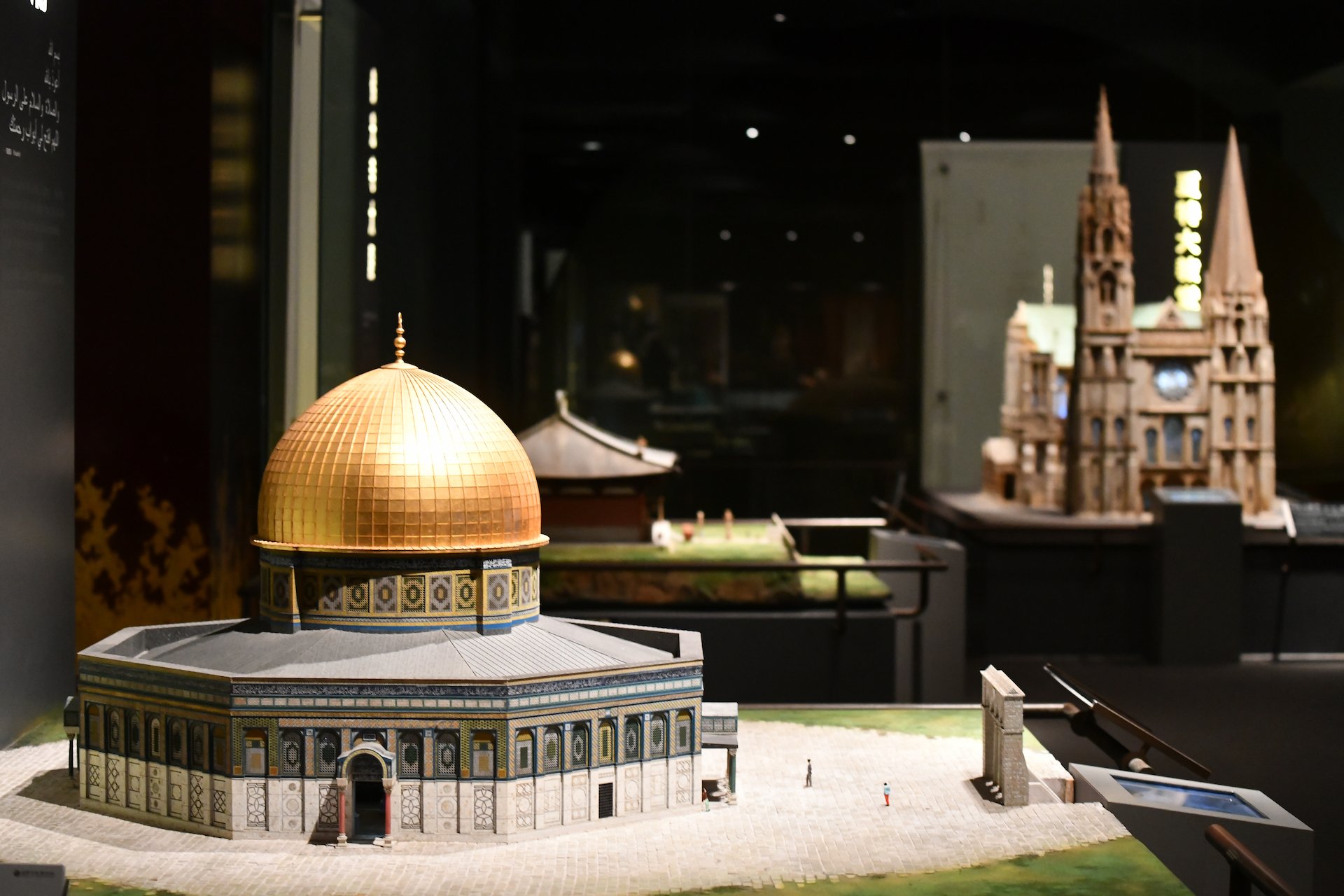
Dome of the Rock
The Dome of the Rock is located on Mount Moriah in the eastern part of the Old City of Jerusalem. Its construction began in approximately 685–688 C.E. and was completed around 692 C.E. It is revered by Muslims as a holy place that preserves the holy rock. Mount Moriah is a religious site for monotheism. It is the place in the Bible where the ancestor of monotheism, Abraham, offered his son, Isaac, in sacrifice to God. It is also the shrine that the Islamic prophet Muhammad walked past at night when he entered the location where Allah was. According to the Bible, after the Jewish people established the Kingdom of Israel, in approximately 980 B.C., King Solomon built the Temple of Jerusalem, which was later destroyed during the Babylonian War. In the seventh century C.E., Islam rose, and Umayyad Caliph Abd al-Malik, the ruler of the Arab Empire that was in possession of this holy land, constructed a mosque on this holy rock to symbolize the power and victory of the Arab Empire. Since then, it has gone through several waves of renovation and remodeling, but it has generally retained the original structure.
Early mosque structures are mostly multi-pillared halls. The center is elevated and has a dome added to form the main hall. The main hall is typically a square, and after the square is raised to form a cube, it is integrated with a dome. The integration of a cube and a dome presents a perfect symbol for Islam, representing the unity of the human world and Heaven. The main structure of the Dome of the Rock is more diverse than a square; it is an octagon, each side 21 m in length. Mosques are places for Muslims to worship, so its interior space includes a wide and clean hall. However, the Dome of the Rock was constructed to mark the location of the holy rock in the mosque. Its interior round hall has an area for the holy rock, surrounded by railings, making it the destination for pilgrimages by Muslims. The mosque has 24 arched doors, on which 240 m of religious scripture are engraved. The upper side of the interior walls has intricate inlaid patterns, exhibiting highly developed decorative arts. The exterior walls are made of marble and have colorful tile mosaics forming Arabic patterns. On the upper half of the walls, scripture from the Qur’an is presented in tiles.
Islamic art forbids the use of human or animal images, so it promotes the wide application and development of abstract decorative patterns. In the craft arts of architecture, a decorative system called the Arabesque was gradually formed. The Arabesque involves geometric patterns, plant patterns, and word patterns that can be infinitely extended, achieving a decorative effect with unlimited variations and with splendid colors and rich variations in light and shadow. The artists execute the symbolism and decorative art of patterns to the extreme, making them significant features of the Islamic arts. To date, Jerusalem retains holy symbols of monotheism. Judaism, Islam, and Christianity all meet here due to their religious histories. The religious beauty of the Dome of the Rock, exhibited through architecture and crafts, is also a spiritual power expressed through people’s pursuit of peace.

Luce Chapel
With funding from Dr. Henry Luce, the publisher of the Time magazine in the United States, a chapel for gathering and worshiping was built on the campus of Tunghai University in Taiwan in memory of the missionary Henry W. Luce for his missionary work and his efforts in higher education in China. In 1963, the Luce Chapel was completed under the design and planning of architects Chen Chi-Kwan and Pei Ieoh-Ming. It became the spiritual symbol and landmark of Tunghai University, and it was an important building in the early period when Tunghai University was founded.
In the beginning stage of the design, the architects considered constructing a building that could reflect local culture and tradition, the Christian spirit of charity, as well as the time period. The beginning of the construction was plagued by problems and was, for a time, interrupted. The chapel, which took a total of 8 years to complete, consists of four curved walls. For lighting, the curves are completely isolated, and the ridge of the roof is parted to allow sunlight in. The light from the side windows in the middle gives the altar a sense of holiness. The back curved walls are taller than the front and overlapping walls, providing the altar area with more interior space. When believers enter the chapel, they feel as if they are embraced by it. The model of this chapel was constructed and studied for a long time to finalize the ratios of the four curved walls before construction began.
It is worth noting that Luce Chapel is located in the center of the campus. No matter where people are on campus, they can see the chapel standing tall on the plain, like the gathering place the chapel was intended to represent. The chapel connects roads from all directions, inviting all people to enter its bosom.
Regarding the orientation of the chapel, it overlooks Taichung City, seated at the foot of the mountains, and the mountains in the distance. The altar is in the west end, and the pews sit east of it. At the center of the altar is a golden cross. At approximately 10 A.M., sunbeams from the side windows shine onto the cross. The Sunday service begins at 9:30 A.M., so during the service, people can enjoy this awe-inspiring spectacle. This structure completely represents God’s magnificence and glory.
Because the geometric structures of the sides and the front of the chapel differ, one must first walk around the chapel to understand the entire appearance of the chapel, and think about the overall impression. Overall, the Luce Chapel is a beautiful building, both inside and outside. Because the thickness of the edge beams of the curved walls is proportional, the curved walls seem light while maintaining a necessary sense of weight.
Thought was also put into the ventilation of the chapel. Because the chapel is large at the bottom and small at the top, the internal air ventilation functions like a chimney. Hot air rises to the top of the chapel, keeping the bottom, where the pews are, pleasantly cool. The chapel has bright glazed tiles, which both protect the cement surface and are waterproof and stain proof. Diamond-shaped tiles were chosen because they were suitable for covering curved surfaces. Also, they were in line with the gridwork girders inside the church. The Luce Church is one of the few structures in Taiwan that has been featured in international magazines. The innovative architectural design presents the architectural trends and ideals of that period.

Buddha's Light Temple
The Buddha's Light Temple is located in the hillside of Buddha’s Light Mountain in Wutai County, Shanxi Province, China. It was built following the lines of the mountain, reflecting the architectural features of Buddhist Temples in the Tang dynasty in China. The entire temple is divided into three courtyards, and the temple has over 120 halls, pavilions, and rooms. The temple sits nestled among mountains, where ancient trees almost touch the sky. In addition to being a site of pilgrimage for Buddhists, it is also a famous tourist destination. According to Notes on Qingliangshan, Buddha’s Light Temple was established during the reign of Emperor Xiaowen of Northern Wei (471–499). In the Sui and Tang dynasties, the temple was very popular. Emperor Wuzong of the Tang dynasty attempted to destroy all Buddhist temples, and Buddha’s Light Temple was also damaged, leaving only a Zushi Tower. During the reign of Emperor Xuanzong of the Tang dynasty, Buddhism was again embraced, and temples were reconstructed. The main hall of the Buddha’s Light Temple, constructed then, is a representative building. The main hall of the Buddha’s Light Temple is also called the East Main Hall. Having a majestic appearance, it is located in the last courtyard of the temple, at the highest point of the terrain. This hall is 34 m wide and 17.66 m deep.
The East Main Hall is a typical example of existing wooden structures from the Tang dynasty. Wooden construction was common in Chinese architecture. In the Neolithic period, simple subterranean structures of wood appeared around the midstream of the Yellow River in China. The unique ancient Chinese system of architecture developed in the Han dynasty, and it was preliminarily built with wood. Wooden structures have various advantages. Wood is highly shockproof, its weight-bearing structure is clear, it is adaptable to different climate conditions, and it is easily available. However, wooden structures are prone to fires and decay. Therefore, the rooftops of such structures often feature a decorative fish-dragon. According to legend, fish-dragons like to eat fire, so they have the meaning of preventing visits from the fire god. Another feature of wooden structures is the dougong, a system of wooden brackets that can support the overhanging roofs commonly found in Chinese architecture. It serves both as a key architectural structure and as decoration. Its function is to bear the weight above it and to transfer the weight to the columns underneath, so it is essential for large buildings. The East Main Hall of the Buddha’s Light Temple has many beautiful dougong. The capacity of wood was exercised to the extreme to achieve the actual demands. In the meantime, the dougong were in perfect shape. Achieving both aesthetic and functional goals required engineering experience accumulated over thousands of years.
The clay Buddhist statues are also important examples of Buddhist statue arts in the Tang dynasty. On the altar, 35 painted clay Buddhist statues are worshiped. Each of the statues is gigantic. The statues include Buddha, Maitreya, Amitābha, Samantabhadra, Avalokiteśvara, assistive Bodhisattva, and Vajradhara, and they range from 1.9 to 5.3 m tall. At both sides and the back of the main hall are 296 clay statues of Arhat from the Ming dynasty. The main hall holds a collection of arts such as architecture, statues, and paintings from the Tang dynasty, all of them of extremely high historic and artistic value. Liang Sicheng, a famous Chinese architect, dedicated himself to the study of the Buddha’s Light Temple. He surveyed it, painted pictures, and wrote papers on it. Upon publication, his papers caused a sensation in both Chinese and foreign architecture circles, and Buddha’s Light Temple became an important physical structure for studying the history of Chinese architecture.

Ise Jingu(Ise Grand Shrine)
Ise is a city in southeast Mie Prefecture, Honshu, Japan. It was formed by merging the cities of Uji and Yamada. In the past, it was called Ujiyamada. The Ise Jingu is divided into the Kōtai Jingū (or Naikū, the Inner Shrine) and the Toyouke Daijingū (or Gekū, the Outer Shrine). The main kami of the Inner Shrine is Amaterasu (the sun goddess), whereas that of the Outer Shrine is Toyouke-Ōmikami (the god of agriculture, the rice harvest, and industry). The model you see now is the Kōtai Jingū of the Ise Jingu. It is also called the Inner Shrine. According to Nihongi, the construction of the Ise Jingu can be traced back to the 1st century B.C. During the reign of Emperor Suinin, the Inner Shrine was built. The construction of the Outer Shrine (the Toyouke Daijing - omit), was only recorded in the 5th century A.D. during the reign of Emperor Yūryaku. Regarding the origin of the Kōtai Jingū, the Nihongi states that Emperor Suinin ordered Princess Yamatohime-no-mikoto to worship Amaterasu. The princess traveled across Japan and arrived at Ise Province. The goddess told the princess, “Because of the goddess’s majesty and morality, the divine wind blows in Ise Province. This is a place where the aura between heaven and earth is condensed, and it can breed outstanding people. I wish to live here long-term.” The princess obeyed the goddess’s wish and established a shrine for her. It is where, according to legend, Amaterasu descended. Thus, the long history of worshiping Amaterasu in Ise Province began. According to Nihongi, one of the Three Sacred Treasures, Yata no Kagami (the Eight Span Mirror), is the “holy spirit” (or holy embodiment) of the Ise Grand Shrine. It is stored in the Kōtai Jingū. It is worshiped by emperors from generation to generation, and it is not open to general worshipers.
The Ise Jingu is most famous for being dismantled and reconstructed every 20 years. The Ise Jingu is a classic masterpiece of Japanese wooden architecture, having a history of over 1300 years. In fact, it inherited the system of being reconstructed every 20 years. The reason for reconstruction is not its age or a lack of maintenance, or even damage. Rather, at the beginning of the construction, two pieces of neighboring land are prepared, and every 20 years, the shrine is reconstructed on the new site, as a dedication ritual to the goddess. As of 2013, the Kōtai Jingū had been reconstructed 62 times. The architectural style of the Ise Grand Shrine was based on a warehouse for collecting the god’s treasures or the god’s rice. The Inner Shrine and the Outer Shrine are both plain, made of unfinished timbers. The floor is elevated above the ground. The thatched roof is in the shape of a mountain. The main halls of the Inner and Outer shrines are in the Shinmei-making style. It is ancient and unique. With shiny golden yellow decorations on the rooftop, it is holy and clean. Notable features are the chigi and katsuogi on the roof of the shrine. Chigi are crossed wooden chips bulging out of the roof. The crossed wooden chips are attached to the rooftop in the shape of the character “人” (person), vertically connected to the rooftop. This is a design used in ancient aristocratic buildings, and it has become an architectural feature of certain shrines. Katsuogi are also a kind of facility attached to the rooftop. They are short wooden columns horizontal to the rooftop beam. Their numbers can be odd or even. Usually, the rooftops of gods’ shrines use odd-number katsuogi, whereas the rooftops of shrines dedicated to goddesses use even-number katsuogi. Chigi and kasuogi were originally structural reinforcements, and now they have become symbols of holiness. Each year, at least seven million people go to the Ise Grand Shrine to worship and to obtain ōnusa - a wooden wand traditionally used in Shinto purification ritual- for family worship.

Chartres Cathedral
The Chartres Cathedral, located in the city of Chartres in Northern France, is representative of 12th century Gothic architecture. The cathedral was constructed over a span of 300 years, across three different periods of Gothic architecture and aesthetic styles. The cathedral has burned and collapsed in the past. To date, the west entry retains its earliest Gothic style. In 1194, after a fire, the parts that burned down were reconstructed within 30 years, a miraculous achievement for workers in the Middle Ages. What completed the cathedral building was the residents’ zest for religion. According to legend, in the fire, the hood of the Saint Mary statue worshiped in the cathedral was not burned, and the residents believed that it was a sign that the cathedral should be reconstructed. With their enthusiasm for religion, the townspeople donated money, carried stones, and rebuilt the cathedral. A magnificent structure reaching into the clouds was completed under the force of their religious belief.
The Chartres Cathedral has two spires of different styles and heights. The southern spire, constructed in 1160, is of a simple style. It survived the fire in 1194. On the first floor of the spire is a broad and bright room. The northern spire, rebuilt in 1507 after two fires, is 10 m taller than the southern spire, and it has delicate decorations, in stark contrast to the simpler style of older southern spire. Churches of the Gothic period are usually constructed in the shape of a cross. The east end, the direction where Jesus was resurrected, is where the altar is located. The west end is the entry to the cathedral. The entry is surrounded by beautiful statues. At the top, Jesus is surrounded by symbols of the Four Evangelists. A lion, an angel, a bull, and an eagle represent Mark, Matthew, Luke, and John, respectively. The four symbols were derived from holy allusions in the Bible. The slender human statues on the sides are representatives of early Gothic art. In the northern transept portal, the statues are in the style of the prime Gothic period. Each statue seems to be alive and able to walk, and it is clear which Bible character they represent. The southern transept portal is the part of the Chartres Cathedral that was completed the latest, and it features late Gothic art. The carvings are mature enough to vividly present characters’ facial expressions and movements.
The greatest achievement of Gothic churches is their flying buttresses on the sides and stained-glass windows. Flying buttresses are arms that support the exterior walls of a church. They guide the weight originally borne by the external wall to the ground. The application of flying buttresses allowed gothic churches to be built taller and taller, and they allowed the space in the church to be broad. Large windows also appeared, improving the illumination and brightness inside the church. The Chartres Cathedral has 176 stained-glass windows. The stained glass images portray Bible stories as well as the scenes of contemporary people’s lives and the construction of the cathedral. These stories manifest as colorful lights shining in the cathedral, allowing the legendary Heaven and God’s glory to be created in that holy space. A grand Gothic cathedral was achieved through the gathering of talents of various arts and skills. In the long Middle Ages, the general public sought survival in war and labored under feudalism. However, religion offered them support. Considering the level of technology and the skills back then, Gothic churches are practically miracles. Various architectural structures of a Gothic church enabled the church to be developed vertically. The builders elevated the heavy Romanesque vault, allowing the building to have the power to rise. Slender columns and arch ribs woven together at the top of the church replaced heavy, mundane, or simple elements, guiding visitors’ view upward to Heaven.
When you enter the cathedral, what you see first is the labyrinth on the floor. The labyrinth in the golden hall of this museum is a replica of the labyrinth in the Chartres Cathedral. In churches in the Middle Ages, labyrinths represented the pursuit of truth. When believers find the path to the center of a labyrinth, they will be blessed by God. Entering a Gothic cathedral is an unforgettable experience. The vast area itself is enough to make everything mundane seem small. The structure guides the visitors’ eyes upward, allowing worshipers to be closer to God’s Heaven.

Blessing area
On both walls outside of the Creations Theatre, we have set up a blessing area, which is composed of handprints and a long screen on top. Do you see the two engraved handprints on the walls? Can you put your hands into them and look up at the screen above to see what kind of blessing appears there? The design of this wall is done with the hope in mind that, at the end of your visit, you will have a better understanding of the Museum’s underlying concept of "Respect, Tolerance and Love” and leave with a full blessing.

Areas for a gratitude memorial wall
The Museum of World Religions is a collection of donations from people from all walks of life. In order to thank all parties for their contributions, we have designed three special areas for a gratitude memorial wall. On the Wall of Gratitude, you will find the handprints and names of countless generous donors engraved in the form of a prayer wheel, which symbolizes spreading their charity and love to the world. On the wall beside the Hindu exhibit, you’ll find a Guanyin Mandala and a Tibetan Mandala, expressing the spirit of “all donations return to the source.”And on the wall next to the Wall of gratitude, we express our gratitude to the thousands of fundraisers. The museum sincerely thanks and honors the supporters of the Museum’s vision, and all the disseminators of love. We need continued support and sponsorship from the community. You are welcome to join the fingerprint wall.
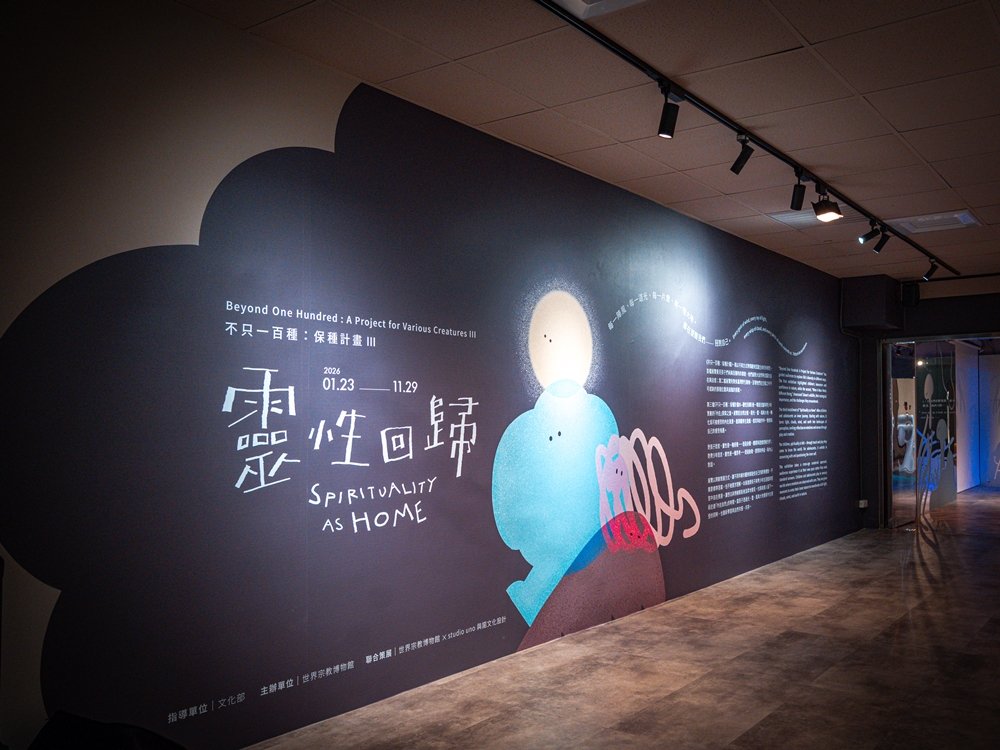
MWR Kids & Teens
“Beyond One Hundred: A Project for Various Creatures” has guided audiences to explore life’s diversity in different ways. The first exhibition highlighted children’s innocence and confidence in nature, while the second, “When A Bear Meets Different Being,” showcased Taiwan’s wildlife, their ecological importance, and the challenges they encountered.
The third installment of “Spirituality as Home” offers children and adolescents an inner journey. Starting with nature, it turns light, clouds, wind, and earth into landscapes of perception, inviting reflection on emotions and senses through play and creation. For children, spirituality is felt—through touch and play they come to know the world. For adolescents, it unfolds in conversing with and questioning the inner self.
The exhibition takes a cross-age curatorial approach, audiences experience it at their own pace rather than seek standard answers. Children and adolescents play in sensory worlds where emotions are observed with care. They are given moments to enter their inner nature to reverberate with light, clouds, wind, and earth in nature.